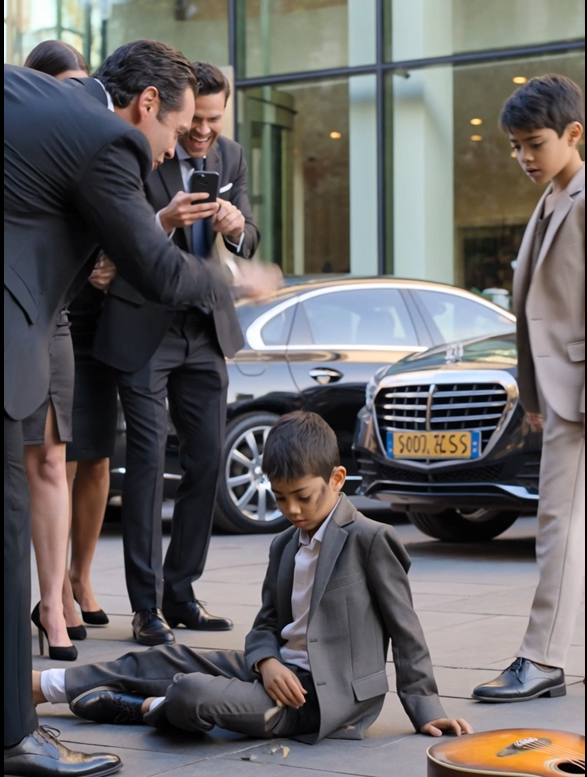
The guitar hit the pavement before anyone could blink.
It skidded across the sun-bleached concrete outside Maison Laurent — that gleaming glass tower of a restaurant on Fifth where a salad costs forty dollars and the valet takes your Porsche without making eye contact — and landed with a hollow, splintering crack that nobody inside would have heard over the piano music and the clinking of crystal. But out here, on the sidewalk, it was the loudest thing Marcus had heard in weeks.
He didn’t cry out. He’d learned not to. He just flinched, his thin shoulders pulling inward like a turtle retreating into a shell that wasn’t there anymore, and watched the neck of his grandfather’s Yamaha spin to a stop near the gutter.
The man who’d kicked it — broad-shouldered, tanned the color of expensive vacations, wearing a blazer that probably cost more than the car Marcus’s mother had driven before everything went wrong — was already laughing. A big, open-mouthed laugh, the kind that expects an audience. He got one.
“Did you see that?” The woman beside him had already raised her phone. Her nails were the color of fresh blood. She zoomed in on Marcus, not on the broken guitar, not on the scattered coins rolling toward the drain. On Marcus. On his face. “Oh my God, he looks like a little — “
“Play, clown!” The man spread his arms like a showman. “That’s what you’re here for!”
The coins came next. Not thrown — launched. A fistful of quarters and nickels flung like confetti at a parade no one wanted to attend. Two of them struck Marcus across the cheek. He felt the sting but stayed low, palms on the warm pavement, quietly trying to gather what he could. The guitar pick was gone. The bridge was cracked. But some of these coins — some of them — he could still use.
Forty-seven cents would buy nothing. But the habit of counting had stayed with him long after the math stopped adding up.
They’d been parked outside Maison Laurent since ten in the morning, the whole crowd of them, dressed like characters from a film set in a world Marcus had only ever glimpsed through windows. The women wore sunglasses that cost more than rent. The men had watches that caught the midday light and threw it back, almost arrogant in their brightness. They’d spilled onto the sidewalk after a long lunch, loose with wine and pleasure, looking for something to amuse them during the thirty seconds it took for their cars to arrive.
Marcus had been sitting in his usual spot — just past the restaurant’s property line, on public concrete, technically legal, technically allowed to exist — for three hours before they came out. He’d played seven songs. He’d made four dollars and eleven cents before the guitar was kicked away.
He was thirteen years old. He’d been sleeping under the Grayson Street overpass for eleven days.
The rich teenager was maybe seventeen. He had the particular confidence of someone who had never once been told no by anyone whose opinion he respected. He stepped forward from the laughing cluster of adults like someone stepping onto a stage, and Marcus recognized the posture — the slight forward lean, the smirk that was really just a question: What are you going to do about it?
“Dance for us.”
The shove wasn’t hard enough to leave a bruise. It was the kind of shove designed to humiliate rather than hurt — a shoulder-check, dismissive, contemptuous. But Marcus was hungry and tired and his legs hadn’t been working quite right since Tuesday, and he went sideways, his palm scraping concrete, barely catching himself before he went all the way down.
The phones went up again. The laughter swelled.
Marcus pressed his palm flat against the ground. He could feel the heat of the sidewalk through his torn jeans. He thought about his grandfather, who had taught him three chords on that Yamaha the summer before the cancer, who had said music is the one thing nobody can repossess. He thought about how wrong that had turned out to be.
He didn’t look up. He’d learned that too. Looking up invited conversation, and conversation invited this.
He was reaching for the guitar — cataloguing the damage, the cracked headstock, the two strings that had snapped — when the voice arrived.
Not loud, exactly. It cut rather than crashed. A single word dropped into the middle of all that laughter like a stone into shallow water.
“Enough.”
The first thing the crowd noticed was the shoes.
Hand-stitched leather oxfords, dark cognac brown, moving fast across the pavement with the kind of purposeful stride that parted people without asking. The man was perhaps forty-five, silver at the temples, his suit a charcoal that absorbed the afternoon light rather than reflecting it. No tie. Jacket open. He’d been walking out of the restaurant, Marcus would later understand, would have kept walking, would have reached his car and driven away and never known — except that the sound of the guitar hitting the concrete had reached him through the glass facade at precisely the wrong moment, or the right one.
He caught the broad-shouldered man’s arm mid-gesture. Not roughly. Just — stopped it. The way you stop a door from closing.
The man in the blazer looked down at the hand on his arm. Then up at the face. And something in that face made him go very still.
“The hell are you — “
“Touch him again.” The silver-templed man’s voice was quiet now, quieter than before, which somehow made it worse. His eyes moved from the man he was holding to the teenager to the woman with the phone to every face in that laughing cluster, taking inventory. “Touch him again, and I end you.”
It wasn’t a threat in any legal sense. It was something older than that. It was a line being drawn in the concrete between what had been happening and what would happen next if it continued. The crowd felt it. You could see them feeling it — the laughter draining out of their faces like water from a tilted glass, the phones lowering degree by degree, the smirks collapsing into something more uncertain.
The broad-shouldered man opened his mouth. Closed it.
The teenager took a step backward.
The woman with the blood-red nails let her phone drop to her side.
Nobody spoke.
And then the silver-templed man did something none of them expected. He let go of the arm. He straightened his jacket. He turned away from all of them — not dismissively, not theatrically, but with the complete and total disregard of someone who had decided that the crowd no longer existed.
He knelt on the pavement.
Not crouched. Not leaned. Knelt — one knee down on the concrete in his expensive suit, directly in front of Marcus, at eye level with him.
Marcus looked up. He hadn’t meant to. It happened before he could stop it.
The man’s face, close up, was harder to read than he’d expected. Not soft, exactly. Not the face of someone performing kindness for an audience. He wasn’t looking at his phone. He wasn’t looking at the crowd. He was looking at Marcus — just Marcus, with the particular focused attention of someone who had learned, at some point and at some cost, how to see what was actually in front of him.
He didn’t say it’s okay or you’re alright or any of the things that adults said to children they wanted to stop crying. He didn’t say anything. He just opened his arms.
And Marcus — thirteen years old, eleven days on the street, four dollars and eleven cents and one cracked guitar — leaned in.
He didn’t mean to do that either. His body made the decision before his mind could argue against it. He felt the man’s arm come around his back, solid and steady, the fabric of the suit jacket pressed against his dirty face, and he smelled cologne and the faint remnant of restaurant air and something else, something underneath all of it, that his brain translated, helplessly and absurdly, as safe.
He pressed his forehead against the man’s shoulder.
The crowd did not move. The phones did not come back up. The laughter was gone so completely it might have never been there at all, the sidewalk outside Maison Laurent held in a silence so sharp you could have cut yourself on it, the only sounds the distant traffic and the hot wind moving between buildings and the slow, unsteady breathing of a boy who had been trying very hard, for a very long time, not to need anything from anyone.
The guitar was still broken. The coins were still scattered. Nothing, technically, had changed.
But Marcus held on anyway. Because some part of him — the part that was still thirteen, still a child, still the kid who had learned three chords from his grandfather — understood that this was the first true thing that had happened on this sidewalk all afternoon.
Behind him, unobserved now, the broad-shouldered man in the expensive blazer said something to the teenager. The teenager nodded. One by one, without ceremony, they filtered toward their cars.
The valet brought a black Mercedes to the curb.
Nobody laughed.
The camera — if there had been a camera, if anyone had thought to hold one steady and let it simply look — would have found the hug. Held it. Shallow depth of field, the crowd blurred to soft shapes in the background, the glass facade of the restaurant catching afternoon light and throwing it gently over two figures on the pavement: one in a charcoal suit, one in torn clothes, motionless together while the city continued around them.
No music.
Just breathing.
