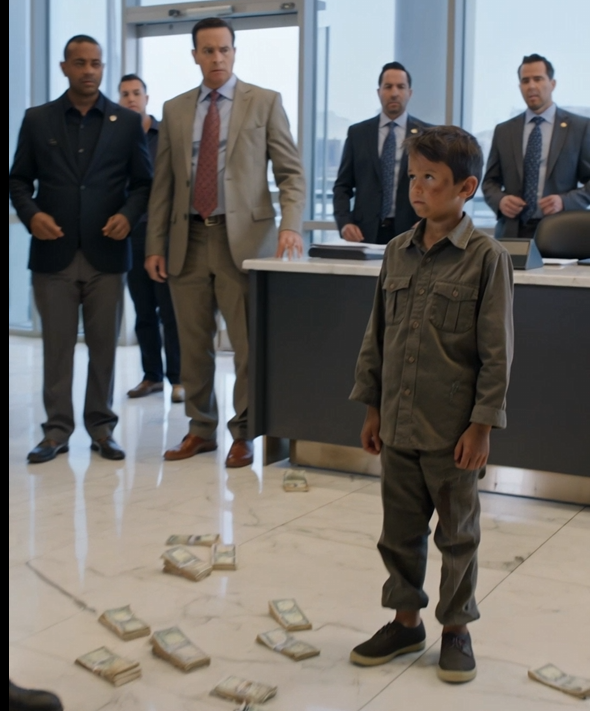
The suitcase hit the marble at 9:47 on a Wednesday morning, and the sound it made was the kind of sound that stops a room.
Not the suitcase itself — though that landed hard, a worn brown rectangle that had clearly traveled further and carried more than its size suggested. What stopped the room was what came after: the cascade, the scatter, the impossible snow of banded cash erupting across the polished floor of First National Bank’s downtown flagship branch, sliding under the feet of people in pressed suits, spinning beneath the rope lines of the teller queue, coming to rest in the particular silence that follows something no one has a script for.
For three full seconds, nobody moved.
Then everyone moved at once.
He had arrived at 9:43.
The morning rush was tapering — the early depositors gone, the lunch crowd not yet arrived, that mid-morning lull where the marble floors showed their full expanse and the bank felt more like a cathedral than a financial institution. Light came through the floor-to-ceiling glass facade in long, clean diagonals, catching the dust in the air and the shine on the floors and the brass of the teller windows in a way that made everything look slightly more significant than it was.
The boy walked in like he had an appointment.
That was the thing several people would mention later, trying to describe it — he didn’t shuffle, didn’t hover at the threshold the way people do when they’re unsure of their welcome. He walked in with the particular, focused purposefulness of someone who has decided what they are going to do and has spent considerable time deciding it. Seven years old, maybe eight — the age is hard to fix precisely because his face had the strange duality of a child who has grown up faster than childhood allows: round cheeks, young eyes, but something behind those eyes that was older than it should have been.
His clothes told a story. Not metaphorically — literally. The jacket was two sizes large, a man’s jacket, the kind with corduroy at the collar that had worn through to the backing. His pants were cinched at the waist with what appeared to be a bungee cord. His shoes were mismatched — not dramatically, not left-and-right different, but one was a sneaker with a broken buckle and the other was a boot with no lace. His face carried the settled grayness of outdoor living: not fresh dirt but resident dirt, the kind that lives in the creases.
He was carrying the suitcase with both hands. Small hands, white-knuckled, the grip of someone transporting something irreplaceable.
The guard — Marcus, twelve years on the job, father of three, a man who had developed his professional instincts the way all security professionals do, through pattern recognition and repetition — saw the boy and processed him in under two seconds. Homeless. Minor. Unaccompanied. The suitcase was a variable he didn’t like. Too large for the kid. Too deliberately carried.
He moved to intercept.
What happened next took less than one second and cannot be undone in this story or any other: the guard’s foot connected with the suitcase in the kind of decisive, dismissive motion that is meant to communicate you don’t belong here in the physical language that words sometimes can’t efficiently deliver.
The suitcase had not been latched.
The floor of First National’s downtown branch became, briefly, the most money a lot of those people had ever seen outside of a vault.
“Get out.”
Marcus said it with the flat authority of a man who expected the words to function as an ending. In his experience — twelve years of it — a sharp action followed by a sharp command produced one result: the person left. Quickly, usually. Sometimes with an argument that resolved when he stood up straighter. Occasionally with a scene that involved the police.
The boy did not leave.
He stood, and the standing was remarkable because of what it wasn’t. It wasn’t defiance performing itself, the jaw-out, chest-forward theater of someone making a point. It wasn’t shock — there was no widening of the eyes, no fractured expression searching for what had just happened. He stood the way people stand when they have been standing in hard places for long enough that their body has learned to simply receive impact and remain vertical.
He looked at the money on the floor.
He looked at Marcus.
“I need to send it.”
Four words with no wobble in them. Not loud. Not soft. Just level, the way a road is level — not interesting in its flatness but reliable. Certain. Stating a fact the way facts want to be stated: without decoration.
The room, which had begun to re-animate after the shock of the scatter, found itself pausing again.
Marcus frowned. In the frown was a recalibration happening in real time — the mental adjustment of a man whose professional read on a situation is presenting unexpected data. He looked at the boy. He looked at the money. He looked back at the boy.
“To who?”
The boy’s face, in close-up — if you were close enough to see it, if you were the teller who had leaned forward over her window, or the businessman who had stopped three feet away with his deposit slip still in his hand — the boy’s face was doing something specific. Not performing. Not calculating the response. Something more internal than that, the brief transit of a feeling too large for the moment, passing behind the eyes like weather.
“My mom.”
Two words.
The silence that followed was not the silence of a room going quiet. It was the silence of a room that had been saying something and suddenly found it had nothing left to say.
There are silences that are empty and silences that are full, and anyone who has spent time in rooms with other humans knows the difference in the body before the mind names it.
This one was full.
Full of the specific weight of two words — my mom — landing differently on different people in different ways. The teller with the leaning posture had a son in college she hadn’t spoken to in three weeks over something neither of them could now clearly articulate. The businessman with the deposit slip had a mother in Phoenix he visited twice a year and meant to call more. The woman in the back of the rope line had been sending money to her own mother in a country she couldn’t get back to easily, wiring it through this exact branch every second Friday, and she knew the transaction, the form, the fee, the waiting — she knew what it cost and what it meant and what it felt like to put money into a system and trust the system to carry it across the distance between you and someone you loved.
The boy was seven years old and standing in a bank with cash scattered around his mismatched shoes and he wanted to send it to his mom.
The questions the room was not asking out loud were the questions the room was absolutely asking: Where is she? Why can’t she come herself? How does a child this age — this child, this specific child — have this much money? And why does the way he said it make it feel like the most ordinary, necessary, human thing that has happened inside these marble walls in longer than anyone can remember?
Marcus — and this is the part that matters, this is the part the twelve years had been secretly building toward without his knowledge — Marcus looked at the boy’s face.
Not at the money. Not at the suitcase. Not at the situation with its complications and protocols and the manager who was going to need to be involved and the forms and the questions and the documentation a minor would need to conduct a transaction of any meaningful size.
At the boy’s face.
And something in Marcus’s face, in the twelve-years-of-pattern-recognition face that had processed thousands of people through that lobby and assigned them categories and managed them accordingly — something in that face shifted.
Not broke. Not collapsed into sentiment. Shifted, the way a building shifts when the ground beneath it adjusts: still standing, but different in some structural way that can’t be fully measured from the outside.
Here is what nobody in that room knew yet, and what would take the rest of the morning to understand:
The boy’s name was Daniel. His mother’s name was Rosa. She was in a hospital forty miles away, and she had been there for eleven days, and she did not know her son had left because she was not conscious enough to know her son had left, and Daniel had spent eleven days doing what Daniel was apparently capable of doing, which was the kind of thing that, once you learned it, rearranged everything you thought you understood about what children were made of.
The money was real. Where it came from was a story. Every dollar of it was a story.
And Daniel had carried it here, in a suitcase with a broken latch, because he had asked someone — a woman at the shelter, a kind someone — how to make sure his mom had money for when she woke up, for the bills that were coming, for whatever came after the hospital. And the woman had said: the bank.
So he had come to the bank.
He had not expected to be welcomed. He had not expected it to be easy. He was seven years old and he understood, with the clear-eyed practicality of a child who has learned to operate in a world not designed for him, that most things would not be easy. He had come anyway because his mother was somewhere in a hospital bed not knowing her son was alright, and Daniel had decided, in the specific, iron, wordless way that children sometimes decide things, that when she woke up she would find that the money was there.
That he had done this.
That she did not have to worry.
Marcus bent down.
Not to gather the money. Not yet. He bent down to be at eye level with a seven-year-old boy in an oversized jacket in the middle of a marble floor scattered with cash, and he looked at him the way you look at someone when you are no longer performing your role and have simply become a person.
“Okay,” Marcus said.
Just that. Low, and level, and meant.
“Let’s figure it out.”
The money got gathered. The manager got involved. The forms were complicated and took time and required phone calls and the kind of institutional navigation that grinds slowly. The morning stretched past noon.
But Daniel sat in a chair beside Marcus’s desk with the suitcase on his lap, watching the proceedings with the patient, assessing calm of someone who has decided to trust — cautiously, provisionally, but genuinely — that the people in this building are trying to help.
The marble floor, once the money was gathered, showed nothing of what had happened. It was polished and clean and reflected the afternoon light exactly as it had before.
But the room remembered.
Rooms always do.
