The Last Witness
The coins hit the pavement like broken promises.
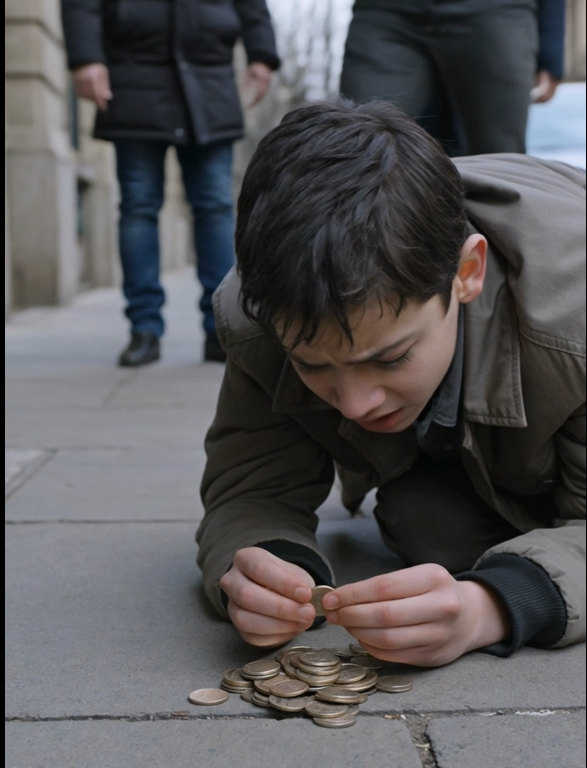
Marcus counted them again, lips moving silently in the gray November air outside the Pittsburgh bus terminal. Forty-three cents. Forty-three cents between him and the two-dollar fare that would get him across town to St. Catherine’s before the shelter closed its doors at nine. He’d been counting and recounting for ten minutes, as if mathematics might somehow be convinced to change its mind.
“Please,” he whispered to no one, to God, to the coins themselves. “Please don’t be wrong.”
He was twelve years old and had been sleeping in doorways for six days.
The boot came out of nowhere.
One sweep, almost casual, like a man kicking leaves. The coins exploded across the sidewalk — a quarter spinning under a bench, dimes scattering into the gutter, pennies rolling into the darkness beneath a parked truck. Marcus lunged forward on his knees, fingers scraping concrete, and the man who had done it crouched down with a smile that had never once been kind.
“Whoops,” said the man.
He was big. Not tall, but wide in the shoulders, with the specific confidence of someone who had never faced a consequence. He wore a Steelers jacket and a two-day beard and eyes that found everything in the world slightly amusing. His name, Marcus would later learn, was Denny Coulter, and he was forty-one years old and had been doing small, vicious things to people smaller than himself since he was roughly Marcus’s age.
He picked up the quarter. Held it up to the light.
“That’s mine,” Marcus said. His voice came out smaller than he wanted.
“Was yours.” Denny pocketed it. Reached for the dime near his left foot.
“Hey — that’s mine!“
People moved around them like water around stone. A woman in a business coat glanced over and then found something extremely interesting on her phone. Two college-aged guys in Pitt hoodies looked, registered the situation with perfect clarity, and simultaneously discovered they needed to be somewhere else immediately. An old man with a newspaper tucked under his arm slowed for just a moment — their eyes met, his and Marcus’s — and then the old man looked away, and that was somehow the worst thing that had happened all evening.
Marcus grabbed for the dime. Denny’s hand closed over his wrist.
“Easy, kid.”
“Let go of me—”
“I said easy.”
The grip tightened. Marcus felt the bones in his wrist compress and his eyes went hot with tears he refused — absolutely refused — to let fall. He had learned in six days that crying on the street accomplished nothing except making you a more interesting target.
He was still trying to pull free when the car door opened.
Not opened — exploded. That was the only word for it. The black Mercedes at the curb — the one Marcus had vaguely noticed idling there but assigned no importance to, because expensive cars had nothing to do with his life — that door flew open with the force of a decision that had already been made, and the man who came out of it moved with a velocity that didn’t match his age, which appeared to be somewhere around sixty, or his suit, which appeared to cost more than most people’s cars.
He hit Denny Coulter like weather.
One hand seized the collar of the Steelers jacket, one hand went to the wrist that was crushing Marcus’s arm, and in a motion that seemed almost architectural — precise, geometric, inevitable — Denny Coulter went from standing to sprawled across the sidewalk with the specific gracelessness of a man who had never once considered the possibility of falling.
The whole thing took maybe two seconds.
Denny looked up from the pavement, genuinely confused, like a dog that had been swatted and couldn’t locate the hand that did it. The man in the suit stood over him, not breathing hard, not posturing, just present in a way that took up considerably more space than his physical body required.
“The coins,” the man said. Quietly. Like he was ordering coffee.
Denny blinked. “What?”
“The coins you took from this child. Return them.”
There was a long moment. The people who had been so carefully not watching were now, somehow, watching — from safe distances, from the corners of their eyes, with the particular fascination of witnesses who have not yet decided whether they are witnesses.
Denny put the quarter and the dime on the pavement. His hands weren’t entirely steady.
The man didn’t look at him again. He crouched down — expensive suit and all — and began collecting Marcus’s scattered coins from the concrete with unhurried, methodical hands. He found the quarter under the bench. He retrieved two pennies from the gutter. He moved the way people move when they are not performing patience but actually have it, which is rarer and more unsettling.
He straightened. Held the coins out to Marcus.
And looked at him.
His eyes were gray-green, the color of the Ohio River in winter, and they held an expression Marcus couldn’t immediately read. Not pity — Marcus knew pity and had learned to hate it. Not the aggressive charity of people who help strangers so they can feel good about themselves. Something else. Something more like recognition.
“You picked the wrong child,” the man said.
His voice was cold and quiet and directed, technically, at the general situation — at Denny, who was now gathering himself from the pavement and calculating exit strategies, at the watching strangers, at the city itself. But his eyes stayed on Marcus.
Marcus took the coins.
“Thank you,” he said.
The man nodded once. Then something shifted behind his eyes — a thought arriving, or a decision being made — and he turned slowly, his gaze tracking back to where Denny Coulter was now three steps away and accelerating.
“Wait,” the man said.
It wasn’t loud. But Denny stopped.
The man looked at Marcus for a long moment. Then he said, very quietly, almost to himself: “Because he’s the only witness I needed.”
Later, Marcus would try to explain what happened next to the social worker at St. Catherine’s, and he would find it difficult, because the facts were simple but the feeling underneath them was not.
The man’s name was Robert Ellison. He was, it turned out, not a good man in the simple way that the stranger who buys a kid a sandwich is a good man. He was a complicated man who had done significant harm in his life through legal mechanisms — a property developer whose projects had displaced three neighborhoods in the past decade, a man with lawyers instead of apologies, a man who had learned to use systems the way Denny Coulter used his boot: efficiently and without consequence.
But he was also a man who was, on this particular Tuesday evening, on his way to a federal courthouse to testify in a case that had been trying to exist for three years. A case about payments made and permits granted and a building inspector named Victor Hales who had a wife and two kids and had refused to sign off on falsified safety documents and had subsequently had things happen to him that were very hard to prove but very easy to understand.
The problem, from the prosecutor’s perspective, was that Robert Ellison’s attorney was extraordinarily good at making his client’s testimony unreliable. There were inconsistencies in the timeline. There were questions about what Ellison had personally known versus what had been handled by intermediaries. There were, frankly, enough loose threads that the defense had been pulling them successfully for two and a half years.
What the defense attorney had not accounted for was a boy on the pavement outside the bus terminal.
Because when Robert Ellison had made that call — the decision to step out of the car, which had been a decision he’d been building toward for a year without knowing it — he had been seen. Not just by Marcus, but by six other people who suddenly remembered how to look. Two of them had phones out. One of them, the college student who had been heading so urgently somewhere else, stopped and then turned back, because something about the image of a sixty-year-old man in an expensive suit crouching on dirty concrete to retrieve a child’s pennies had short-circuited whatever calculus had been operating in his chest.
Robert Ellison’s attorney would later argue that the publicity changed nothing, that his client’s credibility was a legal matter separate from a viral moment of apparent decency. He argued this well.
He lost.
Marcus didn’t know any of this yet when Ellison turned back to him on the sidewalk.
What he knew was forty-three cents, the nine o’clock deadline, the weight of six nights on concrete, and the specific loneliness of being invisible to a moving crowd.
What he knew was that his wrist hurt where Denny had grabbed it.
What he knew, suddenly, was that the man was talking to him — not at him, to him — asking if he had somewhere to be, asking if he was all right, asking with the slight formality of a man who has not spoken gently in a long time and is doing his best with limited practice.
“I’m trying to get to St. Catherine’s,” Marcus said. “On Larimer. But I’m—” He stopped. Looked at the coins. “I’m short.”
Ellison was quiet for a moment.
“I know where that is,” he said.
He looked at his watch. He looked at the courthouse, which was three blocks north. He looked at Marcus.
“My driver will take you,” he said. “It’s on the way.”
It wasn’t on the way. Marcus didn’t know the city well enough to know this, but the driver, whose name was Antoine and who had been working for Robert Ellison for nine years, knew it immediately and said nothing, just nodded and opened the back door.
The car smelled like leather and heat and the particular silence of expensive things. Marcus sat very still and held his forty-three cents in his closed fist and watched the city move past the window.
“Kid,” Antoine said from the front.
Marcus looked up.
“He’s not usually—” Antoine stopped. Seemed to reconsider. Started again. “That back there. That doesn’t usually happen.”
Marcus didn’t say anything.
“I’m just saying,” Antoine said. “Something about tonight.”
They rode the rest of the way in silence. When they pulled up to St. Catherine’s — the lights still on, ten minutes before nine — Antoine turned around and handed Marcus a twenty-dollar bill and told him it was from Mr. Ellison.
Marcus looked at it for a long time.
“What does he want?” Marcus asked. Because six days had been enough to teach him that things given had a weight to them.
Antoine shook his head slowly. “I don’t think he knows yet,” he said. “But I think he’s starting to figure it out.”
Marcus got into St. Catherine’s that night.
Three weeks later, a caseworker named Donna found him a placement with a family in Squirrel Hill who had two dogs and a spare room and a refrigerator with a whiteboard on it where family members wrote each other notes.
Six months after that, Robert Ellison testified. Fully. Clearly. With the specific certainty of a man who has recently done one small, unambiguous thing right and found it impossible to go back to a life of careful ambiguity afterward.
The case closed.
Victor Hales, the building inspector, received a settlement. He called it the beginning of something. His daughter, who was eight, drew him a picture of a house with a very solid foundation, and he cried in the good way.
Marcus, by then, had started seventh grade. He was not a simple success story — no child is — but he was warm, and fed, and known by name to at least six people who meant it.
He still remembered the coins spinning on the concrete.
He still remembered the feeling of being walked past.
But he also remembered a man crouching down in an expensive suit, patient and unhurried, picking up what had been scattered. Sometimes that image came to him in the early morning before the house woke up, and he held it carefully, the way you hold something that has weight but doesn’t hurt.
A person can change the direction of a life in two seconds.
Most people just don’t stop the car.
