The door hit the wall like a gunshot.
That was the first thing — the sound. A crack of glass and brass, the deep resonant boom of a solid door thrown open with everything a small body had. It echoed off the marble floors, off the polished display cases, off the high ceilings of Elaine’s Fine Jewelry on North Michigan Avenue, and for one suspended second the entire boutique went absolutely, perfectly silent.
Then the customers flinched.
Three of them — a woman in a cream blazer examining a tennis bracelet, a man in a charcoal suit consulting with one of the associates near the far case, and a couple near the window who had been holding hands and looking at engagement rings. All four of them looked up at exactly the same moment, startled the way people are startled in quiet, expensive places when something intrudes that has no business being there.
The boy stood in the doorway.
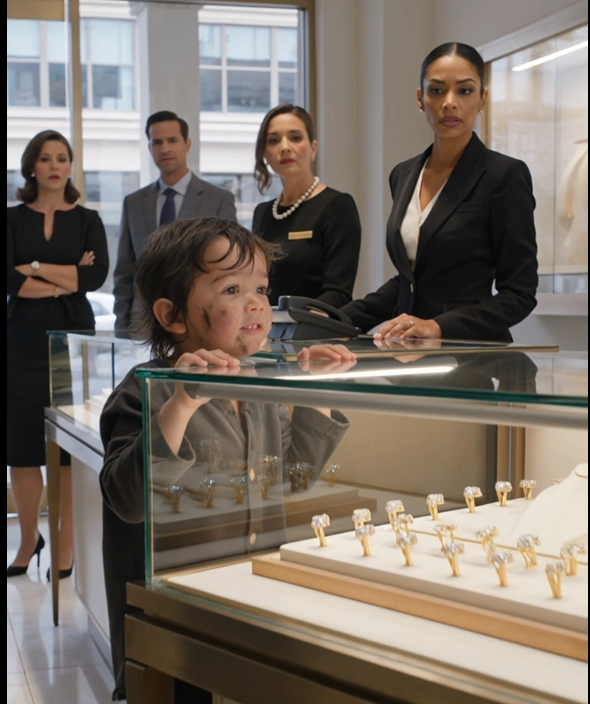
He was maybe four years old. Maybe five. It was hard to tell because he was small — genuinely small, the kind of small that registers somewhere in the chest before the brain catches up with it. He was wearing a man’s T-shirt that fell past his knees, gray and torn at the collar, the sleeves hanging almost to his elbows. His shorts — if they were shorts — were invisible beneath it. His hair was tangled, uncombed, a dark halo of neglect around a face that was dirty in the specific way that meant it had been dirty for more than a day. His feet were bare. Bare on the marble. You could see the soles when he stepped forward — pale and gray with pavement.
He was breathing hard. Like he had run here.
He stepped inside.
Rebecca Holt had worked at Elaine’s for eleven years. She had handled difficult situations before. Shoplifters — nervous teenagers mostly, sometimes adults who should have known better. Scenes. Once, memorably, a man who had tried to return a ring he’d stolen as an engagement gift after the relationship ended. She was good at reading a room and she was good at reading people and what she read now, the instant the door hit the wall, was trouble.
She moved toward the boy on instinct. Not fast. Practiced — the controlled, measured pace of someone trained to de-escalate through body language. Her hand was already moving toward the counter where her phone sat, where the small laminated card with the security number was taped beside the register.
She had the number half-memorized.
She was going to need it.
The boy didn’t look at her. He was looking at the cases.
He walked — that word is too casual for what he did; he navigated, he aimed himself — he moved with a directness that was startling in something that small, straight toward the long central display case, the one under the brightest overhead lights, the one that held the bracelets.
He stopped in front of it.
He went up on his toes.
His hands came up and pressed flat against the glass.
In the case, under the lights, the bracelets caught everything — the daylight streaming through the plate glass storefront, the warm overhead halogens, the flash of other jewelry in nearby cases. Gold and silver and rose gold. Tennis bracelets with diamonds in pavé settings. Charm bracelets with small enamel figures. A thin hammered-gold cuff. A twisted rope bracelet with a sapphire clasp.
The boy’s small handprints bloomed on the glass above them like fog.
He stared.
Rebecca was six feet away, close enough now that she could have touched his shoulder. She stopped. Something in the way he was staring at the case — not frantically, not hungrily, but with a kind of focused, deliberate attention, like he was studying for something — made her wait one more second.
Just one.
The boy looked up at her.
His eyes were brown and very clear. Whatever was on his face was not guilt and was not fear and was not the expression of a child caught doing something wrong. It was something older. Something that had no business on a four-year-old’s face.
Determination.
“I want to buy my mom a gift,” he said.
His voice trembled but didn’t break. The way a voice trembles when it has prepared something careful and is trying very hard to deliver it correctly.
“It’s her birthday today.” A pause. He steadied himself. “A bracelet.”
The room went quiet in a different way than before.
Before, when the door slammed, the silence had been reflexive — shock, the instinct to freeze. This silence was something else. It was the silence of people who have heard something they weren’t prepared to hear and don’t yet know what to do with it.
Rebecca heard the man in the charcoal suit make a sound under his breath. Not quite a laugh. The shape of a laugh — the rhythm of condescension — without the full commitment. She didn’t look at him.
Behind her, from somewhere near the engagement ring case, she heard a woman’s voice, very low, shaped for the person next to her but audible to the whole room: “He can’t even afford food.”
The boy didn’t react. He either didn’t hear it or had already learned not to hear things like that. Neither option was comfortable to sit with.
He was still looking at Rebecca. Waiting. He had said what he came to say and now he was waiting to find out what happened next, with the patience of a child who has learned that waiting is what you do, that you don’t push, that you hold yourself very still and you wait and you hope.
His hands were still on the glass.
The smudges were still blooming.
Rebecca looked at the phone. She looked at the security number on the laminated card. She was aware of every customer in the room — their positions, their expressions, their silence. She was aware of the man in the suit and whatever he was thinking. She was aware of the woman who had whispered and the couple by the window who had said nothing and the weight of what this moment had become without anyone deciding it should.
She looked at the boy.
His eyes were completely, devastatingly hopeful. The kind of hope that is not naive — not the hope of someone who doesn’t know what the world is — but the hope of someone who knows exactly what the world is and has decided to try anyway. The hope that costs something.
He was four years old and barefoot on marble and he had run here, hard enough to be breathing like that when he arrived, because his mother’s birthday was today and he wanted to give her a bracelet.
Rebecca’s hand lifted from the counter.
It did not pick up the phone.
What happened next was not large. It did not look like anything on the outside. It looked like a woman leaning down slightly, the way you lean when you want to be at eye level with something small. It looked like a conversation beginning. It was not a movie. There was no swelling music. The light in the store was the same light it had always been — the daylight through the glass, the halogens in the cases, the shimmer of gold and silver on felt.
But the woman in the cream blazer had stopped looking at the tennis bracelet.
The couple by the window had turned.
The man in the charcoal suit was quiet.
Rebecca Holt crouched down until her face was level with the boy’s face, until she was looking at him the same way he was looking at her, and she said something no one else could hear.
The boy listened. He nodded, once, solemnly.
He kept his hands on the glass a moment longer.
Then he lowered them.
And he stood there — barefoot and dirty and smaller than anything had a right to be in that room — and waited to see what the world would do.
The camera would have pushed in here, if there had been a camera. On his eyes. On the hope in them. On the cost of it.
The saleswoman’s hand moved toward the phone.
