The doors of Courtroom 14 had never opened like that before.
Not in twenty-three years of Judge Harold Mercer presiding over the Northern District of Chicago. Not during the Kellerman murder trial. Not during the riots of 2012, when protesters had pressed against the glass outside and the bailiffs had locked every entrance. Not once — in two decades of order, procedure, and the careful, measured tempo of American justice — had those heavy oak doors flown open the way they did on the morning of March 4th.
They didn’t open. They exploded.
The sound hit the room before anything else did. A concussive slam that bounced off the marble floors and the high ceilings and rattled the water glasses on the attorneys’ tables. Every head in the courtroom turned. Sixty-three people — jurors, attorneys, reporters, spectators — all swiveled toward the back of the room in the same instant, like a single organism responding to a threat.
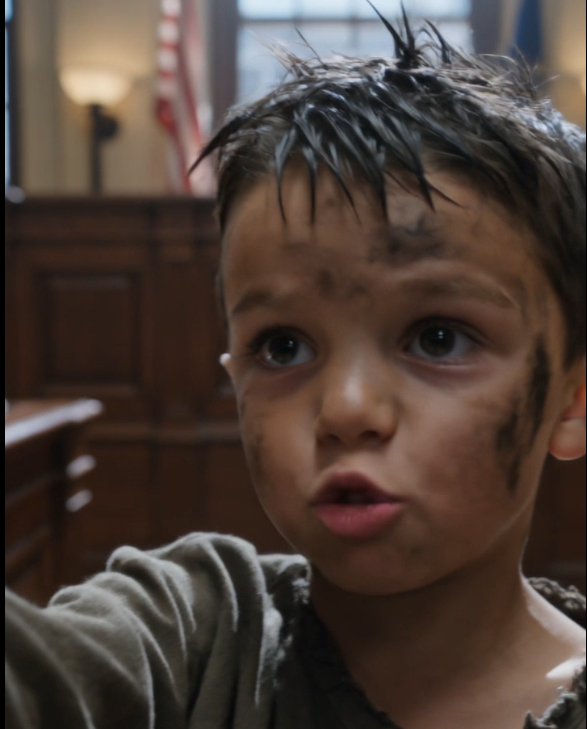
And standing in the doorway, chest heaving, barefoot on the cold marble floor, was a child.
He couldn’t have been more than seven years old. His face was streaked with dirt — real dirt, the kind that settles into the creases of skin after days without washing. His clothes were torn at the knee and elbow, a gray hoodie two sizes too large hanging off one shoulder, jeans that had been cut or worn down to ragged threads at the hem. His feet were bare and red from the cold November pavement outside. His hair was matted. His eyes were wild.
But his voice — God, his voice — cut through every cubic inch of that courtroom like a blade.
“I SAW EVERYTHING! HE DIDN’T DO IT!”
The silence that followed lasted exactly one second.
Then the room detonated.
Gasps erupted from the gallery. A reporter dropped her pen. One of the jurors — Seat Four, a retired schoolteacher named Margaret Howell — pressed both hands over her mouth. The court stenographer stopped typing mid-sentence, her fingers hovering frozen above the keys. Two spectators stood up instinctively, as if the boy’s entrance had triggered some primal alarm.
Judge Harold Mercer — twenty-three years on the bench, a man who had watched murderers confess without blinking, who had sentenced men to life imprisonment with the same flat calm he used to order his morning coffee — stared.
Then he found his gavel.
BANG. BANG. BANG.
“Order!” His voice cracked across the room. “Order in this court!” He leaned forward, peering over his glasses at the boy still standing in the open doorway. “Who let him in?! Someone tell me — who let this child in?“
Two bailiffs were already moving. They crossed the courtroom floor fast, their shoes loud on the marble, hands up in the universal gesture of stay calm, don’t run. The boy saw them coming and didn’t move. Didn’t flinch. Just stood there with his small chest rising and falling, his eyes scanning the room until they found what they were looking for.
The defendant’s table.
Marcus Webb, thirty-four years old, sat with his wrists in handcuffs, dressed in the gray suit his public defender had borrowed from a church charity closet. He had spent eleven months in pretrial detention. He had sat through three weeks of testimony — forensic analysts, eyewitnesses, a neighbor who claimed she’d heard shouting. He had listened to a prosecutor named Daniel Ashford describe him as a cold, calculated killer with the kind of practiced disgust that comes from years of performing conviction in front of juries.
For eleven months, Marcus Webb had looked beaten.
He didn’t look beaten now.
The moment he saw the boy — that small, filthy, trembling child in the doorway — something shifted in Marcus Webb’s face. Something cracked open. His eyes went wide and wet, and he was on his feet before his attorney could stop him, his chair scraping back hard against the floor, his handcuffed wrists thrust forward as he shouted across the room:
“WAIT! Let him speak!”
“Mr. Webb, sit down—“
“He knows something! He was there — let him speak!“
“Bailiff, control your defendant—“
“He’s just a kid, he walked in here alone, he doesn’t even have shoes — someone let this child speak!“
The room was chaos. The gavel was swinging. The bailiffs had stopped halfway to the boy, caught between two orders pulling in opposite directions. The boy himself hadn’t moved an inch. He was watching Marcus Webb with an expression that no seven-year-old should have been capable of — something ancient and exhausted and absolutely certain.
Judge Mercer held up one hand.
Everything stopped.
He was quiet for a long moment. Long enough that the only sound in Courtroom 14 was the distant hum of traffic fourteen floors below and the soft, unsteady breathing of a barefoot child.
“Bailiff,” Mercer said finally, his voice stripped of theater, “bring the boy forward.”
His name, it turned out, was Danny.
Just Danny — he didn’t offer a last name, and when the court-appointed child advocate who materialized from somewhere in the hallway tried to coax one out of him, he just shook his head with the quiet stubbornness of someone who had learned that full names were things you kept close. He was six, maybe seven. He had been sleeping in the parking structure across the street for two weeks. Before that, a shelter on Wabash Avenue. Before that — he shrugged.
Before that didn’t matter right now.
What mattered was the night of January 14th. What mattered was the alley behind the Meridian Hotel on South Michigan Avenue, where a man named Robert Greer had been found at 11:42 PM with two broken ribs and a fractured skull, unconscious in a puddle of freezing water. What mattered was that Marcus Webb had been arrested four blocks away twenty minutes later, and that the prosecution had built their entire case on a single eyewitness — a man named Thomas Calloway, well-dressed, well-spoken, a financial consultant with an office in the building adjacent to the alley — who had testified under oath that he had seen Marcus Webb commit the assault.
Danny had been in that alley.
He had been asleep behind the dumpster near the fire exit, buried under a flattened cardboard box and a stolen moving blanket, invisible to anyone who didn’t know to look. He had woken up to the sound of shouting.
He had seen everything.
Judge Mercer had cleared the gallery. The jury remained. Both attorneys remained. Marcus Webb remained, sitting very still now, his handcuffed hands flat on the table in front of him, watching the boy with an expression that had moved past hope into something quieter and more fragile. The child advocate sat beside Danny on a chair someone had pulled from the jury box. A court reporter typed in silence.
Prosecutor Daniel Ashford stood at his table, arms crossed, jaw tight. He was fifty-one years old. He had a perfect conviction record in felony assault cases. He wore cufflinks that cost more than Danny’s entire existence.
He had not looked at Danny once since the boy sat down.
“Danny,” Judge Mercer said, his voice gentled in a way the courtroom had never heard before, “I need you to tell us, in your own words, what you saw that night.”
Danny’s hands were folded in his lap. He looked at the judge for a moment — assessing, the way children who’ve lived hard lives learn to assess adults before trusting them — and then he nodded.
“I was sleeping,” he said. His voice was small but steady. “Behind the big metal box. The green one.” He meant the dumpster. “There was yelling. Two men. One man was hitting the other man.” A pause. “The man on the ground was yelling stop, stop, stop. But the other man didn’t stop.”
“Can you describe the man who was hitting?” the advocate asked gently.
Danny nodded. “He had on nice clothes. Like church clothes. Dark coat. Shiny shoes.” He glanced down at his own bare feet briefly, then back up. “I remember the shoes because they were loud on the ground when he walked away.”
Ashford shifted behind his table.
“And the man who was hurt,” Mercer said carefully, “the man on the ground — was the defendant, the man sitting over there—” he indicated Marcus Webb, “—was he the one doing the hitting?”
Danny turned and looked at Marcus Webb for a long moment.
“No,” he said simply. “He came after. He tried to help. He was yelling for someone to call 911.” Danny’s brow furrowed slightly, as if the injustice of what had followed was something he was still working to understand. “Then the police came and took him.“
The room was perfectly silent.
“Danny.” The advocate’s voice was careful. “The man in the nice clothes. The one you saw hitting the man on the ground.” She paused. “Is he in this room today?”
Danny’s chin came up slightly.
He raised his arm — small, thin, unwavering — and pointed.
Not toward the defense table.
Not toward the jury.
Past the prosecutor’s table, past the bar, into the gallery that had been cleared of spectators but not of court personnel, not of the various attorneys and consultants and observers who had seats by professional courtesy —
His finger pointed at a man in a charcoal suit sitting in the second row.
Thomas Calloway.
The eyewitness.
The man who had testified, under oath, with perfect composure, that Marcus Webb had committed the assault.
Calloway’s face did something terrible in that moment. It didn’t go through the stages — it didn’t cycle through denial and calculation and fear. It simply collapsed. All the composure, all the expensive tailoring, all the careful architecture of a lie held together for three weeks — it fell away in a single second, like a wall hitting the floor.
His mouth opened.
Nothing came out.
Danny lowered his hand. He looked tired now, the way children look when they’ve carried something heavy for a very long time and have finally been allowed to set it down.
“That’s him,” he said quietly. “That’s the man with the shiny shoes.”
The appeals process moved faster than anyone expected.
Marcus Webb walked out of the Cook County Detention Center on a Tuesday morning in April, seventeen days after Danny’s testimony had been entered into the record and Thomas Calloway had been taken into custody. He stood on the front steps in the same borrowed suit, blinking in the weak spring sunlight, and for a long moment he just breathed.
Reporters asked him how it felt.
He didn’t answer them.
He had one question, and he asked it of the public defender who had stood beside him for eleven months of wrongful proceedings.
“The boy,” Marcus said. “Danny. Where is he?”
She looked at him for a moment, then pulled out her phone. “I was hoping you’d ask that,” she said quietly. “Because someone needs to.”
The Chicago Department of Family Services had placed Danny in emergency foster care the night of the trial. The caseworker assigned to him had noted in her intake report, in the flat bureaucratic language of a system that processes too many children too quickly, that the subject was unaccompanied, unregistered, no known guardian, no documentation. That he was calm and cooperative. That he had asked, before they took him anywhere, whether the man in handcuffs was going to be okay.
He was six years old.
He had walked into a federal courthouse alone, barefoot, because he understood — in the wordless moral logic of a child who had seen real wrong and real innocence standing side by side — that someone had to.
Marcus Webb found him three weeks later, in a group home on the North Side.
Danny was sitting on the front steps when the car pulled up, turning a bottle cap over and over in his fingers the way kids do when they’re thinking about something far away. He looked up. Recognized the face. Didn’t say anything.
Marcus sat down on the step beside him.
For a while, neither of them spoke.
Then Marcus said: “You didn’t have to do that.”
Danny turned the bottle cap over once more.
“Yeah,” he said. “I did.”
Some people enter a room and change nothing. Some people walk through a door and change everything. On March 4th, in Courtroom 14 of the Northern District of Chicago, a six-year-old boy with no shoes and no last name walked through a door.
He changed everything.
