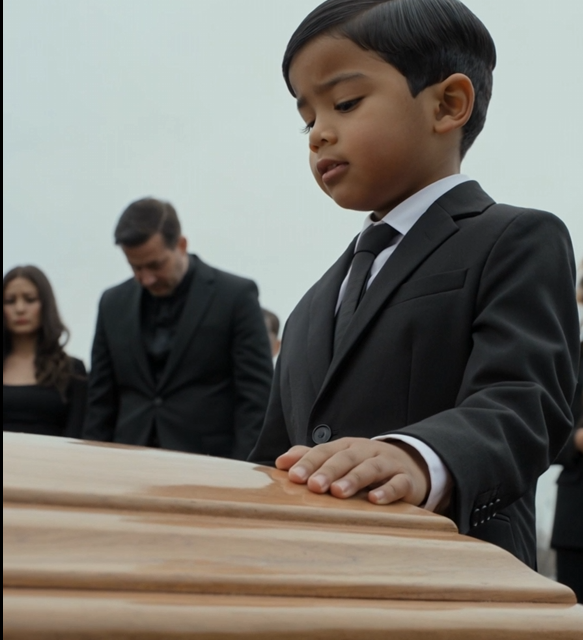
The day they buried Richard Calloway, the sky couldn’t decide what it wanted to do.
It wasn’t raining. It wasn’t sunny. It was the kind of flat, gray October sky that just watches — the way certain people watch, expressionless, giving you nothing back. The cemetery sat on a low hill outside of Dayton, Ohio, and the grass was still wet from the night before, and the folding chairs they’d set up beside the grave had left small dents in the soft earth, like the ground itself was reluctant to hold any of this.
There were maybe fifty people. Office colleagues in stiff black blazers. A few cousins who’d driven in from Columbus. Richard’s mother, eighty-one years old, sitting in the front row with her hands folded in her lap and her eyes somewhere far off, doing the math that no parent should ever have to do. His daughter from his first marriage stood near the back, nineteen years old, holding a tissue she hadn’t used yet.
And then there was his wife, Diane.
Diane stood at the front left of the gathering, close enough to the coffin that she could have reached out and touched it. She didn’t. She stood very still, in a black coat she’d owned for fifteen years, her hair pulled back, her face doing something complicated that didn’t have a name. Not grief, exactly. Not relief. Something older and heavier than both of those — the face of a woman who had known, for a long time, that this day was coming, and had spent those years deciding how she felt about it, and still hadn’t finished.
The priest had just opened his mouth to begin when the car door slammed.
Everyone turned.
She came through the cemetery gate fast — too fast for this place, too fast for these clothes, heels catching on the uneven ground, one hand gripping the strap of her bag like it was the only thing keeping her upright. She was maybe thirty-five, dark hair, a red dress under a black coat she’d thrown on wrong, one button misaligned. Her eyes were already wet before she’d made it twenty feet.
Nobody knew her name. Half the crowd figured it out anyway.
She stopped at the edge of the gathering, breathing hard, looking at the coffin. Just looking at it. For a long moment she was perfectly still — the only still thing about her — and then something cracked open inside her chest and she let it out.
The scream didn’t sound like grief. It sounded like fury. It sounded like years.
Her hand shot out, pointing at the polished wood, and she screamed: “You ruined my life!”
The crowd recoiled as one — a single backward lean, like a field of grass hit by wind. Nobody spoke. Nobody moved toward her. They just watched, the way people watch things they don’t know how to stop, with their hands at their sides and their mouths slightly open.
Her fists came down on the coffin lid. Once. Twice. The sound was hollow — that specific, terrible hollow sound of expensive wood over empty space.
“You promised me!”
She hit it again. Her knuckles were white. Her whole body was shaking, not just her hands — her shoulders, her jaw, the muscles along her neck. She was trembling the way a building trembles before something gives way.
Diane did not move. She watched the woman the way you watch weather — not judging it, not afraid of it, just accounting for it. Something behind her eyes had gone very quiet.
The woman’s legs went out from under her.
It wasn’t a faint. It was a collapse — intentional and total, the way you collapse when you’ve been holding something so long that your body simply refuses to hold it anymore. She went down beside the grave, palms hitting the wet grass, knees sinking into the mud. She pressed her hands flat against the earth and the mud filled every line on her palms, every crack, every scar, dark and permanent-looking.
She made a sound that wasn’t a scream anymore. It was lower. It was the sound underneath the scream — the thing the scream had been covering.
Around her: fifty people doing nothing. Shoes pointed slightly away. Eyes dropped to the ground. The priest stood with his prayer book open and his finger marking a page he would not read for a long time. Richard’s mother hadn’t turned around. Richard’s daughter had started using the tissue.
Nobody helped the woman. Nobody asked her to stop. They just stood there in their black coats on the gray October hill, each of them alone with what they knew, which was more than they were willing to say out loud.
And then the boy moved.
He’d been standing at the edge of the gathering, half-hidden behind the adults, small enough that he’d been invisible until this moment. He was eight, maybe nine. He had on a dark blue sweater that was slightly too big for him, and his hair needed cutting, and he was holding a single white flower that someone had given him and that he’d forgotten about until now.
He stepped forward — not quickly, not slowly, just with that particular confidence that children have before the world teaches them to hesitate — and he walked through the open space between the crowd and the coffin and crouched down beside the woman on the ground.
He looked at her for a moment. Then he looked up at the coffin. Then he looked back at her.
He placed one small hand on the coffin lid. Gently. The way you’d steady something that might fall.
And he asked — not unkindly, just genuinely, because he actually wanted to know:
“Why are you mad at him… if he’s already dead?”
The silence that followed was different from the silence before.
Before, the silence had been full of held breath and averted eyes and the collective discomfort of fifty people pretending they weren’t watching a woman come apart at a stranger’s funeral. It was a crowded silence. A cowardly one.
This silence was empty. Clean. The kind of silence that only a child can make, because a child’s question lands without agenda, without performance, without the weight of everything adults carry into every room they enter. He wasn’t trying to shame her. He wasn’t trying to comfort her either. He just wanted to understand.
The woman looked up from the ground.
Her face — for the first time since she’d come through the gate — was still. The rage had drained out of it, fast, the way color drains from something when you hold it under water long enough. What was left underneath was something younger. Something that looked, if you were being honest, a lot like grief after all.
She didn’t answer him.
Diane stepped forward.
One step. Her heel sank slightly into the soft earth and she didn’t adjust for it, didn’t shift her weight, just stood at a slight angle with her eyes on the coffin and her voice very controlled and very quiet.
“Because he lied.”
Two words. She didn’t elaborate. She didn’t look at the woman on the ground. She didn’t look at the crowd. She looked at the coffin with the expression of someone delivering a verdict on a case that had taken a very long time to reach the courtroom.
The guests didn’t move. The priest didn’t speak. A crow somewhere in one of the cemetery’s old oak trees made a sound and then thought better of it.
The boy hadn’t moved. His hand was still on the lid. He was looking at the coffin now the way he’d been looking at the woman before — with that uncomplicated attention, that willingness to simply see what was there.
He leaned in. Just slightly. The way you lean toward a sleeping person you don’t want to wake. And he spoke so quietly that later, people would argue about whether they’d actually heard it or just understood it somehow, the way you sometimes understand things that happen at funerals without quite knowing how.
“You should have told her the truth… before you died.”
Nobody responded. There was nothing to respond with.
The woman on the ground let out a slow breath — not a sob, not a sigh, something between the two — and she sat back on her heels and pushed her mud-dark hair out of her face and looked at the coffin for a long moment. Then she looked at Diane.
Diane looked back at her.
It lasted only a few seconds. But something passed between them — not forgiveness, not yet, maybe not ever — but recognition. The recognition of two people who had both loved the same liar, in different rooms, for the same number of years, and had never been allowed to talk about it.
The boy stood up. He still had the white flower in his other hand. He looked at it, seemed to remember it, and set it down on top of the coffin without ceremony, without meaning anything by it, just because it seemed like the right place for it.
Then he stepped back into the crowd and disappeared between the coats and the legs and the black umbrellas that no one had opened because it still hadn’t rained.
The priest cleared his throat.
He found his page.
Above the hill, the gray sky watched — and said, as it had said all morning, absolutely nothing.
