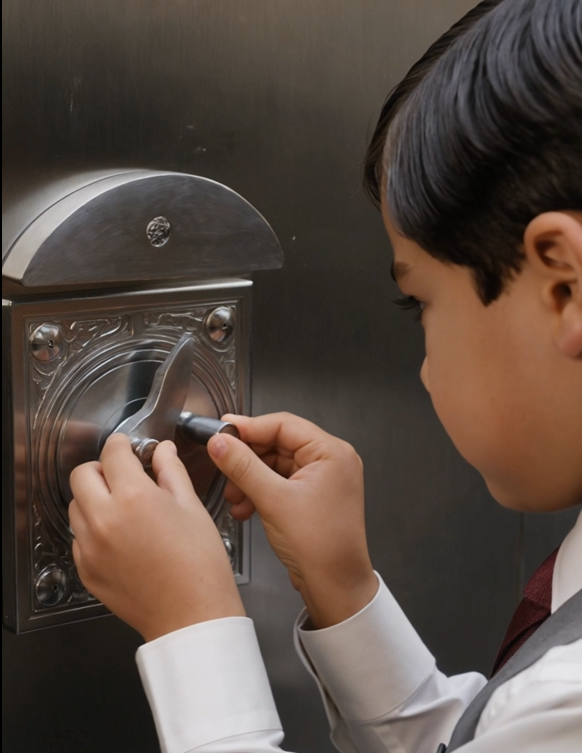
The vault door at Aldridge Private Wealth was a thing of considered beauty. Four inches of hardened carbon steel, polished to the kind of finish that reflected a man’s face back at him slightly better than he deserved. The locking wheel was nickel-plated, six-spoke, twelve inches in diameter — machined in Zurich by a company that had been making vault hardware for the same families for four generations. It weighed eleven pounds. It turned with a resistance calibrated to feel, to a practiced hand, like turning the wheel of a very fine ship: purposeful, authoritative, the sensation of controlled power moving through a system designed to hold.
The vault suite itself was a room within a room — glass walls on three sides so that the main floor of the private banking hall could observe it, the way a theater has a stage. This was deliberate. Aldridge’s managing director, a man named Gerald Holt, had insisted on the glass walls when the suite was renovated in 2019. Transparency, he had said. The word had meant something specific to him, though not the thing it usually means.
What it meant, in practice, was this: when a client came to access their vault, the other clients in the hall could see them do it. Could see the wheel turn, the door swing, the private interior of serious wealth becoming briefly, tantalizingly visible. It was aspirational architecture. It made people want to have vaults of their own.
On the morning of the twenty-second, eleven people stood on the hall side of the glass wall and watched a man named Warren Cassel try to open vault number seven.
Warren Cassel was fifty-eight years old and had the build and bearing of a man who had spent three decades making other people aware of his presence in rooms. He was in a grey suit that cost more than most people’s monthly rent. His cufflinks were monogrammed. His hair was silver and deliberate. He was the kind of man whose handshake arrived before he did — the anticipation of it, the performance of it, the way it communicated that the person receiving it should consider themselves fortunate.
He had been at the wheel for forty seconds.
His combination was four numbers. He had opened this vault twenty-three times in the last three years. His hand knew the sequence the way a hand knows a familiar door — not through thought, through repetition, through the accumulated muscle memory of a gesture performed so many times it had become unconscious.
Except this time the door had not opened.
He tried again. The same sequence, slower, more deliberate, with the focused attention of a man applying conscious thought to something that had always worked without it. The last tumbler should have caught. The wheel should have released. The door should have produced the deep, satisfying click of four inches of hardened steel yielding to the correct instruction.
Nothing.
Through the glass, eleven people watched. Some of them had been watching with the polite disinterest of people in a waiting room. Now they were watching with something different — a sharper attention, the attention of people who have identified that a small thing is going wrong for someone who is not accustomed to small things going wrong. There was, in the hall, a low collective murmur that was doing its best to disguise itself as the normal ambient sound of a private banking floor but was not quite succeeding.
Warren Cassel stepped back from the wheel. He smoothed the front of his jacket. He turned to face the glass with the controlled expression of a man who is reordering his options and does not intend to let the reordering show.
Warren Cassel
“I’ll pay ten thousand dollars. Cash. To anyone who can open it.”
He said it the way he said everything — with the volume and finality of a man who has learned that certainty, projected outward at sufficient amplitude, tends to become contagious. He smiled as he said it. The smile of a man who considers himself to be in control of a situation he has temporarily ceded to for entertainment purposes.
Through the glass: smirks. Crossed arms. A woman who raised her eyebrows at the man beside her. A young associate in a navy suit who looked at the floor. Nobody moved.
Warren Cassel’s smile held. He clasped his hands behind his back and waited, because he was a man who had made offers like this before — public, theatrical offers with large numbers attached — and the number always, eventually, moved someone.
It moved someone now. Just not the someone he was expecting.
Part Two · The Boy
He was perhaps eight years old. Perhaps nine — the kind of age that is difficult to determine when a child is very still, because stillness tends to add something to a face that youth usually hasn’t settled into yet. He was sitting in one of the low leather chairs along the east wall of the banking hall, the chairs positioned there for clients waiting for appointments, and he had been sitting in it with the quiet self-containment of a child who has learned to be unobtrusive in adult spaces.
He was not dressed for Aldridge Private Wealth. Dark jeans, a plain white shirt, sneakers that were clean but not expensive. His hair was brown and slightly too long. His hands were resting on his knees, and his eyes — when they came up from the middle distance they had been aimed at for the last ten minutes — were a very dark grey, the color of the vault door’s steel in the moment before the light caught it.
He stood up.
Not quickly. Not with the sudden enthusiasm of a child responding to a reward. With the measured, unhurried movement of a person who has made a decision and is now executing it — step one of a sequence that has already been thought through.
He walked to the glass door of the vault suite. Pushed it open. Stepped inside.
The shift in the room was immediate and total. The murmur stopped. The smirks stopped. The woman with the raised eyebrows lowered them. The associate in the navy suit looked up from the floor.
Warren Cassel looked at the boy the way a man looks at something that has arrived in his field of attention and has not yet been categorized. His smile, which had been holding at approximately sixty percent of its usual wattage while he waited for an adult to take him up on his offer, recalibrated itself to something closer to amusement.
The boy stopped in front of him. Looked up. Not intimidated. Not performing fearlessness — just genuinely, constitutionally unconcerned with the man’s size and suit and posture and the eleven people watching through the glass.
The Boy
“Are you sure?”
Two words. Quiet. The question of a person who wants to confirm that an offer is real before accepting it — not because they doubt the number, but because they want the man to commit to it fully, in front of witnesses, before they proceed.
Warren Cassel looked at him for a moment. Then the smile widened into something genuine — the real thing, unguarded, because the situation had become genuinely funny to him, which was a feeling he didn’t have often enough and found he enjoyed.
Warren Cassel
“Try.”
Part Three · The Combination
The boy turned to the vault door. He looked at it for a moment — not studying it, not assessing it, but doing something that was closer to recognition. The way you look at a face you know from a photograph and are now seeing for the first time in person, checking the correspondence between the image you carried and the thing in front of you.
He raised both hands. His fingers touched the nickel-plated wheel — gently, at first. The pads of his fingers, not his palms. Feeling the temperature of the metal, the texture of the machined surface, the specific resistance of a mechanism that had been built to yield to one thing only and had not yet decided whether this was it.
He began to turn.
The sound in the vault suite was breathing. His breathing — slow, even, the breathing of concentration — and the faint, barely-audible whisper of the wheel moving through its arc. Nothing else. The eleven people outside had stopped producing any sound at all. The associate in the navy suit had moved closer to the glass.
The first tumbler caught.C L I C K
The sound was small. In the polished steel acoustics of the vault suite, it arrived with perfect clarity — a single, definitive mechanical event, the sound of a thing moving into alignment.
The crowd outside leaned forward. Not consciously. As a body, the way crowds move when something has happened that the individual members have not yet processed but the collective has already responded to.
Warren Cassel’s smile had changed. It was still present — the architecture of it was still in place — but something behind it had shifted. A microexpression, gone before it fully arrived. The expression of a man who has just noticed something he did not expect to notice and is deciding how to feel about it.
The boy’s hands moved. A precise adjustment — three degrees clockwise, the kind of correction that is not a guess but a calculation, the kind that comes from knowing something in advance rather than discovering it in the moment. His eyes were focused on a point somewhere beyond the surface of the door. He was not looking at the wheel. He was looking through it, at something internal, something structural, something that existed in the mechanism the way a word exists in a language — present but invisible unless you know what you are reading.
He was not trying to open the vault.
He was remembering how.C L I C K
The second tumbler. Louder than the first. Or perhaps the room was simply quieter — the silence having deepened in the interval between the two sounds into something more specific than the absence of noise. Into the silence of people who are holding their breath because they have understood that something is happening that they do not have a category for, and they are waiting, without knowing they are waiting, for the category to arrive.
Warren Cassel’s hands, which had been clasped behind his back with the easy authority of a man watching entertainment, had moved. They were at his sides now. One of them had closed, slightly, into something that was not quite a fist.
He was watching the boy’s hands. The way they moved — the economy of it, the precision, the absence of uncertainty. He had watched locksmiths work. He had watched engineers handle mechanisms. He had never watched an eight-year-old boy approach a Zurich-machined vault lock with the calm assurance of someone who had been here before. Who had done this before. Who knew, in the specific embodied way that the body knows things that the mind was taught by someone else, exactly what came next.
The boy’s right hand paused. One degree. One half-degree. He was listening to the mechanism the way you listen to a familiar voice — not for the words, but for the person behind them. For the specific quality of the thing that tells you: here. This. Now.
Warren Cassel
“Who taught you that?”
Sharp. The casual authority gone from his voice, replaced by something he was working to keep controlled and not entirely succeeding. The question of a man who has just recognized something — a movement, a technique, a specific angle of approach to a specific mechanism — that he did not expect to see again after a certain point in time.
The boy didn’t stop. Didn’t turn. His hands continued their work with the same focused, unhurried precision.
The Boy
“My father.”
Part Four · The Freeze
The word landed differently than words usually land.
Warren Cassel went still. Not the stillness of composure — the other kind. The kind that happens when a body receives information that is too large to process in motion and simply stops, the way a machine stops when you cut the power, all at once and completely.
His face did something. The eleven people outside the glass could see it happening — could see the change moving through his features the way weather moves across open water — but from that distance and through that glass they could not read it clearly. They could only see that it was significant. That the man who had been smiling forty seconds ago was no longer smiling in any sense of the word, and that the eight-year-old at the vault lock had caused this, and that the cause was two syllables long.
My father.
Warren Cassel knew one man who could open vault number seven. One man, in the world, who had been given the combination by a person who should not have given it and who had used it in ways that the vault was not supposed to be used for and who had known things about the contents of that vault that were not in any document and not in any conversation that Warren Cassel had ever allowed to be recorded.
That man had died fourteen months ago.
He had died in a hospital in New Jersey and Warren Cassel had attended the funeral because attending the funeral was the kind of thing you did to signal that a chapter was closed — that the thing which had existed between two men was over, was resolved, was sealed as thoroughly as a vault door sealed against the world. He had stood at the graveside in a grey suit and felt, beneath the performed grief, a careful and specific relief.
He had a son. Warren Cassel had known that. He had not known the son was eight years old. He had not known the son had been taught the combination. He had not known — had never considered, had never needed to consider — that a dying man might have decided, at some point during his dying, that the most important thing he had left to give his child was not money or property or a letter. Was a sequence of numbers. Was a way into a room that held the proof of what had been done to him.
The boy’s hand moved again. Final adjustment.
Warren Cassel
“Stop. Right now.”
The voice had changed completely. The theater of it was gone. What was left was something older and less managed — the voice of a man speaking from below the performance, from the place where the fear lives that the performance is built to cover. Urgent. Low. The specific urgency of a person who has run out of time to be indirect.
The boy did not stop.
His hands remained on the wheel. His breathing remained even. The vault suite was so quiet that the sound of the mechanism — the fine, internal shifting of tumblers moving toward alignment — was audible to both of them. A language of metal, patient and precise, approaching its conclusion.
Through the glass: eleven people watching. The associate in the navy suit had his hand on the glass wall. The woman with the eyebrows had her phone out — not raised, not filming yet, but out, the way a person holds something when they are waiting for the moment that makes the holding necessary. Gerald Holt, the managing director, had appeared at the far end of the hall and was moving toward the vault suite with the rapid, controlled stride of a man who has been told something is happening and has not yet seen it and does not yet understand the full dimensions of it.
Warren Cassel took one step toward the boy.
The boy turned his head. Not his body — just his head, a precise quarter-turn, enough to see the man behind him without releasing the wheel. His grey eyes, calm and specific, found Warren Cassel’s face.
The Boy
“Do you want it to stay closed… or the truth to come out?”
Quiet. Almost gentle. The tone of a child who is not making a threat — who does not understand themselves to be making a threat — but is simply asking a question that has two answers, one of which Warren Cassel very much prefers, and the other of which is already in motion.
Warren Cassel stood where he had stopped. One step from the boy. Close enough that the boy could hear his breathing, which was no longer controlled. His hand — the one that had been moving toward the child — was suspended. Not raised in threat. Simply stopped, in the space between intention and action, in the moment of understanding that neither option available to him ends well.
If he grabs the boy: eleven witnesses. A managing director approaching. A woman with a phone that is already out and waiting.
If he doesn’t: the third tumbler catches. The wheel releases. The door opens. And whatever his dead business partner decided to put inside vault number seven fourteen months ago, when he was sick and running out of time and apparently teaching his eight-year-old son a sequence of numbers that were never supposed to leave two living minds — whatever it is comes out into the light of a private banking hall in Lower Manhattan on a Tuesday morning in October, in front of eleven witnesses and a managing director and a woman with a phone.
The boy’s hands moved. Slow. Final.
The last tumbler.
· · · silence · · ·deep metallic resonance
The sound the vault made when the final tumbler caught was not the small, precise click of the first two. It was something larger — a full-throated mechanical event, four inches of hardened steel releasing from eleven years of engineered resistance, the sound of a system built to hold surrendering to the one instruction it was built to yield to.
The wheel spun free.
The boy’s hands came off it. He stepped back — one step, two — and turned to face the vault door fully, and stood there with his hands at his sides and his breathing even and his grey eyes on the seam where the door met the frame, watching it the way you watch a thing you have been waiting to see for a long time.
The door began to move.
Not fast. Four inches of carbon steel does not move fast. It moved the way inevitable things move — slowly, massively, with the indifferent momentum of something that has made its decision and is now simply executing it, regardless of what anyone in the room would prefer.
Gerald Holt reached the glass door of the vault suite and stopped. His hand was on the handle and he did not open it. He was looking through the glass at the vault door and at the boy standing in front of it and at Warren Cassel standing behind the boy with his suspended hand and his broken composure and his face doing something that Holt had never seen on the face of a client in twenty-six years of private banking.
Something that looked, in the polished steel light of the vault suite, very much like reckoning.
The woman with the phone raised it.
The vault door continued its slow, massive arc.
The boy looked back at Warren Cassel one more time — a brief look, almost incidental, the look of a person checking that the right person is present for the right moment — and then looked forward again. Into the opening dark of the vault interior. Into whatever his father had decided was worth teaching a combination for.
Into the truth that had been sealed in there, waiting, since before the boy was old enough to understand what truth cost the people who kept it.
Warren Cassel did not move. Could not move. Was standing in the exact place where a man stands when the thing he spent years making sure would never happen has happened anyway, because he had not accounted for one variable: that a dying man’s last lesson to his son might not be about survival, or money, or how to navigate the world alone.
Might be about a combination.
Might be about a vault.
Might be about a Tuesday morning in October when a boy walks into the most controlled room in the most controlled building in Lower Manhattan and opens, quietly, calmly, with his father’s hands and his father’s knowledge and his father’s absolute refusal to let the truth stay buried — the one door that was never supposed to open again.
The vault door reached its full extension. The interior was visible now — the shelves, the boxes, the particular organized darkness of a space built to hold important things in secret. And on the middle shelf, exactly where a man who knew this room would have known to look, a single manila envelope. Thick. Sealed. A name written on the front in handwriting that Warren Cassel recognized immediately, viscerally, the way you recognize a voice you hoped you would never hear again.
Not his name.
The boy’s name.
His father had addressed it to him. Had placed it there himself, at some point during the fourteen months between when he understood he was dying and when he finally did. Had sealed it and labeled it and left it in a vault whose combination he had given to no one except his eight-year-old son, because he had understood — with the clarity that terminal illness sometimes produces in people who were already clear-eyed — that the only person he could trust to open this door was someone who had no reason to be afraid of what came next.
Someone who didn’t know yet what the envelope contained.
Someone who only knew that his father had asked him to do one thing. Had taught him a sequence of numbers and an address and a name — the name of a man who would be there, who would try to stop him, who would offer money and then fear and then a direct order — and had told him that when the man said stop, that was how he would know he was doing the right thing.
The boy reached into the vault. His small hand closed around the envelope.
He held it. Felt the weight of it. The specific weight of a thing that has been waiting for you in the dark and is now in your hands and is going to change the shape of everything that comes after this moment, though you do not yet know how.
He turned around.
Warren Cassel was looking at the envelope. His face had completed its journey from control to something that had no professional name — the face beneath all the faces, raw and specific and very old, the face of a man who has just seen the thing he buried walk back into the light.
The boy looked at him. At the man who had offered ten thousand dollars to whoever could open the vault — who had made the offer publicly, in front of witnesses, with the confidence of a man who was certain the vault would stay closed because the only person who knew the combination was in the ground.
Who had not accounted for an eight-year-old in clean sneakers sitting in a leather chair along the east wall, waiting for the right moment, with his father’s hands and his father’s knowledge and a single sealed envelope addressed to him in handwriting that Warren Cassel would be seeing in his sleep for the rest of his life.
The boy held the envelope up. Not as a threat. Not as a performance. Simply showing it — the way you show someone something that belongs to you, that you have come to collect, that has been here the whole time waiting for the right person to arrive with the right numbers in the right order on the right morning.
“Thank you,” the boy said.
For the offer. For the permission. For stepping back from the wheel and inviting the room to watch. For not understanding, until it was too late to matter, that ten thousand dollars was not the price of this particular door.
He walked out of the vault. Across the suite. Through the glass door that Gerald Holt held open because Gerald Holt was a man who had spent twenty-six years in private banking and had just understood, in the space of four minutes, that he was going to spend the next considerable portion of his life dealing with the consequences of a transparency policy he had championed in 2019.
The boy walked across the marble floor of the banking hall — eleven people watching, the woman’s phone raised, the associate in the navy suit completely motionless — with the envelope held against his chest and his face doing nothing in particular, because he had done the thing he came to do and the rest of it was not his to carry.
The heavy glass door of Aldridge Private Wealth closed behind him. Gentle. Certain.
Inside, in the vault suite, the door of number seven stood open to the light for the first time in fourteen months. Warren Cassel stood in front of it and looked at the empty middle shelf and did not move.
Some vaults are built to protect wealth.
Some are built to protect something else entirely.
And some combinations are the last things a father teaches a son — not because the son will need money, or access, or the mechanical knowledge of how a Zurich-machined lock yields to the right instruction.
But because the father understood that truth, sealed in the right place and left for the right person, can wait as long as it needs to.
And that the right person, when the time comes, will know exactly how to open the door.
