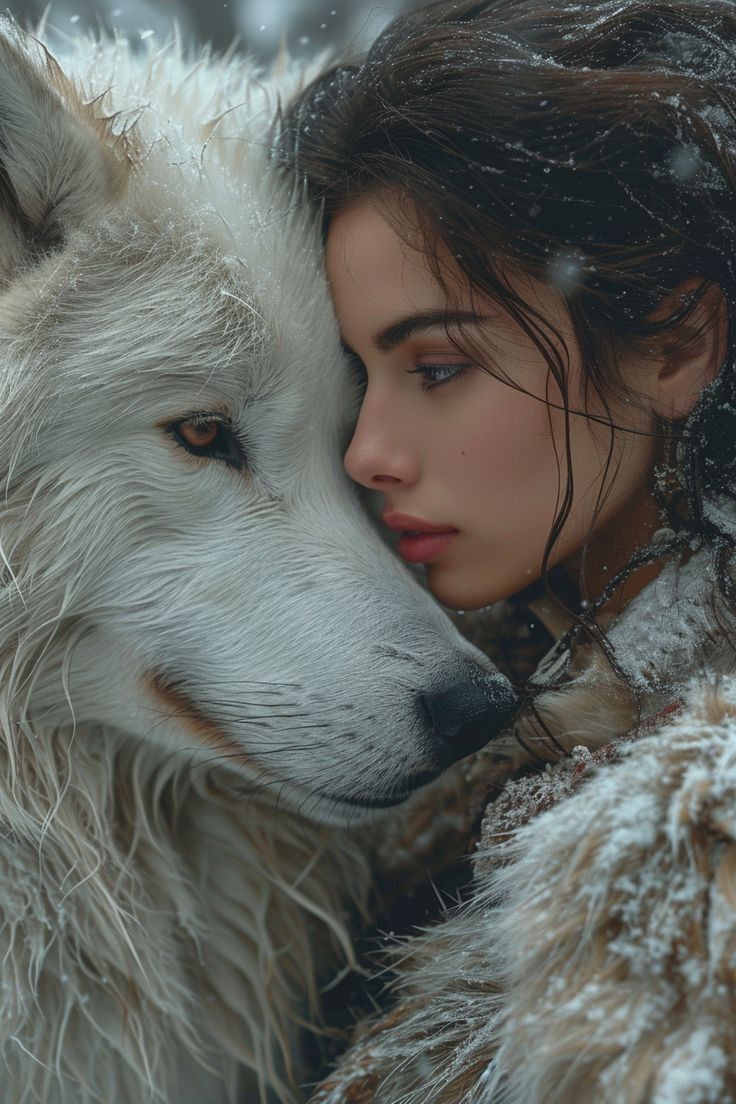
Everyone in the town of Coldwater, Montana told Nora Ashby the same thing: wolves don’t choose people. People choose wolves, and even then, the wolf decides whether the choice is worth accepting.
Nora had never been interested in choosing anything safe.
She was twenty-six, recently returned from two years working at a wildlife rehabilitation center in Colorado, and she had come back to Coldwater not because she missed it but because her father was sick and the ranch needed running and sometimes life makes decisions for you before you’ve finished thinking. She arrived on a gray Tuesday in early November with two duffel bags, a truck with a cracked windshield, and a quiet that people mistook for sadness. It wasn’t sadness. It was just the particular stillness of a woman who had learned to listen more than she spoke.
The white wolf appeared for the first time on a Thursday morning, ten days after her return.
Nora had been out checking the fence line on the north edge of the property, the part that bordered the national forest, when she saw him standing at the tree line. Large. Unnaturally still. White as fresh snowfall with pale amber eyes that caught the weak morning light and held it. She stopped walking. He didn’t move. They looked at each other across about forty yards of frozen field for what felt like a very long time but was probably only thirty seconds.
Then he turned and walked back into the trees.
She didn’t tell anyone. She wasn’t sure why, except that some things feel like they belong to you alone, at least at first.
He came back the next morning. And the one after that.
By the end of the second week, he was coming to within twenty yards of where she stood. She never moved toward him. She understood instinctively — the way she understood most things about animals — that the distance was his to close, not hers. She would stand in the cold with her breath making small clouds in the air and simply exist near him, and he would watch her with those amber eyes that felt older than they had any right to be.
She named him Ghost. Not because it was original, but because it was true.
Her father, propped up in his recliner with the oxygen tank humming beside him, noticed something had shifted in her.
“You look like you did when you were twelve,” he said one evening. “Right after you found that injured hawk in the south field.”
“I’m fine, Dad.”
“I didn’t say you weren’t. I said you look like that.” He studied her over the rim of his coffee mug. “What is it?”
“A wolf,” she said simply.
He was quiet for a moment. “Wild?”
“Yes.”
“Coming close?”
“Closer every day.”
Her father set down his mug. “Nora.” His voice carried the particular weight of a man who had spent forty years ranching and knew what wolves meant in practical terms — not just the beautiful, complicated truth of them, but the reality of livestock, of neighbors, of state wildlife authorities.
“I know,” she said.
“Do you?”
She looked at him. “I know all of it. I’m still not going to stop.”
He sighed — long, slow, the kind of sigh that contains an entire argument and then the surrender of it. “No,” he said. “I don’t suppose you will.”
Three weeks in, Ghost crossed the field completely.
Nora had not planned for it. She was standing in her usual spot, still as she always was, and she watched him move out from the tree line and walk toward her through the snow in a straight, unhurried line, as though he had made up his mind about something during the night and saw no reason to second-guess it now. She held herself completely motionless. Her heart was loud in her own ears.
He stopped directly in front of her. Close enough that she could see the individual hairs of his thick white coat, the faint gray shading near his ears, the steady rise and fall of his breath. He was enormous up close. Beautiful in a way that was almost frightening — the kind of beauty that reminds you that the world is larger and older and less manageable than you usually allow yourself to remember.
He lowered his great head.
Slowly — very slowly — Nora raised one hand and pressed her cheek against the side of his face.
The warmth of him surprised her. She had expected cold, the way you expect everything wild to be cold. But he was warm and solid and real, and the low sound he made — not quite a growl, something beneath language — moved through her chest like a frequency she had been tuned to her whole life without knowing it.
She closed her eyes.
In that moment she was not a woman with a sick father and a failing ranch and a future that looked like a series of obligations stretching endlessly forward. She was just a person, standing in the snow, held briefly in the gravity of something ancient and honest and free.
When she opened her eyes, the snow had begun to fall again. Ghost lifted his head. He looked at her once more — that amber gaze, direct and clear and carrying something she could not name — and then he turned and moved back across the field toward the trees.
At the edge, he stopped.
He looked back at her over his shoulder.
Then he was gone.
That night, sitting by her father’s bed while he slept, Nora thought about what it means to be chosen by something wild. Not owned. Not tamed. Just — seen. Acknowledged. Met.
She thought maybe that was the rarest thing in the world.
