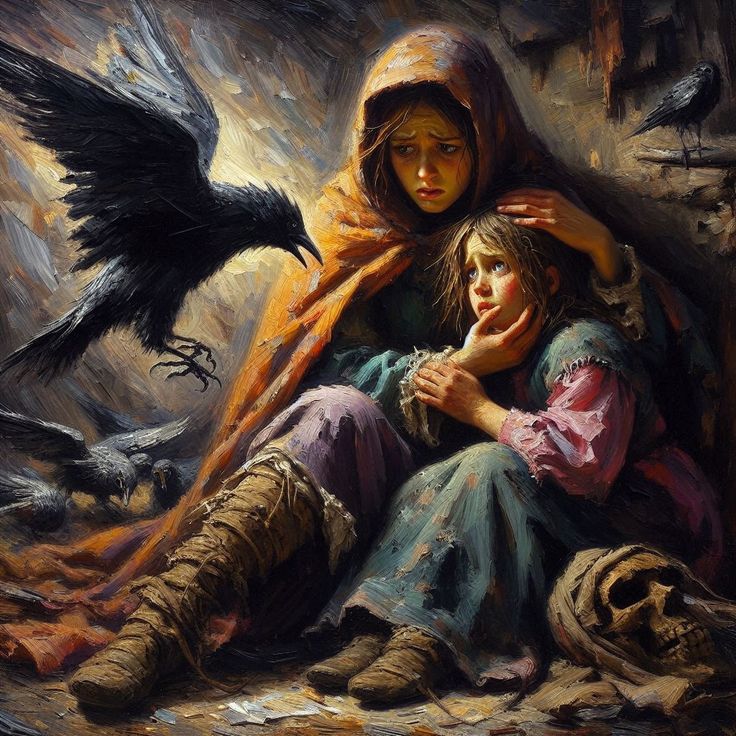
The crow landed three inches from Maya’s boot, and she didn’t flinch.
That was how Delia knew her daughter had stopped being afraid of ordinary things. When a child stops flinching at ravens, she has already met something worse. Maya was nine years old, and she had the eyes of someone who had stopped counting days.
Delia pulled her daughter closer, feeling the small ribcage beneath her palms, counting the bones the way a person counts money they know is running out. Outside the broken wall behind them, the wind moved through what used to be Jefferson Street. She remembered Jefferson Street. She remembered the bakery on the corner that smelled like cinnamon on Sunday mornings, the old man named Earl who walked his beagle at six a.m. without fail, the yellow fire hydrant the neighborhood kids used to crack open every August when the heat became something living and cruel.
All of it was gone now. Not burned. Not flooded. Just — gone, the way a dream goes when you reach for it after waking.
“Mama,” Maya whispered. “Is that one angry?”
She meant the crow. It had hopped closer, turning its head sideways, studying them with one oil-black eye the size of a coat button.
“No, baby. Just curious.”
“How do you know the difference?”
Delia thought about that longer than the question deserved. “Angry things don’t look at you,” she finally said. “They just come.”
Maya accepted this the way children in hard times accept everything — quietly, filing it away with all the other lessons that had no classroom.
The skull near Maya’s foot had been there when they arrived two nights ago. Delia had considered moving it but decided against it. There was something honest about it. In the old world, people hid their dead beneath marble and flowers and carefully chosen words. Out here, the dead simply stayed where they fell, and maybe that was its own kind of dignity.
They had walked from Cincinnati. Delia didn’t like to think about how far that was or how long it had taken. She measured the journey instead in smaller units — the night Maya found half a granola bar in an abandoned gas station and split it evenly without being asked. The morning they heard helicopters and hid beneath a highway overpass for six hours, not knowing if safety or danger flew above them. The afternoon Maya laughed for the first time in weeks because a squirrel dropped an acorn on Delia’s head.
She lived for those laughs now. They were currency. They were oxygen.
The crow hopped closer still, and a second one landed near the wall. Then a third settled on a broken beam above them, folding its wings with the casual authority of something that owned the world. The birds had multiplied everywhere since the Collapse. Crows and ravens and starlings, filling the quiet spaces humans had abandoned. Delia didn’t blame them. Nature had been waiting patiently for its turn.
“Where are we going tomorrow?” Maya asked.
“East.”
“You always say east.”
“East is still true.”
Maya leaned her head against her mother’s shoulder. Her hair smelled like dust and something faintly sweet that Delia couldn’t identify — some wildflower they’d brushed through two days back, clinging stubbornly to her daughter’s tangled hair like a small act of hope.
“Grandma used to say there were good people everywhere,” Maya said.
“Grandma was right.”
“Did she know it would get like this?”
Delia looked at the darkening sky through the broken ceiling. Stars were appearing, more stars than she’d ever seen in her Ohio childhood, because the lights were all gone now and the darkness was complete and total and ancient.
“No,” she said honestly. “Nobody knew.”
“But we’re still good people, right?”
She squeezed her daughter so tightly that Maya made a small sound of protest.
“We are the best people,” Delia said. “We are the absolute best.”
The largest crow tilted its head and made a sound low in its throat — not quite a caw, something more like a question. Maya reached out her small hand, palm up, the way you offer bread to a pigeon in a park in a world where parks still existed.
The crow stared.
Then, in a movement so slow it seemed deliberate, it stepped onto her fingers.
Maya turned to look at her mother, eyes wide, face lit with something Delia hadn’t seen in months. Not relief. Not survival. Something older and better and more essential.
Wonder.
“Mama,” Maya breathed. “Mama, look.”
“I see it, baby. I see it.”
Delia did not cry. She had made a rule about crying after the first month — not because crying was wrong, but because she needed her eyes clear and her jaw steady for Maya. But in that moment, watching her daughter’s face glow in the last light of the day while a wild thing chose her hand voluntarily, chose her, Delia felt something inside her chest unlock.
They were still here. They were still this. A mother and a daughter in the ruins of everything, and somehow, between them, there was still enough warmth to attract living creatures.
That had to mean something.
The crow lifted off, rejoining its companions in the rafters. Maya watched it go without sadness, already understanding that beautiful things pass without owing you anything.
She settled back against her mother.
“East tomorrow,” she said.
“East tomorrow,” Delia confirmed.
And outside, the crows kept watch through the long night, patient and black-eyed and strangely faithful, while the stars burned overhead with the cold, indifferent brilliance of a universe that had never needed people at all — but somehow kept making room for them anyway.
