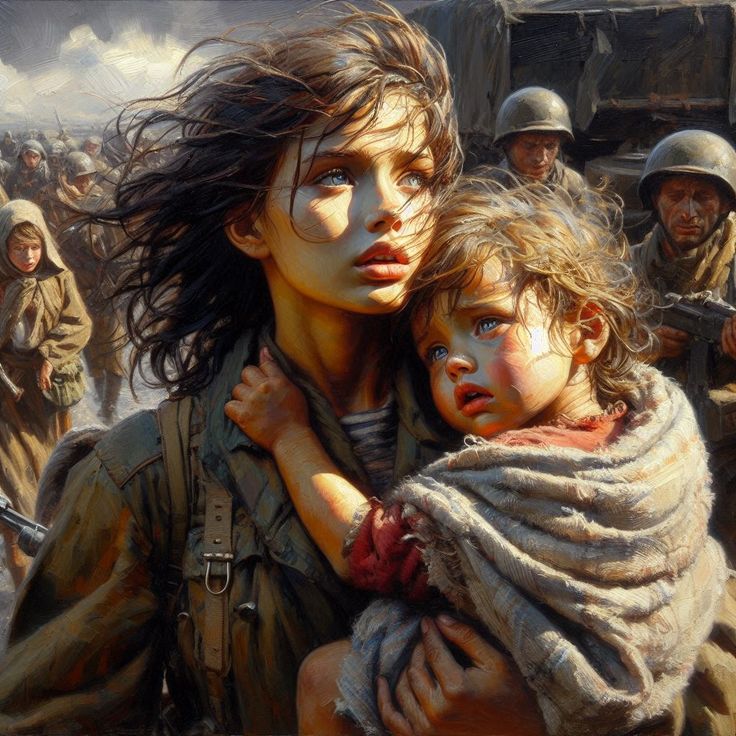
She had not slept in four days.
She knew this the way you knew things when your body had stopped being a place you lived in and had become something you were simply operating, pulling levers, keeping upright through the application of will rather than any genuine reserve of strength. Her name was Mara. She was twenty-six years old. Forty-eight hours ago she had been a graduate student in literature at a university that no longer had all of its walls. Now she was moving through a checkpoint in a line of people that stretched so far behind her she could not see its end, and she was carrying a child who was not hers.
The child’s name was Anya. She was two and a half. She had blue eyes and curly blonde hair and a small red cloth she clutched in her left fist with the determined grip of someone for whom one thing had become the entire world. She had not spoken since Mara found her. Not a word, not a cry — just the wide, assessing eyes of a child taking in more than a child should ever have to take in, processing it in some interior place that Mara hoped, deeply and without evidence, was protected somehow from the full weight of what it contained.
Mara had found her two days ago on the road outside Haliv.
The road had been chaos in the specific way that roads became chaos when the thing everyone had told themselves would not happen actually happened — not dramatic, not cinematic, just the overwhelming and unglamorous reality of thousands of people moving in the same direction at the same time with what they could carry, vehicles stopped where they’d run out of fuel, children crying, old people sitting on luggage by the roadside with the particular exhaustion of those for whom this was not the first time history had done this to them.
Anya had been standing alone beside an overturned cart. Just standing, in the middle of the human current, people streaming around her the way water moved around a stone. She was not crying. She was holding the red cloth and looking at something in the middle distance that was not there anymore, that may have stopped being there recently or may have stopped being there in a way Mara was not ready to think about directly.
Mara had stopped.
People behind her had moved around her the way they’d moved around Anya — the hydraulics of a crowd that had somewhere to be and no capacity for detours. Mara had crouched down in the road and looked at the child and the child had looked back at her, and some negotiation had happened in that moment that required no language and no time, some primal recognition between a small person who needed carrying and a person who still had arms.
She had picked her up.
She had not asked herself what came next. What came next was the checkpoint, the line, the moving, the putting of one foot in front of the other in the direction that had been named as safer without any guarantee that safer meant safe. What came next was keeping the child warm and keeping the child fed with the half of whatever she had that she gave to Anya before eating any herself, which was not a decision she made consciously but simply what happened when she opened her bag.
The soldiers at the checkpoint were young. That was the thing she kept noticing about the soldiers — how young they were, how they held their weapons with the careful, deliberate attention of people who were new to holding weapons, how some of them had the faces of the boys she had sat beside in lecture halls discussing nineteenth century poetry not very long ago in a life that felt like it belonged to a different version of her.
One of them stopped her.
He was perhaps twenty, broad-shouldered, with the kind of face that would have been open and unremarkable in ordinary times but had been arranged by the last weeks into something more careful, more controlled. He looked at Mara. He looked at Anya.
“Yours?” he said.
Mara met his eyes. “Yes,” she said.
It was not true and they may both have known it was not true and it did not matter, because Anya’s fist had found the collar of Mara’s jacket and was holding on with the same iron grip she gave the red cloth, and whatever the technical answer to the question was, the functional answer — the answer that existed in the space between this child’s hand and this woman’s jacket — was yes. Whatever yours meant in the ordinary world, it meant something in this one, in this line, on this road, with this particular weight in her arms and this particular grip at her collar.
The soldier looked at them for a moment longer. Then he nodded and waved her through.
On the other side of the checkpoint the line thinned. There were vehicles — buses, trucks, the organized chaos of an evacuation corridor that was working imperfectly and nevertheless working. People being sorted, directed, given information about where the buses were going and what was at the other end. Mara stood in the flat gray daylight and held Anya and tried to make sense of the information being given to her by a woman in an orange vest who was clearly exhausted and nevertheless present, nevertheless doing the next thing and the next.
A bus. There was a bus. It was going to the western border.
Mara got on.
She found two seats together and sat down and settled Anya in her lap and wrapped both arms around her and felt the child’s weight settle against her chest — the specific, complete surrender of a tired child against a warm body, the way they went boneless when they finally felt safe enough, when the vigilance could drop even briefly, when the animal part of them decided: here. This is enough. Rest.
Anya slept.
Mara looked out the window as the bus began to move, watching the country she had known her whole life scroll past the glass, and she did not cry — not because she didn’t feel it, but because she was carrying something, and you held yourself differently when you were carrying something. Steadier. More deliberate. You breathed from a different place.
She put her chin on top of Anya’s head.
The bus moved west. The road was long. In her arms, a child slept with a red cloth in her fist and the particular trust of someone who had decided, without language, without certainty, with nothing but the available evidence of two arms that had not let her go: this one. I will trust this one.
Mara held her.
Outside, the country moved past in the gray and gold of an afternoon that did not know what it was framing, that simply continued being afternoon regardless — light falling on damaged things and undamaged things alike, indifferent and very beautiful, the way light always was.
She held her all the way to the border.
