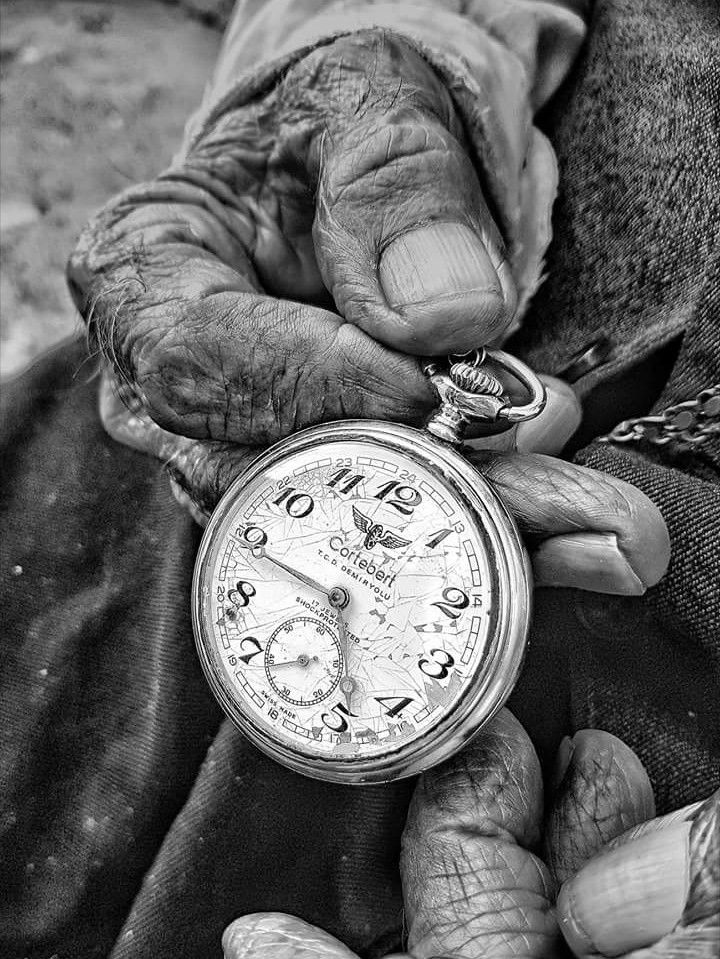
He wound it every morning without fail.
Not because it needed winding every morning — the old Cortebert was a reliable mechanism, Swiss-made and railroad-grade, built in an era when things were constructed to outlast the people who used them. It could go two days, sometimes three, before it needed attention. But Arthur Pembrook wound it every morning anyway, the same way he made his bed and said his prayers and drank his coffee black — not from necessity but from the understanding, accumulated over eighty-seven years, that the small daily rituals were the architecture of a life, and that when you stopped tending them, the structure began, quietly and then less quietly, to come apart.
He was sitting on the front steps of his house in Clover Hill, Kentucky, holding the watch in both hands the way you held something that had survived more than you had and earned a kind of reverence for it.
The watch had belonged to his father.
Before that, his grandfather.
Before that, a man whose name Arthur knew but whose face existed only in a daguerreotype so faded that the features had become suggestions rather than facts — a great-great-grandfather who had worked the railroad in the years when working the railroad was the kind of work that consumed men entirely, that took their youth and their hearing and sometimes their lives and gave back in return a wage and a purpose and the particular dignity of a man who knew how to keep a machine running. The watch had been issued by the railroad company — T.C.D. Demiryolu, the stamp said, which was a Turkish railroad, which was a fact Arthur had researched at the library in 1987 with the methodical curiosity of a retired schoolteacher who had discovered, late in life, that his family’s history was more international and more interesting than anyone had told him.
How the watch had moved from a Turkish railroad to a Kentucky family in the mid-1800s was a story Arthur had only fragments of — a merchant ship, a port city, a transaction or a gift or a rescue, depending on which version of the family mythology you believed. He had stopped trying to verify the precise facts and had come to accept the mystery as part of the object’s weight, the way all old things carried the weight of what you didn’t know about them alongside what you did.
The crack across the face had been there as long as Arthur could remember.
His father had told him never to repair it. The crack is part of it, his father had said, in the particular way he said things that he considered settled — not harshly, just finally, the tone of a man who had made his peace with a decision and wasn’t going to revisit it. Everything that’s lasted a long time has marks on it. You don’t fix the marks. You keep the thing running and you carry the marks with you.
Arthur had kept the thing running for sixty-three years. He had wound it through a marriage and a war — the tail end of Korea, eight months in a place that had rearranged his understanding of what human beings were capable of in both directions, toward both cruelty and extraordinary grace. He had wound it through the raising of three children, through the deaths of his parents, through the ordinary decades of a teaching career in which he had stood in front of rooms of young people and tried to give them something durable. He had wound it through his wife Cecile’s illness and her death eleven years ago, sitting in a hospital chair with the watch in his pocket, taking it out every few hours to check the time the way you checked on something you needed to still be there.
He had wound it through his own diminishments — the knee replacement, the hearing aids he hated and wore anyway, the driver’s license he had surrendered last year with the specific grief of a man who understood that each surrendered thing was a world slightly smaller than the one before. He had wound it through his grandson’s visits and his granddaughter’s wedding and the birth of his first great-grandchild, a girl named Ruth who was eight months old and who had been placed in his arms three weeks ago and who had looked at him with the unguarded, ancient scrutiny of new humans and grabbed his finger with a grip that was all future.
He turned the watch over in his hands.
On the back, engraved in script so worn by decades of handling that it required good light and some patience to read: Time is not the enemy. Forgetting is.
He did not know which ancestor had put those words there. He had asked his father once and his father had shrugged — was there when your grandfather gave it to me — which was itself a kind of answer, the answer of something old enough that its origins had become legend, which was what things became when they mattered enough to pass forward but old enough that the passing itself became the story.
Time is not the enemy. Forgetting is.
He had taught that inscription to all three of his children. He had read it to his classes, in the context of history lessons about what was lost when people stopped keeping records, stopped telling stories, stopped treating the past as something that had claims on the present. He had believed it his whole life in the theoretical sense, the way you believed things you’d grown up with.
He believed it differently now.
At eighty-seven, in the morning light on his front steps in Clover Hill, with the cracked face of a century-old watch in hands that had their own cracks and their own marks and their own record of everything they had held and let go and held again — he believed it the way you believed things you had lived long enough to prove. Not as a sentiment but as a fact. Not as inheritance but as evidence.
He thought about Ruth, eight months old, who would inherit this watch someday — who would hold it in hands he would not live to see fully grown, who would wind it one morning and turn it over and read the inscription and perhaps come to understand it at forty or sixty or eighty-seven in whatever way her own life gave her the material to understand it.
He hoped she would keep it running.
He hoped, even more, that she would learn what it meant — that time itself was not the thing that took people from you. What took people was the forgetting. The letting go of the stories. The failure to keep winding.
He wound the watch.
The small crown turned under his thumb, the mechanism catching and holding, the spring tightening its coil. He felt the familiar resistance of it — the watch pushing back, as it always did, requiring something from you before it agreed to keep going. He had always found this appropriate. The best things required something from you. The ones that didn’t were the ones you lost track of.
He tucked it back into his vest pocket and felt its weight settle against him — that familiar, anchoring weight, the thing that had been in this family longer than any living person could remember, still running, still keeping time, still carrying its crack across the face like a scar it had decided was part of its character.
He got up from the front steps.
There was a letter he needed to write.
