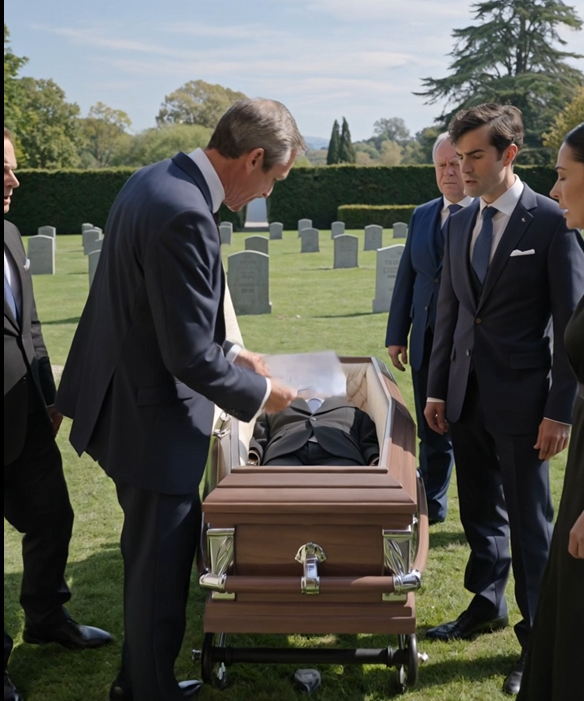
The slap came before the eulogies.
It cracked across the still cemetery air like a branch snapping underfoot, sharp and wrong against the sound of wind moving through the old oaks and the distant, mechanical hum of the lowering apparatus that no one had yet needed. The gathered mourners — sixty, perhaps seventy, in coats of dark wool and expressions calibrated to the particular performance of wealthy grief — turned in unison toward the sound.
Victor Ashworth-Crane’s palm was still raised. His brother Edmund stood beside the open coffin with one hand braced against the polished mahogany edge, the other pressed to his reddening cheek, and the look on his face was not one of pain or shock but of a man who had been expecting something like this for a very long time and was merely absorbing the specific form it had finally taken.
“You had no right,” Victor said. Low, clipped, the consonants of old boarding schools making even his rage sound like a reprimand. “None. Whatever you think you know — whatever arrangement you think—”
“Victor.” This from Caroline Whitmore-Ashworth, the widow, who had not looked up from the coffin. Her voice was the kind of quiet that commands. The kind that comes not from volume but from the specific density of a woman who has been the most composed person in every room for thirty years and intends to remain so even here, even now, even at the burial of her husband of twenty-six years. “Not today.”
Victor’s jaw worked. He lowered his hand.
Edmund straightened slowly, with the deliberate care of someone performing normalcy for an audience, and adjusted his tie with two fingers. He looked across the coffin at his sister-in-law. Something passed between them. Whatever it was, it was not condolence.
The officiant — a pallid man in a black suit two sizes too correct, the kind of correctness that announced itself — cleared his throat and returned to his prepared remarks with the studied professionalism of someone paid to be unflappable. The mourners reoriented. Coats settled. Expressions were recomposed and redeployed.
Caroline turned back to the coffin.
She had been standing at its edge for four minutes now, which those closest to her had taken for grief. She was not a woman who performed feeling; she was understood to process it internally, architecturally, building walls around pain and routing her days around them. So her stillness at the coffin’s edge read as devotion. As the particular, private communion of a widow saying the things she could not say in front of seventy people.
She leaned forward. Her gloved hand found the mahogany edge. She bent slightly — not kneeling, Caroline Whitmore-Ashworth did not kneel, not at sixty-two, not in Valentino — and she looked at the face of the man in the coffin with the focused, final attention of a woman memorizing something she would never see again.
She stayed like that for a long moment.
Then she went completely still. Different from before. This stillness was not composed. This was the stillness of a system encountering something it has no category for, a mind at the edge of a fact it cannot process and cannot set aside.
Her voice, when it came, was not loud. It was barely above speaking level. But it moved through the cemetery the way cold moves through a room — not filling it suddenly but finding every corner at once.
“This is not my husband.”
The officiant stopped mid-sentence. The silence that replaced his words was so total that the sound of a car on the road beyond the cemetery wall became briefly, absurdly audible.
Caroline straightened. She turned from the coffin and looked at the gathered mourners with an expression that no one present would be able to accurately describe afterward — not quite accusation, not quite fear, something more interior than either. The look of a woman who has just discovered that the map she has been navigating by was drawn of somewhere else entirely.
“This is not James.” Her voice was steadier now, which was somehow worse. “I don’t know who this man is. But I have been looking at my husband’s face for twenty-six years, and this is not his face.”
The funeral director — Hargreaves, sixties, with the smooth professional gravity of a man who had managed three generations of wealthy English funerals — materialized from the perimeter of the gathering with the particular velocity of someone whose entire professional life has just arrived at its worst-case scenario.
“Mrs. Whitmore-Ashworth.” He said her name the way you might say careful to someone near a cliff edge. “I understand this is an extraordinarily difficult—”
“I am not confused.” She said it without looking at him. “I am not in shock. I am not overcome with grief and misidentifying the man in front of me. I am telling you that the person in that coffin is not James Whitmore-Ashworth.”
The seventy mourners had ceased to be a gathering and become a single organism trying to understand whether to believe the widow or the funeral director, and finding no consensus.
Victor Ashworth-Crane had gone the color of old plaster. He was standing with both hands at his sides and his eyes moving — not to his brother, not to Caroline, but to a spot approximately two feet to the left of the coffin, which contained nothing visible. The specific nowhere of a man running calculations.
Edmund was watching Victor.
Hargreaves stepped closer to the coffin with the measured movements of a man defusing ordnance. He looked in. His expression performed a series of rapid changes that he was not quick enough to fully conceal — the first genuine, the second controlled, the third constructed entirely for the audience.
“I can assure you that all identifications were conducted in full accordance with—”
“Who identified him?” This from Philippa Crane, Caroline’s eldest daughter, who had separated herself from the cluster of family members and was now standing with her arms crossed in the posture of a woman who had suspected something was wrong for weeks and was experiencing the grim satisfaction of being right alongside the horror of what being right meant. “At the hospital. Who made the official identification?”
Hargreaves hesitated. Just briefly. But everyone saw it.
“Your uncle, as I understand it. Mr. Edmund Ashworth-Crane, acting in the family’s interest given that Mrs. Whitmore-Ashworth was—”
“I was sedated,” Caroline said, quietly. “Edmund insisted I be sedated.”
Edmund had not moved. He was still watching his brother, and his brother was still watching the empty air beside the coffin, and the mourners were watching all of it with the helpless, compelled attention of people who have arrived at a social event and discovered it is something else entirely.
It was Margaret Forsythe — eighty-one, James Whitmore-Ashworth’s aunt, a woman of such advanced age and established eccentricity that she said things others merely thought — who spoke next.
“The necklace,” she said, from her chair at the edge of the gathering, in the tone of someone finishing a sentence they began some time ago. “The one that was buried. Edmund will know about that.”
The temperature in the cemetery dropped two degrees that had nothing to do with weather.
“Aunt Margaret—” Victor began.
“Hush,” she said, without particular malice. “I am eighty-one and this is a funeral and I will say what I like.” She looked at Edmund across the open coffin. “James showed me what he found last spring. In the estate records. The necklace that shouldn’t have been there, that was listed under a name that wasn’t his, that had been moved through accounts that Edmund controlled.” She folded both hands over her bag. “He said he was going to address it at the quarterly meeting. He never reached the quarterly meeting.”
Edmund Ashworth-Crane looked at his aunt. Then he looked at Hargreaves. Then he looked at his brother, and something traveled between them that was not brotherhood — something older than that, and colder, the shared knowledge of people who have stood on the same wrong side of something and know they are now standing on it together and alone.
A sound came from somewhere in the family cluster. Not quite a cry. More like the noise a person makes when they’ve been holding something very heavy for a very long time and their grip finally gives. Philippa turned to find her cousin Robert — Edmund’s son, twenty-eight, who had always had his father’s eyes and, she had always suspected, his father’s capacity for willed blindness — on his knees on the stone pathway. Not theatrically. Not dramatically. His legs had simply stopped holding him, in the sudden way that legs stop holding people when the architecture of their life gives way beneath them.
Two people moved to help him. Two more stepped back.
This was the moment the gathering became what it actually was. Not the fracturing of a family in grief, but the fracturing of a family in exposure — the difference being that grief organizes itself around a center of loss while exposure organizes itself around nothing, each person spinning outward into their own particular calculation of damage.
Caroline walked back to the coffin. She stood before it with her hands at her sides and looked at the face of the man in it — this man she did not know, this man whose name she could not say because she did not know it, this man who had come to rest in the grave prepared for her husband and who might, in some sense she was not yet ready to think about, have been placed there as a kind of answer to a question James had been getting too close to asking.
“Where is he?” she said. Not to the gathering. Not even to Edmund, really. To the air. To the ground. To whatever part of the world had swallowed her husband and sent this substitute in his place. “Where is James?”
No one answered.
Hargreaves was on his phone now, turned away from the family with his shoulders raised and his voice inaudible, the body language of a man speaking to lawyers and trying to become temporarily invisible.
Victor Ashworth-Crane sat down heavily on a stone bench at the path’s edge and covered his face with both hands, and the mourners who moved away from him did so quietly, instinctively, the way people move away from something that has stopped being what they thought it was.
Edmund stood alone beside the open coffin of a man no one knew, in the cemetery of a family that was no longer a family in any sense that mattered, and he looked out across the polished stone pathways and the old oaks and the road beyond the wall, and his face showed nothing.
Which was, by then, the most frightening thing left in the cemetery.
The wind moved through the oaks. The lowering apparatus waited. The autumn light lay flat and cold across the headstones of people who had, at least, been buried under their own names.
