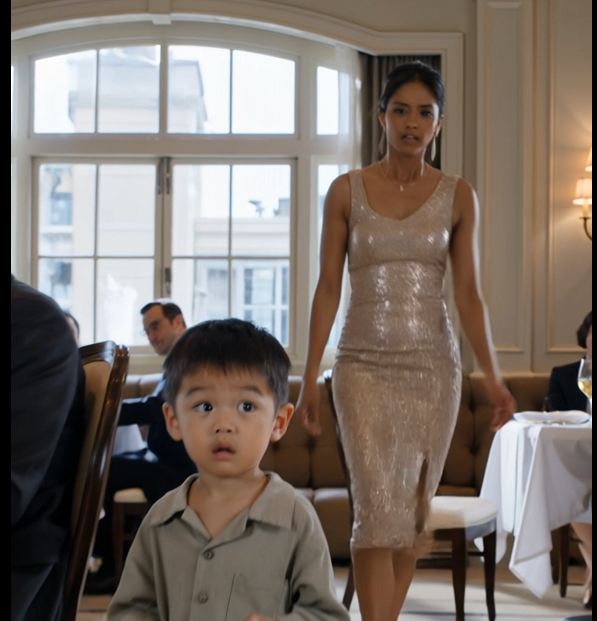
It had just been placed there—carefully, almost kindly at first. A small piece from a basket meant for the table, not for him. The boy had reached for it like someone who had learned not to expect permission. His fingers closed around it with a hesitation that came from experience, not fear.
And then the man’s hand moved.
Fast.
Clean.
A sharp, dismissive knock that didn’t feel like anger so much as correction. Like fixing something that didn’t belong in the frame.
The bread skidded across the marble floor, spinning once, twice, before coming to rest near a table leg. Too far for the boy to reach without crawling. Too public for him to try.
Silence didn’t follow immediately.
First came the sound.
A few short laughs from somewhere in the room.
Not loud. Not joyful.
The kind of laughter people use when they want to signal they understand the rules. When they want to prove they’re on the right side of whatever is happening.
“Don’t touch what you can’t pay for,” the man said.
He didn’t look at the boy when he said it.
He was already moving on.
Already deciding the moment was over.
But the moment wasn’t over.
Not for the boy.
He stood frozen.
Seven years old, maybe eight. It was hard to tell. Hunger didn’t just thin the body—it distorted time. Made age blur at the edges.
His hands stayed in the air for a second longer than they should have, still curved around nothing. Like they were waiting for instructions his mind hadn’t caught up to yet.
Then slowly, they lowered.
The boy didn’t cry.
Not because he wasn’t hurt.
Because he had already learned that crying didn’t change outcomes.
It only added interest to the pain.
The restaurant was the kind of place where silence had weight.
Polished marble floors reflected the soft glow of chandeliers above. Tables were spaced just far enough apart to suggest privacy, but not enough to forget you were being observed. Everything was intentional. Controlled. Expensive in a way that didn’t need to announce itself.
People here didn’t raise their voices.
They didn’t need to.
They were used to being heard without trying.
And the boy—
he was not part of that world.
He looked down at the bread on the floor.
Then up at the table.
Then at no one in particular.
“I’m hungry,” he said quietly.
It wasn’t a performance.
It wasn’t a tactic.
It was just true.
And truth, in rooms like this, is often treated like an interruption.
The man who had knocked the bread away leaned back slightly in his chair.
“Then go somewhere else,” he said.
Simple.
Efficient.
Final.
A few more laughs followed, softer this time. Not amusement—agreement. The kind of social reinforcement that keeps systems like this intact.
The boy didn’t move.
He didn’t know where “somewhere else” was.
That was the problem no one in the room cared to solve.
Then she stood up.
The chair scraped against marble, sharp enough to cut through the room’s careful balance.
Every head turned slightly—not fully, not dramatically. Just enough.
A disturbance had occurred.
She didn’t notice them.
Or didn’t care.
Her eyes were locked on the boy.
Not the man.
Not the bread.
The boy.
And something about the way she looked at him changed the air in the room.
She crossed slowly.
Not rushed.
Not hesitant.
Like someone walking toward a memory they had spent years avoiding.
She stopped a few feet away.
The boy looked up at her.
Uncertain.
Expecting punishment, maybe. Or more dismissal.
But she didn’t speak immediately.
Instead, she studied him.
Every detail.
The shape of his face.
The way his hair fell unevenly, like it hadn’t been cut in a long time.
The thinness in his arms.
The stillness in his posture—not calm, but conditioned.
Like a child who had learned to take up as little space as possible.
Her breath caught slightly.
And then she leaned in.
Just a little.
Close enough that it felt intimate in a way that made the room uncomfortable.
“Those eyes,” she whispered.
It wasn’t a question.
It wasn’t even directed at him anymore.
It was something she said to herself without meaning to let anyone hear it.
But they all heard it.
And something in the room shifted again.
Because now it wasn’t just about a boy being humiliated.
It was about recognition.
The man at the table frowned.
“Excuse me?” he said.
But she didn’t answer him.
She couldn’t.
Her attention was somewhere else entirely now.
Somewhere older.
Somewhere buried.
The boy shifted slightly under her gaze.
“Do I know you?” he asked quietly.
The question landed heavier than it should have.
Because children don’t ask that unless they’ve learned to expect disappointment from it.
She swallowed.
Her voice came out softer than before.
“What’s your name?”
He hesitated.
Names were dangerous things.
They made you findable.
“Daniel,” he said finally.
Something broke in her expression.
Not loudly.
Not dramatically.
But enough that her hand lifted slightly, then stopped halfway as if she had forgotten what she was going to do with it.
Behind her, the man stood up.
Now the tone had changed.
“Is there a problem?” he asked.
Still controlled.
Still assuming authority.
But something in him had started to tighten.
Because he could feel it too now.
The shift.
The way attention had moved away from him without permission.
She didn’t turn.
“Where did you get him?” she asked.
The question wasn’t directed at the boy.
It was aimed at the man.
That changed everything.
The room felt it.
The man scoffed slightly.
“What are you talking about?”
But his voice wasn’t as steady as before.
She finally turned to him.
And when she did, there was something in her face that no one at the table had ever seen before.
Not anger.
Not confusion.
Recognition sharpened into something dangerous.
“I said,” she repeated slowly, “where did you get him?”
A pause.
The kind that stretches just long enough to make everyone aware of their own breathing.
Then the boy spoke again.
“I just want food,” he said quietly.
And that simple sentence—repeated, unchanged—did something worse than escalate the moment.
It exposed it.
Because it revealed that nothing about this situation was new to him.
This wasn’t the first time.
The man looked at the boy again.
Really looked this time.
And something flickered in his expression.
Just for a second.
A hesitation.
A fracture in certainty.
“You’re mistaken,” he said finally.
But no one sounded convinced.
Not even him.
She stepped closer to the boy again.
This time slower.
Careful.
Like approaching something fragile.
“Turn your head,” she said gently.
The boy blinked.
Confused.
But he did it.
Slowly.
He turned slightly.
Just enough.
And then she saw it.
Just below his ear.
A faint scar.
Thin.
Old.
Barely visible.
But not to her.
Her hand covered her mouth immediately.
Not in shock.
In recognition.
The kind that arrives before thought.
The glass at the table behind her slipped from someone’s hand and shattered on the floor, but no one reacted to it.
No one cared.
Because the sound had already been replaced by something else.
Silence that meant everything had changed.
“No,” she whispered.
The boy turned back toward her.
“Did I do something wrong?” he asked again.
Same question.
Same tone.
And now it wasn’t just heartbreaking.
It was devastating.
Because it meant he had learned this pattern well enough to repeat it without fear.
She shook her head quickly.
“No,” she said. “No, you didn’t.”
Her voice cracked slightly.
The man stepped closer now.
“What is going on?” he demanded.
But even he sounded uncertain.
She didn’t answer him immediately.
She couldn’t.
Her eyes never left the boy.
“Where did you find him?” she asked again, quieter now.
The man exhaled sharply.
“This is ridiculous.”
But his anger didn’t carry weight anymore.
Because doubt had entered the room.
And doubt spreads faster than certainty ever does.
She knelt slightly so she was closer to the boy’s level.
Her voice softened.
“When were you born?” she asked.
The boy shrugged.
“I don’t know.”
That answer landed harder than anything else.
Because it meant no one had ever told him.
The man looked away briefly.
Just briefly.
But she saw it.
And that was enough.
Her voice dropped.
“Daniel,” she said again, carefully, like testing it, “do you remember anything before… this?”
The boy shook his head.
“No.”
Simple.
Clean.
Absolute.
And that was when it hit her fully.
Not as a suspicion anymore.
As certainty.
She stood slowly.
Her hand trembling slightly.
And when she looked at the man again, her voice was different.
“He’s ours,” she said.
The words didn’t explode.
They settled.
Heavy.
Unmovable.
The man froze.
For the first time.
Completely still.
“That’s impossible,” he said.
But he didn’t sound like he believed it.
She pointed at the scar.
“Tell me you don’t recognize that.”
He didn’t answer.
Because he did.
And that was the problem.
The boy stood in the middle of it all, confused, small, watching adults fracture around him without understanding why.
And the worst part was—
none of them had answers clean enough to give him.
The truth, when it finally arrived, didn’t feel like resolution.
It felt like consequence.
And in that expensive restaurant, surrounded by people who had spent their lives avoiding uncomfortable realities—
something long buried had finally come back into the light.
And it was looking directly at them.
