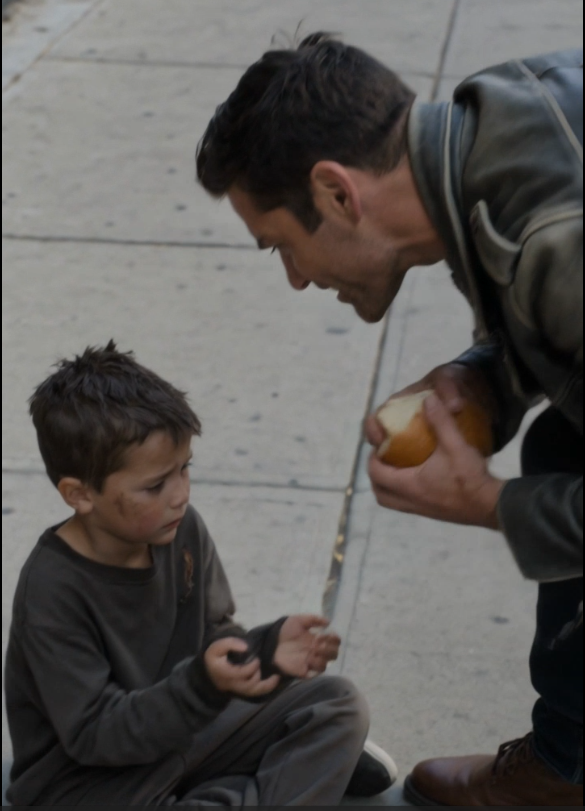
The August heat pressed down on 47th Street like a hand on the back of a neck. The kind of heat that made everything slower — the pigeons, the traffic, the thoughts.
Marcus was twelve years old and weighed maybe eighty pounds.
He danced on the sidewalk outside the corner store, because dancing was the only thing left. His sneakers — white once, gray now, held together at the toe with electrical tape — scraped against the concrete in a shuffling two-step he’d learned from a YouTube video in the library last winter. His arms moved like the air itself was too heavy to push through. A half-eaten granola bar wrapper sat near his feet, empty, already blowing away.
He’d been out here since seven in the morning. It was almost noon.
A man stopped watching from the shade of a bus shelter. Late thirties. Gold chain catching the sun. He had a Styrofoam cup of sweet tea in one hand and an expression on his face like someone watching a dog try to figure out a sliding door. Amused. Private. A little contemptuous.
He stepped closer.
“Hey.” The man’s voice was easy, unbothered. “Hey, little dude.”
Marcus stopped. Looked up. His eyes were too large for his face — all children in certain kinds of hunger look like that, the eyes taking over, the cheeks retreating.
“Yeah?”
“Dance again.” The man tilted his head. Not asking. Not exactly. The kind of tone that assumed the answer.
Marcus looked at him for a moment. The granola bar wrapper was gone now. The heat pressed down.
He danced again.
“Faster.”
The word landed flat. The man sipped his sweet tea. Smiled a little. Like this was something being given to him. Like this was entertainment rather than humiliation.
Marcus moved faster. His thin legs worked the pavement. His arms came up, went down. Sweat cut tracks through the dust on his face. He danced faster and his eyes were somewhere else — not on the man, not on the street, not here at all.
Nobody noticed the other man at first.
He was standing near the edge of the sidewalk, maybe fifteen feet away, in a slim charcoal suit that cost more than most people’s rent. He was younger than he looked from a distance — mid-forties, maybe — with the kind of face that had been tested by something and come back quiet. Not soft. Quiet. There’s a difference.
He’d been standing still for almost forty-five seconds, watching. His coffee was cooling in his hand, forgotten.
He wasn’t watching Marcus.
He was watching the other man’s face.
It happened quickly, the way these things always do — in the space between one heartbeat and the next.
The man in the gold chain laughed. Not loud. Not cruel, exactly. Just easy. Like this cost him nothing. Like Marcus was just a small moving thing in the landscape of his afternoon.
The suited man set his coffee down on a newspaper box. Carefully. With the deliberateness of someone who has decided something.
He walked forward.
Three steps.
The slap was not a small thing. It was a full turn of the shoulder, a commitment, a statement made in the currency of physics rather than language. The sound of it cut above the traffic. The man in the gold chain — bigger, thicker through the chest, a whole head taller — dropped. Not staggered. Dropped. Knees first, then sideways, like something structural had failed in him.
The sweet tea hit the sidewalk and spread.
Marcus stood completely still.
The suited man stood over the figure on the ground. His breathing was level. His suit jacket hadn’t even shifted.
“You think this is funny?”
His voice was quiet. Not raised. The kind of quiet that doesn’t need volume because the room — the street, the August air, the whole thick afternoon — had already gone silent around it.
The man on the ground rolled slowly onto his back. His cheek was already darkening. He blinked at the sky. His gold chain had twisted around to his shoulder.
Then — slowly, remarkably — he started laughing.
It was a thin, broken sound, but it was definitely laughter. He pressed one hand to the side of his face and looked up at the suited man and smiled with his teeth.
“You made a big mistake,” he said. His voice was still easy, still unhurried. As if the positions were not what they appeared to be. As if the floor was exactly where he’d intended to be.
The suited man looked at him for a long moment.
Then he looked at Marcus.
The boy hadn’t moved. He was still standing in his taped sneakers on the baking sidewalk, arms at his sides, watching with those too-large eyes. He didn’t look frightened. He looked like someone who had learned to wait and see — had been learning it for a long time.
The suited man reached into his jacket pocket and took out his wallet. He removed several bills without counting them and held them out to Marcus.
“Get something to eat,” he said. “Real food.”
Marcus took the money. His hands were steady. He folded the bills once and put them into his shorts pocket.
“Thank you,” he said. Quietly. Properly. Like he’d been taught by someone who wanted him to be treated with dignity even when the world wasn’t cooperating.
The suited man nodded once. A small motion. Acknowledgment.
From somewhere to the south, sirens. Faint, then less faint.
The suited man heard them. Something changed in his posture — not fear, exactly. More like a man who has accepted the weather.
He reached down and picked up his coffee from the newspaper box. Took a sip. It was cold. He drank it anyway.
At the end of the block, two dark SUVs appeared. Not police — too dark, too quiet, no lights. They moved slowly, the way vehicles move when they already know where they’re going and aren’t in any particular rush about it.
The man on the ground saw them too. He stopped laughing. He sat up. The easy expression had shifted into something more calculating, more watchful.
The suited man watched the SUVs for a moment. His jaw moved, barely. Something between a smile and a decision.
On the sidewalk behind him, Marcus had already started walking — heading toward the corner store, bills folded in his pocket, granola wrapper long gone, the afternoon opening up ahead of him like a door that had been, unexpectedly, unlocked.
The suited man didn’t turn around. He kept watching the SUVs approach.
The sirens grew louder.
He smirked. It was a small, private expression — the kind of expression that belongs to a man who has played longer games than this one, and lost fewer of them than most.
The first SUV slowed.
The door opened.
On 47th Street, the pigeons didn’t stop moving. The traffic didn’t stop moving. The heat pressed down, indifferent, on everything.
Marcus turned the corner and was gone.
