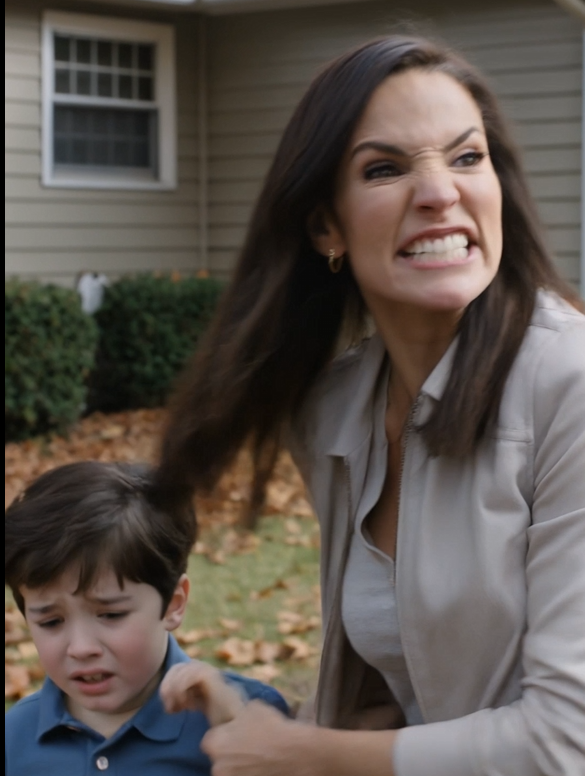
The yard was the kind that looked like a postcard in October—wide and flat, bordered by a split-rail fence that had been there longer than the marriage, longer than the boy, longer than most of the things that mattered anymore. Three oaks stood in a loose triangle near the back, and they had been generous this year, generous and indifferent, the way trees always are, dropping their cargo in slow drifts that had been accumulating since the first cold snap two weeks ago.
The pile was enormous. That was the first thing you noticed. It rose nearly to Caleb’s hip when he was standing, and Caleb was eleven years old and not particularly short. Someone had started it—maybe the wind, maybe an earlier, abandoned effort—and it sat in the middle of the yard like an accusation.
Caleb was not standing anymore.
He had been at it for an hour and fifteen minutes. Sandra had timed it, more or less, glancing through the kitchen window between tasks she had invented for herself, little projects that kept her near the glass. She had watched him drag the rake from the garage. She had watched him start at the far corner by the fence. She had watched his shoulders—thin, still boyish, not yet the shoulders of someone who understood what was expected of him—begin to curl inward around the forty-minute mark.
She had said nothing then. She was not cruel. She wanted to be understood as someone who was not cruel.
But when she came outside at the hour-fifteen mark and found him sitting in the leaves—not resting against the rake, not pausing to stretch, but sitting, his knees pulled to his chest and his face turned down—something in her jaw tightened in a way she had learned, over the past three years, to call standards.
“Get up,” she said.
He didn’t answer. That was when she heard it—a soft, ragged sound, barely audible over the wind lifting through the oaks.
He was crying.
Not performing. Not the theatrical sob of a child angling for release. This was the other kind, the kind that comes out sideways, through the nose and the back of the throat, the kind you hear from people who have been trying not to do it for a long time.
“Caleb.” She crossed the yard. The grass was still damp from the morning. “Caleb, get up right now.”
“I can’t.” His voice was hoarse. He pressed the heels of his hands against his eyes. “I can’t. It hurts.”
She reached down and closed her hand around his upper arm. She felt how thin it was. She pulled anyway.
“Pain,” she said, and her voice was not loud—she was aware, always, of the neighboring yards, of the Hendersons on the left, of the retired couple on the right whose name she could never remember—”is not an excuse.”
She got him to his feet. He was shaking. Not from cold. The afternoon was still warm for the season, that thick amber warmth of late October that feels borrowed, like it belongs to a different month. He was shaking from something else.
“You finish this yard,” she said. “All of it. Before your father gets home.”
He was sobbing now, standing, the rake loose in his other hand, his chest hitching in that irregular way that meant he was past the point of controlling it. His sneakers were dirty. There was a leaf caught in his hair, orange-red, the color of something that used to be alive.
“I hurt my wrist,” he said. “Yesterday. I didn’t want to—”
“I didn’t ask about your wrist.”
“It’s been hurting since—”
“Caleb.” She let go of his arm. She stepped back. She arranged her expression into something she thought of as firm but fair. “No one in this life is going to accommodate your excuses. That’s the lesson. You can be angry at me now. You’ll thank me later.”
He looked at her. Eleven years old. His eyes red, his face streaked, his wrist—she noticed now—held slightly away from his body, at an angle that looked involuntary, like the angle of a thing that had been protecting itself for some time.
He picked up the rake with his left hand.
He started pulling leaves.
She was back inside when she heard the car.
David’s Subaru made a specific sound pulling into the driveway, a low familiar crunch of gravel that she had, in the early years, found comforting. She moved to the kitchen window. She watched him get out.
He was unhurried. He was always unhurried in a way that she had once read as steadiness and now, more and more, read as something she did not have a clean word for. He wore his work clothes—gray slacks, a dark jacket, the loosened tie that meant a long day. He carried nothing but his keys.
He didn’t come inside.
She watched him stop at the edge of the yard. She watched him take in the scene: the enormous leaf pile, barely touched. The rake, moving slowly. The boy.
Caleb had not seen him yet.
Sandra went to the back door. She pushed it open and stepped onto the small wooden deck. “You’re home early,” she said, and smiled.
David said nothing. He was still watching Caleb.
After a moment, Caleb looked up. Something moved across his face—relief, she thought, and felt, for the first time, a small cold prick of something she would not name.
“Hey, bud,” David said. His voice was very calm.
“Dad.” Caleb’s voice broke on the word.
David walked toward him. Sandra came down from the deck and crossed the yard. She was composing something—an explanation, the reasonable version of the afternoon, the version that communicated intention and structure and love expressed through accountability.
David crouched in front of his son. He looked at the wrist. He touched it, gently, and Caleb flinched.
David stood up.
He turned and looked at the house.
He looked at the untouched gutters, the unswept porch, the garage door Sandra had been meaning to ask Caleb to clean for two weeks.
“Strange,” he said quietly.
She stopped walking.
“I told you,” he said. “When we talked in August.” He was not looking at her yet. He was still looking at the house, the yard, the enormous pile of leaves that his eleven-year-old son had been attempting to move with an injured wrist, alone, in the amber October afternoon. “I told you he was never to work. Not like this. Not alone. Not without asking me first.”
She laughed. It came out wrong—too quick, too high, the laugh of someone buying time. “David, it was just the yard. It needed to be done. I was teaching him—”
He turned then. He looked at her.
He reached into the pocket of his jacket.
She stopped laughing.
He pulled out a folded sheet of paper. Pale yellow, the color of legal documents, of official things. He held it at his side for a moment before he extended it toward her.
Her face—she felt it change. She felt it happen before she understood why, the body knowing before the mind does, the way it always does with the things that actually matter.
She took the paper.
She opened it.
The yard was very quiet. The oaks moved. A few last leaves came down.
Caleb stood with his rake and watched his father, who was watching his stepmother, who was reading something that was changing the shape of her face.
The afternoon light held them all in its amber, borrowed warmth.
And then it was gone.
Cut to black.
What follows darkness is always the same: the understanding of what the light contained.
The paper was dated six weeks earlier. David had not shown it to her then. He had carried it in various jacket pockets, transferring it each morning from one coat to another the way you carry something you’re not yet ready to use, a thing that exists in the category of when it becomes necessary.
It had become necessary.
The document was from Caleb’s pediatrician—Dr. Anita Reyes, who had been seeing Caleb since he was four, who had known his mother, who had written the report with a careful clinical precision that made its contents more devastating, not less.
Suspected stress fracture, distal radius, right wrist. Recommend imaging. Child reports pain onset approximately 7–10 days prior to examination. Child also reports sustained periods of physical labor at home, above and beyond what would be expected for his age and condition. Recommend family follow-up. Child appears tired.
Child appears tired.
Three words. The most ordinary words. The kind you could read past. The kind that, if you were paying attention, you could not.
David had not said anything to Sandra when he received it. He had thought about the right moment. He had thought about what he was building, whether the thing being built could hold, whether the materials were what he had believed they were.
He had reached his conclusion.
The paper. The pocket. The patience that she had always read as steadiness.
She was still holding it when the scene ended, the yard holding its silence around all three of them, the boy with his rake, the father with his stillness, the woman with her education.
Somewhere in the neighborhood, someone else was raking leaves.
It sounded, in the quiet, very far away.
