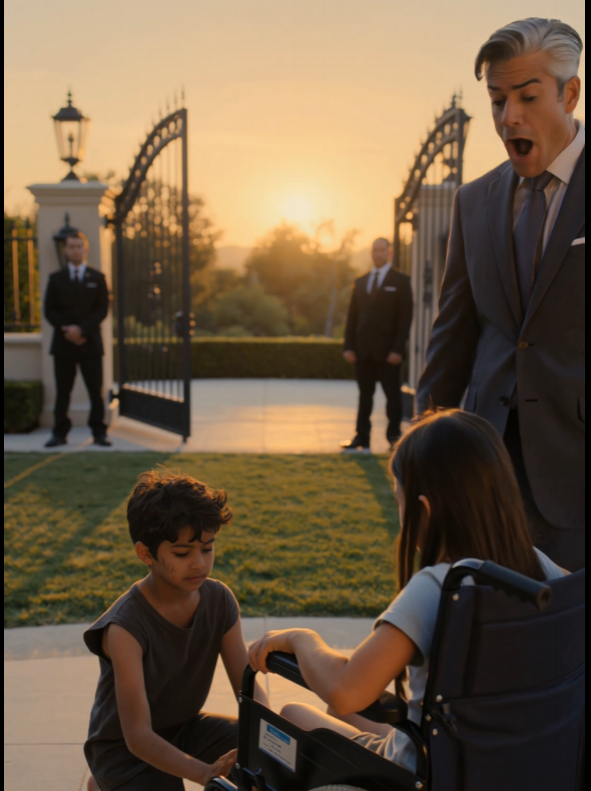
The sun was dying over Malibu.
It bled orange and gold across the Pacific, painting the sky in shades that only money could buy a view of—or so Richard Calloway had always believed. He stood at the edge of his travertine patio, hands clasped behind his back, watching the light fall across the infinity pool as it turned the water into hammered copper. Behind him, the mansion rose in clean, angular lines of glass and pale stone. Fourteen thousand square feet. Three years to build. A monument to the particular kind of success that doesn’t apologize for itself.
Beside him, in her wheelchair, sat Emma.
She was eight years old, with her mother’s dark eyes and his own stubborn jaw, and she was watching the sunset too, though in the distracted way of a child who has learned that beautiful things don’t necessarily belong to her. She’d been in the chair for two years—since the accident on the I-10 that took her mother and left Emma with a spinal contusion that three of the best neurosurgeons in Los Angeles had separately described using the same careful, devastating word: permanent.
Richard had not accepted that word. He had paid, instead, to fight it. Specialists in Zurich. A stem cell trial in Seoul. A rehabilitation center in Houston where Emma had spent four months relearning to use her hands. He had spent eleven million dollars in twenty-four months doing the thing that powerful men do when confronted with problems: he had thrown resources at it, relentlessly, without sentiment, the way you flood a burning building with water and watch the smoke keep rising anyway.
None of it had worked.
Tonight, he had brought her outside because the therapist had said fresh air was important, and because he was a man who followed instructions even when he’d stopped believing in the ones giving them.
He didn’t hear the gate open.
His security team—two men, ex-military, stationed at the perimeter—had apparently not heard it either, or had seen something that confused their training enough to leave them motionless. This was the first strange thing: that a ten-thousand-dollar gate, requiring a six-digit code and a biometric scan, opened at all.
The second strange thing was the boy who walked through it.
He was eight, maybe ten—it was difficult to tell, the way it’s difficult to tell with children who have lived outdoors long enough that weather has become a feature of their face. He was small, brown-skinned, with feet that were bare and blackened at the soles, and clothes that had started life as something ordinary—jeans, a gray t-shirt—and had since become a map of long distances traveled. He had no bag. No shoes. No expression that suggested he knew he was trespassing.
He walked the length of the stone path with the unhurried calm of someone arriving exactly on time.
Richard turned when he heard Emma shift in her wheelchair. She had gone very still—the particular stillness of a child who has noticed something the adults have not yet processed. Richard followed her gaze and saw the boy.
“Hey.” He stepped forward, planting himself between the child and his daughter. “Hey—who are you? Marcus!”
One of the security men startled to life, moving toward the intruder. But the boy didn’t flinch. He didn’t run. He looked past Richard’s shoulder at Emma with a focus that was not childlike—or rather, it was exactly what children have before adults train it out of them: complete, uncomplicated attention.
“I can help her walk again,” the boy said.
His voice was quiet. Not a whisper, but the kind of steady, low sentence that carries across a space without needing volume. Certain words are like that. They don’t need amplifying.
Richard stared at him.
He had heard many things in the past two years. He had heard promising results and cautious optimism and innovative approach from people with degrees covering entire walls. He had heard we’re not giving up from a surgeon in Geneva who charged forty thousand dollars for a consultation. He had heard God has a plan from his sister-in-law, which he had found so useless that he’d stopped returning her calls.
He had not been moved by any of it.
He was not moved now.
“That’s impossible,” he said, flatly, the way you close a door.
The boy walked forward.
Marcus moved to intercept him, and Richard raised a hand. He wasn’t sure why. Some flicker of something—not belief, he was certain of that—but something older and less rational that lived below the part of him that read quarterly reports and signed NDAs. He let the boy pass.
The child approached Emma slowly, the way you approach an animal that has been hurt before. Emma watched him come without pulling back, without the wariness that strangers usually produced in her now. She’d developed a talent for reading people’s intentions—the overcompensating brightness of the pitying, the practiced neutrality of the clinical. This boy had none of either.
He stopped in front of her chair.
For a moment he simply looked at her legs—at the way they rested, passive, as though they belonged to someone else—and Emma looked at him looking, and neither of them seemed troubled by the strangeness of this.
Then he crouched down, slowly, and placed both of his hands, open-palmed, on her knees.
The air on the patio changed. That’s the only way Richard would later be able to describe it—not to anyone else, because he never told this story to anyone else, but to himself, in the quiet of the room he still couldn’t bring himself to redecorate. The air changed, the way pressure changes before a storm, or the way a room feels different after something has shifted in it that you can’t name.
The boy’s eyes closed.
Richard’s first instinct was to say something sharp and adult—*that’s enough, what do you think you’re doing, this is—*but the word that would have followed this is didn’t come. Because he didn’t know what this was.
“Stand,” the boy said.
It was one syllable. Soft as a question, certain as a fact.
Silence.
The Pacific wind moved through the cypresses at the edge of the property. The pool light shimmered. Emma’s hands, resting in her lap, curled slightly at the fingers—and Richard saw it, the twitching, the involuntary small seizing of fingers that had no reason to seize—and something cracked open low in his chest, something he had sealed shut with eleven million dollars and two years of refusing to cry in front of his daughter.
He heard the music before he understood where it was coming from. It took him a moment to realize it was from the outdoor speakers—something he hadn’t turned on. Something no one had turned on. A piano, low and tentative, the kind of melody that doesn’t announce itself but simply appears, the way memory does.
Emma’s legs moved.
Not the involuntary tremor of muscle spasm—he knew that, had seen it, catalogued it grimly over months of physical therapy sessions. This was different. This was from inside. A slow, difficult, determined shaking, the way something long-dormant tests its own edges before committing.
“Emma—” He couldn’t get further than her name.
She looked up at him, and there was something in her face he hadn’t seen in two years: not hope exactly, but something preceding hope—the possibility of hope, the moment before the coin lands. She gripped the arms of the chair.
Her left foot came flat to the ground.
Then her right.
She pushed.
Richard took a step toward her, then stopped, because he understood with some animal part of himself that what was happening required him to not intervene, that it belonged entirely to her, that the only thing he could do was witness it. His hands were shaking. He hadn’t noticed when they’d started.
She rose.
Slowly. Trembling. Her legs were thin from disuse, unsteady as a new foal’s, and she swayed dangerously when she reached full height, but she was full height—she was standing, actually standing, weight distributed on both feet, on the travertine of his patio with the Pacific sunset at her back.
Richard Calloway, who had not wept in two years, who had transformed his grief into a corporation and his fear into financial instruments, who had paid for fighting because fighting was the only language he had left—that man stumbled backward and hit the half-wall at the edge of the patio and slid down it until he was sitting on the ground, looking up at his daughter, standing, breathing.
The music swelled.
Emma was laughing. Not the polite laugh she’d used for two years when adults made jokes she could tell they needed her to appreciate—real laughing, the helpless, surprised kind, as though joy had arrived suddenly and with force and she hadn’t braced for it.
The boy stood to one side.
He was watching Richard.
Not Emma. Not the sunset. Not the spectacle of his own apparent miracle. He was watching Richard with eyes that were still and old and held absolutely nothing that looked like wonder—because he had known this would happen. He had known it the way you know a thing that is simply true, the way you know the sun is going to come up.
Richard looked at him.
“How,” he started.
The boy looked back at him without blinking, without smiling, without any of the expressions you expect from an eight-year-old standing in a stranger’s backyard.
“Now you owe me,” the boy said.
Not threatening. Not triumphant. The way you state the terms of an agreement that both parties already understand.
The patio was quiet except for Emma’s breathing and the low piano still threading through the speakers. The sun had touched the horizon. In sixty seconds it would be gone.
Richard looked at his daughter—standing, still shaking slightly, her hand now resting on the arm of the empty wheelchair as though she couldn’t quite believe it was behind her now—and then he looked at the boy.
He had spent two years buying solutions.
He understood, for the first time in those two years, that he was standing inside a transaction he hadn’t negotiated, in a currency he didn’t yet know the name of, and that whatever came next was going to cost him something that eleven million dollars wouldn’t cover.
“Okay,” Richard said.
The boy held his gaze for a moment longer—measuring something, or perhaps simply giving him time to understand the weight of the word he’d just spoken.
Then he turned, and walked back up the stone path, bare feet silent on the travertine, through the open gate.
The gate closed behind him without a sound.
Emma took her first step.
The sun went down.
