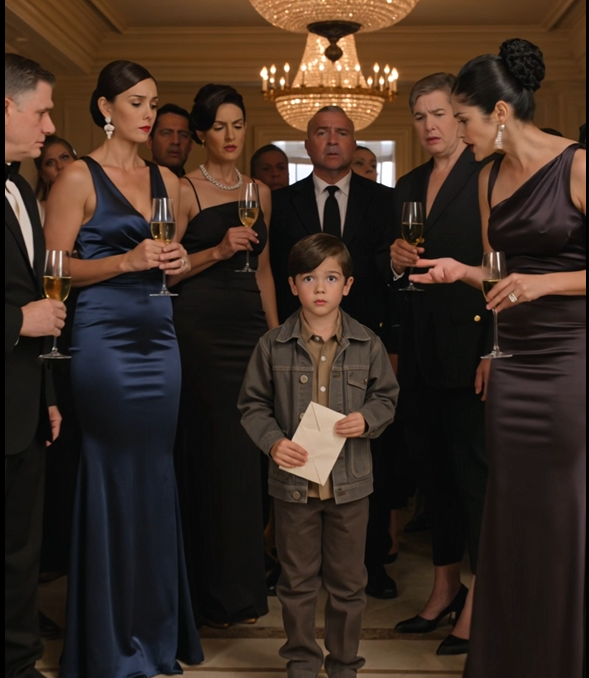
The Whitmore Grand Hotel’s ballroom had not changed much in forty years. The chandeliers still dripped crystal like frozen rain, the marble floors still swallowed sound into their cold perfection, and the waitstaff still moved with that practiced invisibility that wealthy people have always required of those who serve them.
Tonight was the Hartwell Foundation Gala — the most anticipated charity event in Boston’s social calendar. Eight hundred dollars a plate. Silent auction items beginning at fifteen thousand. The guest list was the usual architecture of ambition: senators, surgeons, hedge fund managers, tech founders who had discovered philanthropy around the same time their PR teams suggested it. Women in gowns that cost more than some people’s cars. Men wearing watches that could have paid a year’s rent on a decent apartment.
The theme was Hope for Tomorrow. The centerpiece was a Steinway Model D grand piano, polished to a mirror finish, positioned stage-left beneath a warm amber spotlight, where a string quartet had been playing soft Vivaldi for the past hour.
Richard Calloway stood near the bar, nursing a Scotch that cost more than he liked to admit, nodding at the right moments in a conversation about municipal tax incentives. He was sixty-three, broad-shouldered, silver-haired in the way that photographed well for magazine profiles. He had built Calloway Capital from a two-man office in 1989 into one of the most respected private equity firms in New England. His foundation bore his name. His name was on a wing of Children’s Hospital. His name was on a scholarship fund that sent forty kids to college every year.
He was, by every visible measure, a good man.
He had not thought about Maria Reyes in eleven years.
The sound cut through everything.
Not music — something harder. A chair leg scraping across marble. A small, sharp collision of metal and silence that made conversations stutter and heads turn.
The boy was standing near the piano.
He was small — maybe six, maybe eight, the kind of age that’s hard to pin down when a child is underfed and wearing clothes clearly chosen for a much larger person. His sneakers were muddy at the toes. His jacket was adult-sized, cinched at the waist with what appeared to be a canvas belt. His hair needed cutting. His eyes were enormous and absolutely still — not frightened, not defiant. Just present. Watching.
The room didn’t freeze all at once. It went still in waves, table by table, conversation by conversation, like a fire being smothered from the edges.
“Hey — what is he doing here?” A voice from somewhere behind the piano. Male. Sharp.
The boy didn’t look toward the voice. He looked at the piano.
Security was already moving — two men in black suits threading through the crowd with practiced efficiency. A woman in a gold dress near the center of the room pressed her hand to her chest and exchanged a look with her husband. Near the bar, a waiter paused mid-pour.
The boy reached out one hand and pressed a single key.
Middle C, probably. It was hard to tell from across the room. The note that came out was soft and slightly off — not because the piano was out of tune, but because the key was pressed too gently, too uncertainly, by a child who had perhaps never touched one before. The sound hung in the air like a question.
Nobody moved.
Then the boy said, quietly — so quietly that people later disagreed about whether they had heard it or simply felt it:
“My mom used to clean this room… after nights like this.”
Richard heard it.
He put down his Scotch.
The hedge fund manager beside him was still talking — something about deferred tax liability — but Richard wasn’t listening anymore. He was looking at the boy’s hands, which he could see now from where he stood, resting on the piano keys. Small hands. Brown skin. A thin scar along the back of the left one, crescent-shaped, the kind of mark a child gets from a fall on concrete.
Maria’s son.
He remembered her, of course. He had always remembered her. He simply had not allowed himself to think about her, which is a different thing entirely.
Maria Reyes had cleaned his offices for six years — the Calloway Capital offices on the 34th floor of 100 High Street, every Tuesday and Thursday night from 9 PM to 1 AM. He had met her properly only twice. Once when she left a scarf she’d found, folded on his desk, and he’d come in late and found her still there, embarrassed to be seen. Once when he’d stayed through the night before a major deal closed and she’d offered him a cup of coffee from her thermos because the building café was locked.
They’d talked that night. For almost an hour. He’d learned she had a son — small then, maybe three — and that she was saving money to get her EMT certification, that she’d been a nurse’s aide in Guatemala before coming here, that she knew things about cardiac care that impressed him enough to mention them to his own cardiologist as a joke. He’d laughed. She’d laughed.
When he left at six in the morning, he’d said, I’ll put in a word. I know someone on the hospital board. We can figure something out.
He had meant it.
He had also had a deal to close, a board meeting to prepare for, a wife’s birthday to plan, a son’s college application to review. He had meant it the way people mean things when they say them at 6 AM on no sleep — genuinely, briefly, and then less and less until the meaning wore thin and fell away without anyone noticing.
He had never called. He had never followed up. He had forgotten.
And Maria Reyes — he learned later, much later, from a building manager’s offhand comment — had stopped working there about a year after. Just stopped showing up. He’d never asked why.
The security guards reached the boy at the same time a woman in a red dress stepped forward and said, sharply, “Wait.”
Her name was Dr. Patricia Osei. She was the chief pediatric cardiologist at Boston Children’s and had been on the Hartwell Foundation board for nine years. She held up one hand, palm flat, in the direction of the guards with the quiet authority of someone who had spent decades making decisions in rooms where people’s lives depended on speed and clarity.
The guards stopped.
Dr. Osei crouched down in front of the boy. She was wearing heels worth more than the boy’s entire wardrobe. She didn’t seem to notice.
“What’s your name?” she asked.
“Marco,” the boy said.
“Marco.” She nodded slowly. “How did you get in here, Marco?”
“Through the kitchen,” he said. “The door by the parking lot. It was open.”
“Okay.” She didn’t look toward the guards. “Who are you looking for?”
The boy’s eyes moved across the room. They moved slowly, deliberately, like he had memorized a description — a height, a face, a way of standing — and was now checking each person against it. His gaze traveled past the bar, past the tables, past the knots of people who were all watching him now with the stunned, uncomfortable attention of people who have been confronted with something they would have preferred not to see.
His eyes stopped.
He looked directly at Richard Calloway.
“She said someone here promised to help us,” Marco said. His voice was still quiet. Still even. There was no accusation in it — which somehow made it worse. “She said he was important. That he had a good face. That she trusted him.”
The room was completely silent now. Even the waitstaff had stopped. The string quartet had lowered their instruments without being asked.
Richard Calloway was walking forward before he fully decided to.
The crowd parted for him the way crowds always parted for Richard Calloway — out of habit, out of the social gravity that money and bearing create over decades. He stopped a few feet away from the boy and crouched down, the way Dr. Osei had, his expensive suit making contact with the cold marble floor without any apparent concern.
He looked at Marco.
He saw Maria’s eyes. Unmistakably. The same stillness in them.
“Your mother,” Richard said. His voice came out lower than he intended. “Her name was Maria.”
It wasn’t a question.
Marco said nothing. He just kept looking at Richard with those enormous, steady eyes that had seen too much for his age and were not going to look away.
“You remember her… don’t you?”
What happened next was not the ending anyone would have written.
There was no dramatic speech. Richard Calloway did not weep, though his eyes went bright and he looked away for a moment toward the chandelier in a way that several people later described as a man fighting with himself.
He asked Marco where he was staying. Marco told him: a shelter in Dorchester, with his grandmother, since his mother had gotten sick — really sick, the kind of sick that meant she couldn’t work — eight months ago. Some kind of heart thing. She was on a waiting list for a procedure she couldn’t afford.
Dr. Osei, still crouching beside them, heard the words heart and waiting list and took out her phone.
Richard Calloway called his assistant at 9:47 PM and said four words — cancel everything tomorrow morning — and then turned back to the boy.
The gala continued around them. The string quartet started playing again. Waiters resumed their careful circuits. But near the piano, in a small island of quiet, a man who had spent eleven years not thinking about a promise he’d made sat on the cold marble floor of the Whitmore Grand Hotel’s ballroom and talked to a small boy in an oversized jacket until the boy’s grandmother arrived at midnight, alarmed and exhausted and then, slowly, not.
The procedure Maria Reyes needed was scheduled three weeks later. Richard Calloway paid for it. He did not announce this. He did not call his PR team. He asked Dr. Osei to handle the details and she did.
Marco’s grandmother, when she found out, said: Too late is still something.
Richard repeated that to himself for a long time afterward. He had it written somewhere, eventually, in his own handwriting, on a card he kept in his desk drawer beside the photographs of the buildings and schools and scholarships that bore his name.
Too late is still something.
It wasn’t absolution. It wasn’t enough. But it was the beginning of being honest with himself about the distance between the man he funded and the man he actually was — and how much work remained in that gap, and how long he had left to do it.
The Steinway stood in the spotlight long after everyone had gone home.
Middle C still hung in the air, somehow.
Or maybe that was just memory, which is its own kind of music — inexact, persistent, impossible to silence once a small hand has pressed the key.
End.
