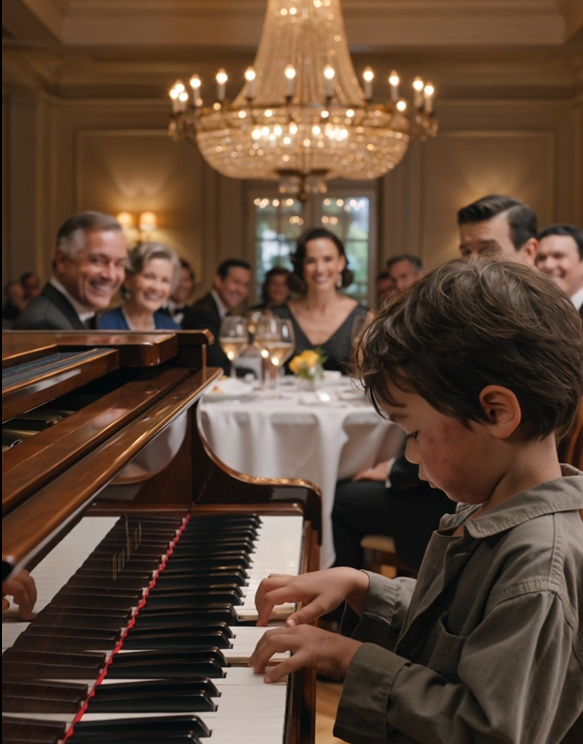
That’s how you got a table at Aurelius — Manhattan’s most quietly powerful restaurant, tucked between a private bank and a gallery that sold paintings for the price of houses. You didn’t find Aurelius on an app. Someone told you about it, once, in a low voice, the way people used to share secrets before the internet made secrets impossible. The maître d’ wore a watch that cost more than most people’s cars. The menu had no prices. If you needed to ask, the thinking went, you had already answered your own question.
It was a Thursday in November, which was the best night to be there — the weekend crowd brought too much performance, too much looking-around to see who else had arrived. Thursday was for people who came to eat, and to talk, and to feel, briefly, that the city outside with its noise and hunger and cold did not exist.
The chandelier above the main dining room was the kind of thing that stopped conversations. It hung low over the center of the room — a cascade of hand-blown amber glass, a hundred suspended teardrops each catching the candlelight from the tables below and throwing it back warmer, softer, golden. At full dinner service, when every table was occupied and every voice was layered over every other voice and the sommelier was moving between tables with practiced silence, the chandelier turned the whole room into something that resembled the inside of a cathedral. Sacred. Self-contained. Separate from the world.
Margaret Chen had eaten here eleven times. She kept count the way some people kept count of countries visited — not out of vanity, but because each visit had meant something. Her late husband had proposed to her at the corner table by the window. She had signed her first major acquisition here, a Basquiat that now hung in the lobby of her foundation. She had come here alone the night her father died, ordered his favorite wine, and sat with it for two hours without drinking it. The sommelier had said nothing. That was the other thing about Aurelius — it understood when not to speak.
Tonight was her sixty-eighth birthday. Her daughter had organized it — a long table, nine guests, laughter already built up like pressure in a pipe before the first course arrived. Margaret wore gray silk and her mother’s earrings. She felt, if she was honest, tired. Not unhappy — just the particular fatigue that comes from being celebrated when celebration requires performance. She smiled when she was supposed to smile. She laughed a half-beat after everyone else laughed, checking first that it was worth it.
The Steinway sat in the far corner of the room the way a Steinway always does in rooms like these — enormous, slightly apart, present but unchosen, like a person at a party who is too serious to be approachable. Aurelius occasionally brought in a pianist on weekends. Tonight was not the weekend. The piano was supposed to be furniture.
Margaret was mid-sentence — something about the new gallery opening in Tribeca, something polite, something she had said before in different words — when the burst of laughter came from the table nearest the piano.
It was the kind of laughter that had teeth in it.
She turned, as everyone turned.
The boy was small. Maybe six, maybe seven — it was hard to tell because he was the kind of child whose age was harder to read than his situation, which was immediately and completely legible. His jacket was too big for him by at least two sizes, the shoulders drooping, the sleeves swallowing his wrists. His face had the particular quality of a child who had been outside in the cold for a long time and had only recently come in. His hair needed cutting. His shoes were wrong for the weather.
He had slipped in — no one could agree later on how, exactly, which entrance, which moment of distraction — and he was sitting at the Steinway with the posture of someone who had sat at one before.
He looked at the nearest table. The men in their suits, the women with their jewelry catching the chandelier light, all of them registered him as something between amusing and alarming, which was enough to produce the laughter Margaret had heard.
The boy said, quietly, into the laughing room:
“Can I play for food?”
The laughter continued. It takes a moment for a room to process a question it hasn’t been asked before.
Margaret set down her wine glass.
The boy turned back to the piano. He didn’t wait for an answer. Or perhaps the laughter was answer enough — he had been told no in louder and clearer ways than this, and had learned that the only argument worth making was music.
His hands found the keys.
The room didn’t stop immediately. Sound takes time to surrender. But the first note was so unexpected — not in pitch but in weight, in the specific gravity of something earned rather than practiced — that the conversation nearest the piano stuttered and collapsed, and then the silence spread outward like a stone dropped in still water, table by table, until the only sound in Aurelius was the chandelier’s faint breath and what the boy was playing.
It was a melody in the lower register, unhurried, each note given its full duration before the next arrived. There was nothing showy about it. It wasn’t the kind of thing a prodigy plays to prove he’s a prodigy — all speed and flourish, music as athletic event. This was something else. This was music that seemed to come from a decision to tell the truth.
Margaret heard the first phrase and her hand closed around nothing.
She knew the piece.
Knew it the way you know a voice before you see the face — the body-knowledge, the recognition that lives below thought. The melody rose slightly in the second phrase, reaching for a resolution it didn’t quite find, turning instead into something that felt like a question held open. It was incomplete. It had always been incomplete.
Because her father had never finished it.
Daniel Chen had been, in the language the newspapers used when they finally wrote about him, a gifted amateur pianist and composer. The language was technically accurate and completely wrong. He was a man who had played piano the way some people breathe — not for performance, not for approval, but because not playing would have required more explanation than playing. He had composed, in the last years of his life, a single piece he never named. He played it for Margaret when she was a child, different each time, never quite the same, never quite done. After his death she had found a single sheet of notation in his desk drawer. The first page. The second page, if there was one, was gone.
She had assumed, for thirty years, that she was the only person who carried those first few bars inside her.
She stood up.
The room was watching her now instead of the boy, because the room had seen her face change and understood that something was happening beyond what was visible.
She walked across the restaurant. The maître d’ took one step toward her and then stopped, reading her correctly, standing down. Her heels on the marble floor were the loudest sound in the room until she reached the carpet near the piano and her footsteps disappeared.
The boy was still playing. He hadn’t looked up. His eyes were half-closed and his expression was the expression of someone who is not in a room at all.
Margaret stood beside the piano.
He finished the phrase — the same phrase her father had always ended on, the unresolved turn, the open question — and stopped.
The silence in Aurelius was total.
Margaret looked at the boy. He looked at her. He was waiting for the verdict: food, or out the door.
Her voice, when she found it, was barely above a breath.
“That,” she said, “was my father’s unfinished piece.”
The boy held her gaze. He didn’t look surprised. He looked, instead, like someone who had learned very young that music travels in ways that can’t be explained and has stopped trying to explain it.
The room held its breath.
Margaret sat down beside him on the piano bench. It had been forty years since she had sat at a Steinway, maybe longer. Her hands knew what to do before her mind gave permission. She found the unresolved phrase. She played it.
And then, slowly, tentatively, she played what came after. What she had always imagined might come after, in the years of carrying those few bars around inside her like a message in a language she could almost read.
The boy listened. Then he played the phrase again, her version this time, and continued it differently — further, somewhere new — and Margaret heard her father in it, and also something that was not her father, something that was whoever this child was, whoever he had learned it from, wherever it had traveled in the years since Daniel Chen had written it on a piece of paper and left it incomplete in a desk drawer.
They played for twenty minutes. Later, no one could say where the piece ended and something else began. The kitchen sent out food without being asked. The maître d’ stood at his station with his hands folded and his eyes bright. The guests who had laughed at the boy sat very still.
The chandelier burned gold above them.
The piece, after thirty years, was finding its way to finished.
