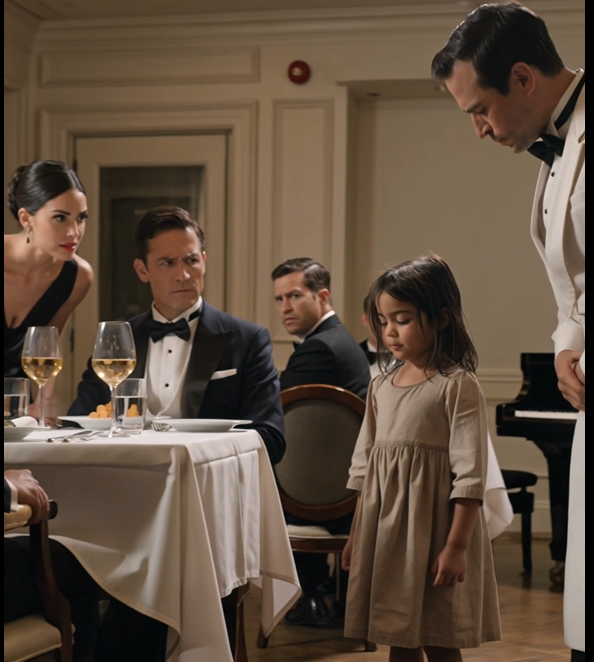
The glass didn’t just fall — it rolled, slow and deliberate, as if something invisible had nudged it. It reached the edge of the polished table, hesitated for half a second, then dropped. The shatter cut through the low hum of conversation like a gunshot.
Every head in the private dining room turned.
The girl didn’t.
She stood there, small and still, no more than eight, clutching a neatly folded napkin in both hands. Her dress was simple, slightly wrinkled, like she had slept in it. Her hair wasn’t messy, but it wasn’t cared for either. It was the kind of in-between that made people uncomfortable — not quite neglected, not quite normal.
“Is this a joke?” the man at the head of the table snapped.
His voice carried the kind of authority that usually ended situations instantly. Conversations died around him. Waiters froze. Even the pianist in the corner missed a note.
But the girl didn’t flinch.
She stepped forward and placed the folded napkin carefully on the table, just to the right of his untouched wine glass.
Up close, people noticed her hands.
Small. Pale. Slightly trembling — but not from fear.
From restraint.
“My mom wrote this,” she said quietly. “Before she stopped coming home.”
The words didn’t land all at once. They settled, like dust in sunlight, slow and unsettling.
A woman seated two chairs down inhaled sharply. Another man leaned forward, curiosity cutting through irritation. Someone near the back muttered something under their breath — something about security, about how this shouldn’t be happening.
But no one moved.
Because the girl didn’t look lost.
She looked like she knew exactly where she was.
And exactly who she was talking to.
The man at the head of the table didn’t touch the napkin.
Not yet.
Instead, he studied her, eyes narrowing slightly. He was used to control — to variables, to leverage, to outcomes he could predict. This… wasn’t predictable.
“Where is your mother?” he asked.
The girl tilted her head, just a fraction.
“I told you,” she said. “She stopped coming home.”
There was no emotion in her voice. No crack, no tremble.
That made it worse.
Someone behind the man shifted in their chair. Another guest reached for their phone, then thought better of it. The tension in the room wasn’t loud — it was tight, coiled, like something waiting to snap.
“Who let you in here?” a different man demanded, louder now, trying to regain control of the situation.
No answer.
Because the question didn’t matter.
The napkin did.
The man at the head of the table finally reached for it.
He didn’t rush. He unfolded it slowly, methodically, like he expected something inside to bite him if he moved too fast.
The fabric was expensive. Crisp. Clean.
Except for the faint writing pressed into it — not ink, not quite visible unless the light hit it right. Indentations. Words written hard enough to leave a mark.
He angled it toward the chandelier.
And read.
At first, nothing changed.
Then his jaw tightened.
Just slightly.
It was the kind of reaction most people would miss — but not everyone.
The girl noticed.
“She said only one person would understand it,” the girl said.
A murmur rippled through the table.
“What does it say?” the woman who had gasped earlier asked, her voice lower now, cautious.
The man didn’t answer.
He read it again.
Slower this time.
As if hoping the words would rearrange themselves into something harmless.
They didn’t.
“What does it say?” the second man pressed, leaning closer now.
Still nothing.
The man folded the napkin once. Then again. Precise. Controlled.
Too controlled.
And that’s when the girl spoke again.
“Why are you the only one not surprised?”
The question didn’t sound accusatory.
It sounded… curious.
Genuine.
Like she was trying to solve a puzzle.
The room went still.
Because now everyone was looking at him.
Not the girl.
Him.
“I don’t know what you’re talking about,” he said, finally.
But the authority in his voice had shifted. It was still there — but thinner now. Less certain.
The girl watched him for a long second.
Then she took a step closer.
Not enough to threaten.
Just enough to remove distance.
“My mom said you’d say that,” she replied.
A quiet ripple of unease moved through the guests.
“Who is your mother?” the woman asked, softer this time.
The girl didn’t look at her.
“She told me not to say her name out loud,” the girl said. “She said it would make people nervous.”
A few people shifted again. A glass clinked somewhere in the background. The pianist had stopped playing entirely now.
“And?” the man asked, forcing a small, tight smile. “Are we supposed to be nervous?”
The girl considered that.
Then she shrugged, just slightly.
“She said I should wait,” she answered. “Watch who reacts first.”
Silence.
Heavy. Immediate.
Because now everyone realized they had already reacted.
Too late to take it back.
The man at the head of the table set the napkin down carefully.
“Security,” he said, without raising his voice. “Please escort—”
“No.”
The word didn’t come from the girl.
It came from the man seated across from him — the one who had leaned forward earlier.
Everyone turned.
“You should let her finish,” he said.
His tone wasn’t loud, but it carried weight.
Different weight.
Not authority — influence.
The kind you don’t question unless you’re sure you can win.
The first man’s eyes flicked to him, irritation flashing for a split second.
“This is not—”
“She came here for a reason,” the second man interrupted. “Didn’t you?”
Now the girl looked at him.
And for the first time, something shifted in her expression.
Recognition.
Not of his face.
Of his tone.
“Yes,” she said.
The room leaned in without meaning to.
The girl reached into the small pocket of her dress and pulled out something else.
A folded piece of paper this time.
Older. Creased. Handled too many times.
She placed it next to the napkin.
“My mom said if the note wasn’t enough,” she said, “this would be.”
No one spoke.
The first man didn’t move.
But the second one did.
He reached for the paper slowly, unfolding it with a care that bordered on reverence.
His eyes scanned the contents.
And unlike the first man—
He didn’t hide his reaction.
A sharp inhale.
A flicker of something raw.
Fear.
“Where did you get this?” he asked.
The girl didn’t answer right away.
Instead, she looked back at the first man.
Waiting.
Measuring.
Then she spoke.
“She left it in a place she said only someone who remembered would find it,” the girl said.
The second man swallowed.
Hard.
“That’s not possible,” he murmured.
But it didn’t sound like disbelief.
It sounded like hope.
The wrong kind.
The first man stood abruptly, his chair scraping loudly against the marble floor.
“That’s enough,” he said, sharper now. “This is over.”
But it wasn’t.
Because the room had already changed.
The balance had shifted — subtly, but completely.
People weren’t looking to him anymore.
They were looking at the paper.
At the girl.
At each other.
“What does it say?” someone asked again.
This time, louder.
More urgent.
The second man hesitated.
Then, slowly, he turned the paper so the others could see.
Not all the words.
Just enough.
Just enough for recognition to spread like a crack through glass.
A name.
A date.
A location.
And something else.
Something that made one of the women cover her mouth.
“That’s…” she whispered.
“Yes,” the second man said quietly.
“It is.”
The girl watched them all.
Calm. Still. Patient.
Exactly like her mother had told her to be.
“Now can I say her name?” the girl asked.
No one answered.
No one wanted to.
Because they all understood now.
The name wasn’t the danger.
The truth behind it was.
And the moment it was spoken—
Everything would change.
The girl took a small breath.
And smiled.
Just a little.
Not because she was happy.
But because she finally understood what her mother meant.
About silence.
About fear.
About the kind of people who only panic when the past refuses to stay buried.
She looked directly at the man at the head of the table.
And began to speak.
