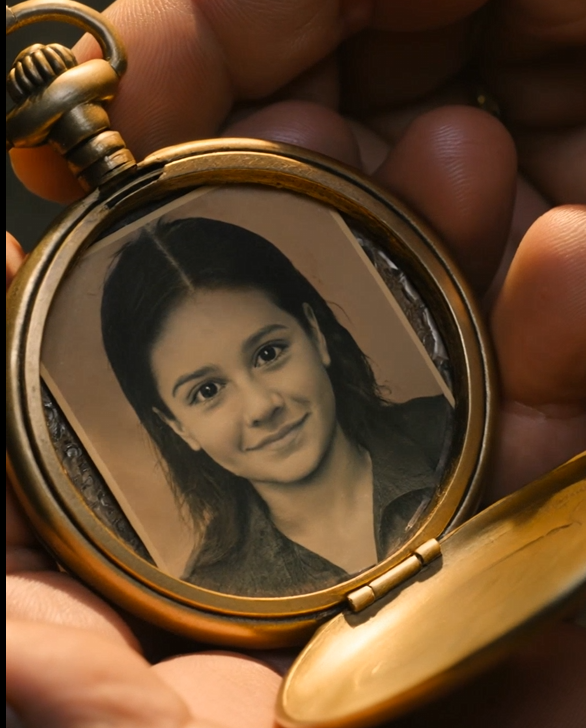
The boy’s fingers would not stop shaking.
He could feel it — the tremor running from his wrist all the way up to his shoulder, like a current through a wire pulled too tight — and still he made himself step forward, reach across the glass counter, and set the watch down. The clink it made rang out sharp and strange, too loud for a room this size, bouncing off the low ceiling and the glass cases and the rows of silent clocks on the wall, all of them watching, all of them ticking, none of them caring.
He pulled his hand back. Stood up straight. Tried to look like someone who did this kind of thing.
He had never done anything like this in his life.
He had walked past Harlan’s Fine Timepieces maybe two hundred times. It sat on the ground floor of a narrow brick building on Columbus Avenue, wedged between a laundromat and a cell phone repair shop, its window dressed with velvet and small spotlights that made the watches inside glow like they were lit from within. The sign above the door was hand-painted, gold letters on black: Harlan’s Fine Timepieces, Est. 1971. The kind of sign that did not need to shout.
He had never gone inside. Boys from his block did not go inside places like that. Not because anyone had told them not to — it was just understood, the way a lot of things were understood, quietly and without discussion.
But this morning his mother had called him to her bedside. She was propped up on two pillows, and the cough had been bad through the night, and her face had the gray, used-up look it got when the pain was high and the medication was gone. She had reached under the mattress — he had not known she kept anything under the mattress — and she had pressed the watch into his hand and folded his fingers around it.
Sell it, she had whispered. Her lips had barely moved. It’ll be enough.
He had started to ask where it came from. She had closed her eyes.
So here he was.
The door creaked shut behind him. The street noise dropped away so completely it was almost surgical — one moment, Columbus Avenue, buses and voices and someone’s music from a passing car; the next, a quiet so thick it had texture. Dust turned slowly in shafts of amber light coming through the old window glass. The air smelled of machine oil and brass and something older underneath, something he didn’t have a word for, the smell of time itself maybe, of decades accumulating in a small room.
He stood in the middle of it and waited.
The man behind the counter did not hurry. He was adjusting something beneath the glass — a small tool, some mechanism — and he finished what he was doing before he looked up. When he did, his eyes were calm and dark and took the boy in completely, the way a camera takes in a room: all at once, missing nothing.
He adjusted his glasses. Straightened. Came to the counter.
“Help you?” he said.
The boy had rehearsed this. He had walked the seven blocks from his apartment rehearsing it, trying different versions, trying to find the one that didn’t sound like begging. In the end he had nothing left but the truth.
“My mom is sick,” he said. “She needs medicine.” He looked down at the watch on the counter, then back up. “She said to sell this.”
The man looked at the watch. He did not touch it yet. He just looked at it for a long moment, with his hands flat on the counter and his face unreadable.
Then he reached for it.
In fifty-three years behind this counter, Harold Harlan had held a lot of objects. He had long since stopped counting. Rings from dissolved marriages, heirlooms from cleared-out estates, pieces brought in by people in a hurry and people in grief and people who simply needed rent money and were not ashamed to say so. He had learned to read objects the way other men read faces. Every piece had a story. You only had to be patient enough, and quiet enough, to hear it.
He retrieved a soft cloth from beneath the counter and spread it flat. Then he lifted the watch.
It was extraordinary. Even before he turned it over, even before he brought the loupe to his eye, he could feel it — the particular density of old gold, the way it settled into the palm. The case was hand-engraved, a vine motif, the lines so fine they were almost soft, the work of someone who had spent weeks on a single square inch of metal. The chain was original and intact. The crystal showed no scratches. It was the kind of piece that belonged behind museum glass, and here it was on a cloth on his counter on a Thursday afternoon, brought in by a boy in a thin jacket with worn-out sneakers.
He turned it. Found the engraving on the back.
Three letters. A date.
His hand stopped moving.
The room did a slow, tilting thing, like the floor had shifted a quarter inch to the left. He made himself breathe. He brought the loupe up and looked at the engraving, though he did not need to. He already knew what it said. He had stood in a jewelry workshop thirty-one years ago and watched a craftsman cut those exact letters into that exact case, and he had paid for it with a check he’d had to transfer funds to cover, because it was the most he had ever spent on a single object, and his daughter was worth every penny of it.
He pressed the clasp.
Click.
The lid swung open.
He had taken the photograph himself. A Sunday in October, her mother’s backyard, leaves coming down orange and yellow in the afternoon light. She was twenty-one, home for the weekend, and she was laughing at something he’d said — he could no longer remember what — laughing with her whole face, the way she always had, helplessly, without self-consciousness. He had snapped it without thinking, the way you snap the moments you don’t know yet you’ll need forever.
He’d had it cut to fit. Tucked it inside the case before he wrapped the gift. Told her it was so she’d always have someone with her, even when she felt alone.
Three years later she was gone.
No note. No call. A Tuesday in November, her apartment locked from the inside, her closet half-emptied, her cat left with enough food for three days, as if she had planned to be brief but had not come back. The police had been kind but honest: adults left. It happened. They’d file a report. He had hired two investigators over the following years, had driven routes up and down the Atlantic coast with a photograph and a description and an address book of her friends, most of whom had known nothing or said they had. He had never fully believed the ones who said they had known nothing. He had also never been able to prove otherwise.
The hope had not died. It had simply grown quiet. He had found, in his early seventies, that you could survive alongside a quiet hope the way you could survive alongside a chronic pain — not without noticing it, but without being destroyed by it each day. You got up. You opened the shop. You held other people’s objects and listened to their stories. You kept going.
Eighteen years. He had kept going for eighteen years.
His hands were shaking.
He became aware of it distantly, the way you become aware of a sound that has been there for a while before you finally hear it. The watch trembled against his fingers. He tightened his grip and that made it worse. He set the watch down on the cloth, very carefully, as if it were made of something that could shatter.
He looked up at the boy.
The boy was watching him with wide, uncertain eyes — not frightened exactly, but alert, the way animals are alert, reading the room, ready to move if they needed to. He had his weight shifted slightly toward the door. He was maybe twelve years old. Maybe thirteen.
He had her jaw. The specific, stubborn angle of it. And his ears sat close to his head the way hers had, the way Harold’s own did, a thing his wife had always called the family trademark. And there above his left eyebrow, pale against his brown skin, a small raised scar.
Harold had a scar in the same place. A childhood bicycle accident, a low branch, seven stitches. His daughter had inherited it like a gift she hadn’t asked for, appearing in the same spot when she was seven years old, a different accident, the same result. He had teased her about it for years. We match, he used to say. Like bookends.
He came around from behind the counter. He was not aware of deciding to. His legs simply carried him around the end of the case and across the floor until he was standing in front of the boy, close enough to see the scar clearly, close enough to see the boy’s eyes up close — brown, long-lashed, and shaped just slightly at the outer corners in a way that was not his daughter’s and was not his and was therefore someone else’s entirely, someone who had been part of her life in the years she had been absent from his.
His voice, when it came out, was barely a sound at all.
“Where did your mother get this?”
The boy blinked. “She always had it. For as long as I can remember.” He paused. “She kept it under the mattress. She never took it out, but — she always had it.”
She always had it.
She had kept it. All those years, wherever she had gone and whatever had driven her there and whatever life she had built in the silence, she had kept it under the mattress and she had never let it go. That meant something. Harold did not know yet what it meant — he did not know anything yet, not really, not for certain — but it meant something, and it was the first new thing he had learned about his daughter in eighteen years, and it hit him somewhere below the ribs like a blow he had not braced for.
He reached out and put his hand on the counter beside him, steadying himself.
“I gave this watch to my daughter,” he said. He heard his own voice as if from a slight distance, calm on the surface and breaking in the middle, like ice in early spring. “She was twenty-one years old. I gave it to her and told her to keep it in the family.” He stopped. Looked at the boy. “She disappeared eighteen years ago. I looked for her. I never stopped looking. I just — I never found her.”
The boy had gone absolutely still. His face was doing something complicated and private.
Harold leaned forward. He was an old man, he knew that, a seventy-four-year-old man with shaking hands and wet eyes, crouching toward a child in a shop on an ordinary Thursday, and nothing — nothing — was ordinary anymore, and nothing would be again.
His lips were trembling.
“Boy,” he whispered.
He reached out and touched the scar above the boy’s eyebrow, the lightest touch, barely a graze, and the boy didn’t pull back.
“What is your mother’s name?”
Outside, Columbus Avenue went on the way it always did. Buses. Voices. Someone’s music from a passing car.
Inside, the clocks kept ticking.
And in the amber light, in the dust still turning, the silence between an old man’s question and a boy’s answer lasted only a second — and lasted forever.
