There is a restaurant in every American city where the chandeliers are always polished and the bread is always warm and nobody sitting at the white-linen tables has ever truly been hungry — not the kind of hungry that bends your spine and empties your eyes of their light.
Salvatore Mancini has eaten in rooms like this for forty years. He is seventy-three. His hair is the color of January, and his hands — large, deliberate hands that once built things and later signed things and eventually only trembled at the sight of things — rest beside an untouched glass of burgundy. He is alone. He has been alone, in one form or another, for a long time.
The restaurant hums with the percussion of wealth: a clink, a murmur, the soft percussion of a heel on marble. Salvatore stares at the bread basket. Steam curls off the first roll like a question he doesn’t know how to answer.
She appears the way trouble always appears — in the wrong place, at the wrong time, wearing the wrong clothes for the wrong season. Eight years old, maybe nine. A coat two sizes too large. Eyes that have absorbed more winter than any child should carry.
“Can I sit here?”
The guard moves before anyone else can think. His hand closes around her arm — that economical, practiced grip trained to protect the comfortable from the uncomfortable — and the sound is a small violence: fabric, a sharp inhale, a child’s breath catching in her throat.
“I’m just hungry.”
Three words. The restaurant goes quiet the way a room goes quiet when someone drops something irreplaceable. Every guest turns. Silence spreads table by table, candlelight by candlelight, until the whole room is holding the same breath.
Salvatore’s hand rises.
One word: “Wait.”
The guard pauses. In that pause lives every choice Salvatore has ever made — every room he walked out of, every person he left standing in the cold with their hands extended and their eyes asking. The pause stretches. His eyes, which have been described in his lifetime as shrewd, as calculating, as unreadable — soften. Something old breaks open in them. Something long calcified.
“Sit. Eat. Stay.”
Three words in return. The math of mercy.
She sits across from him in slow motion — or perhaps the room simply slows to observe the event, to give it the weight it deserves. He places the bread in front of her. Her hands shake as she reaches for it — not fear, exactly. Something more like relief, which is its own form of trembling.
Tears form at the corners of her eyes. She lets them. And then she reaches into the interior of that oversized coat and withdraws something with the careful deliberateness of a person delivering a sacred object.
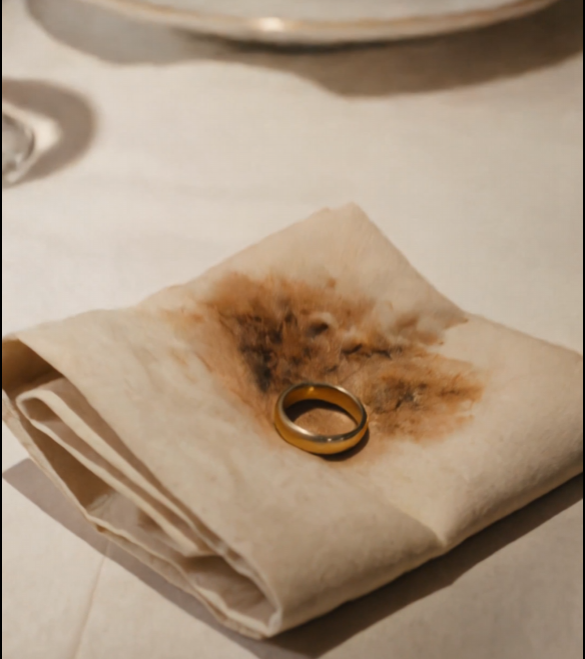
A folded napkin. Old, worn soft. Inside: a ring.
Gold. Simple. The kind of ring that means something — or meant something, once.
“My mom said give this to the man with white hair.”
The metallic sound the ring makes when it touches the table is very small. It is the loudest sound in the room.
Salvatore looks at the ring for a long time. His face does something complicated. The burgundy sits untouched. The bread steams. The chandeliers hold their light.
He looks at the girl — really looks at her, the way you look at something you half-recognize, something seen through fog or years or guilt. He looks at her eyes. He looks at her jaw. He looks at the shape of her hands wrapped around the bread.
His voice, when it comes, is the voice of a man who has just watched his entire past rearrange itself into a different story.
“Where is your mother?”
The girl doesn’t hesitate. Children answer the questions adults are afraid to ask with a directness that has not yet learned to flinch.
“She said you left us here.”
