The coffee shop on Madison Avenue was the kind of place that cost too much and knew it.
Claire Donovan didn’t care. At forty-two, after twenty years of building her interior design firm from a one-room Brooklyn apartment into a company with seventeen employees and a waiting list, she had earned the right to a fourteen-dollar latte on a Tuesday afternoon without justifying it to anyone. She sat at her usual window table — same table every week, same chair, same view of the street — with her laptop open and her reading glasses pushed up into her dark hair and her mind approximately forty percent on the Riverside Drive project and sixty percent on absolutely nothing, which was as close to rest as she ever got anymore.
The silver clip held her hair back on the left side. She’d bought it in a small jewelry shop in Santa Fe four years ago, on the first vacation she’d taken alone, the first trip she’d booked for no reason except that she wanted to go somewhere she’d never been with someone she was still getting to know — herself. The clip was unusual. Hand-crafted, the jeweling along the edge done in a pattern she’d never seen anywhere else before or since. She wore it almost every day. It had become, without her planning it, the one consistent decorative thing about her. Clients remembered it. Her assistant had once described it as her trademark, which she’d found both flattering and slightly alarming.
She was reaching up to adjust it when the hand grabbed her hair.
The sound her chair made against the tile floor was violent enough that three tables looked up simultaneously. Claire was standing before the rational part of her brain had processed anything, spinning around, every nerve in her body firing at once.
“Don’t touch me!”
Her voice filled the café. A barista froze mid-pour. A man near the door looked up from his newspaper. A woman with a stroller instinctively pulled it closer.
Then Claire saw him.
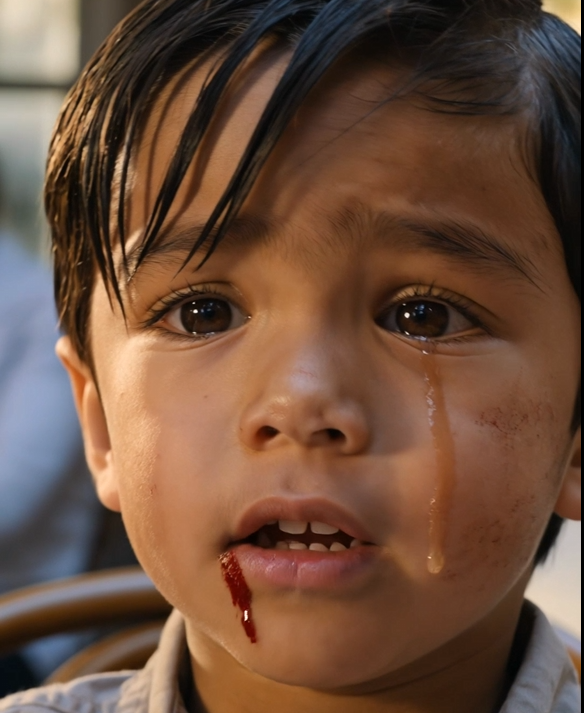
A boy. Small — maybe six, maybe seven, the kind of age that was hard to pin when a child had clearly been living rough. His shirt was gray and enormous on him, the collar hanging off one shoulder. His jeans had a split at the left knee. His sneakers had been white once, a long time ago. His face was smudged along the jaw and across one cheek with the particular dirt of outdoor living, not a single afternoon’s worth but something accumulated and settled.
He had not taken the clip. His hand was still extended, fingers open, trembling. He had touched her hair and then frozen there, the way children froze when they knew they’d crossed a line but didn’t fully understand which one.
His eyes were enormous and already full.
Not the dramatic fill of a child performing distress. The real kind — arriving without permission, surprising even him.
“Sorry,” he breathed. It was barely a word. More like the ghost of one.
Claire stood there. The anger — which had been immediate and total, the adrenaline response of a woman who had been grabbed from behind — went out of her like air from a punctured tire. Fast and completely.
What replaced it she couldn’t name quickly enough.
The boy was still looking at her hair. Not at her face. At the clip specifically, and at the wave of dark hair it held. His head was tilted slightly. He looked the way people looked when they saw something that didn’t make sense and were trying to find the explanation in the thing itself.
“Same as hers,” he said softly.
It wasn’t directed at Claire. It was the kind of thing you said to yourself when you were working something out.
Claire lowered herself back into her chair slowly. “Same as whose?”
He looked at her then. Directly, with the unsettling focus that certain children had, the ones who had learned early that adults required their full attention to understand anything.
He reached into the front pocket of his oversized jeans with both hands, carefully, the way you handled borrowed objects. He drew out a hair clip and held it up.
The afternoon light came through the window and found it immediately.
Claire stopped breathing.
It was her clip. Or it was identical to hers in every way that mattered — the same unusual design, the same jeweling along the edge in the same irregular pattern she had never seen duplicated anywhere. The only difference was age. The one the boy held was slightly more worn, the silver a little softer, one edge of the jeweling rubbed smooth by years of handling.
“Where did you get that?” Claire said. Her voice had changed registers entirely and she was aware of it.
“She gave it to me,” the boy said. He was still holding it with both hands, level and careful. “She said to find the woman with dark hair and a silver clip sitting by the window on Tuesday afternoon. She said you always sit here.”
Claire’s hand went to the table edge and stayed there. “Who said that?”
“She said you’d ask that first.”
“She said—” Claire stopped. Started again. “Who is she?”
The boy looked at her with the patience of someone who had rehearsed this.
“She told me to find you here,” he said. “She said you’d be wearing it. The same one. She said I’d know you right away.”
The café had resumed its sounds around them — spoons, steam, the low wash of conversation — but the immediate vicinity of Claire’s table had gone quiet in the instinctive way that people went quiet when something real was happening near them.
“That’s impossible,” Claire whispered.
The boy’s face didn’t change. A single tear broke free and tracked a clean line through the dirt on his left cheek.
“She said you’d say that too,” he said.
Claire looked at him. At the clip in his hands. At the tear drying on his cheek. The rational architecture of her brain — which had served her extremely well for forty-two years and built her a successful company and navigated a painful divorce and raised a daughter mostly alone — was failing to produce anything useful.
“Where is she?” Claire said. She leaned forward without realizing it. “Right now. Where is she?”
The boy turned.
His gaze moved past Claire, past the window, past the stream of Tuesday afternoon pedestrians on Madison Avenue, across the street to the small plaza where the city had installed benches and two struggling trees and a water feature that worked about half the time.
Claire turned too.
A woman stood at the far edge of the plaza. Beige coat. Dark hair. Completely still, the way only someone who was watching something very deliberately became still. The distance blurred the details but not the posture. Not the particular way she held herself, slightly formal, weight evenly distributed, chin level.
Not the way she held her arms slightly away from her sides, the old nervous habit that no amount of time or distance could apparently cure.
Claire’s hand pressed flat against the table.
Every carefully maintained wall she had built over fourteen years — every brick of it, mortared with justification and time and the daily discipline of not looking backward — developed a crack simultaneously.
“Where is she?” Claire said. Her voice was barely sound.
“She’s been waiting,” the boy said quietly. “She said she’s been waiting a long time.”
Claire crossed Madison Avenue in the long amber afternoon light without checking for traffic in her usual compulsive way, which would have alarmed her if she’d noticed it.
The woman in the beige coat had not moved. She was watching Claire cross the street with the expression of someone who had prepared for many possible outcomes and was now simply waiting to see which one arrived.
At twenty feet Claire could see the face clearly enough.
At fifteen feet she stopped walking.
Her sister was forty-five years old and looked exactly like herself and nothing like herself simultaneously, the way people did when you’d last seen them as someone younger and your brain had to rapidly perform the calculation of all the years in between.
“Nora,” Claire said.
The name came from a place she’d kept locked. It came from a kitchen table argument that had lasted four hours on a December night fourteen years ago. It came from a door that had closed and a phone that had rung twice in the years after and then gone silent. It came from every Christmas morning when her daughter asked about her aunt and Claire said something careful and insufficient.
“Hi, Claire,” her sister said. Her voice was steady. She had clearly been practicing steadiness for this moment for some time.
“You sent a child,” Claire said. It came out more like wonder than accusation.
“I wasn’t sure you’d stay if you saw me first.” Nora’s eyes were steady. Clear. “I thought if Marco got there ahead of me, if you had two minutes to just be a person before you remembered all the reasons to leave—”
“Fourteen years, Nora.”
“I know.”
“Fourteen years and you send a six-year-old boy into a coffee shop—”
“He’s seven,” Nora said. “And he volunteered.”
Claire looked back across the street. Marco was sitting on the curb in front of the café, examining something small in his palm with total scientific commitment, entirely unbothered.
“Who is he?” Claire said.
“He’s mine. For three years now. His mom was my neighbor in Portland. She got sick very fast. She needed someone for him.” Nora paused. “We needed each other. It worked out.”
Claire looked at her sister. Fourteen years of absence had the strange property of making a person both more and less familiar at the same time. The face was the same face. The voice was the same voice. The way Nora stood with her weight slightly forward when she was nervous — unchanged. All of it unchanged and also fourteen years older and also standing right here in front of her on a Tuesday afternoon in October.
“The clip,” Claire said.
Nora reached into her coat pocket and produced it — the worn twin of Claire’s own. “I bought them both that day. You remember, Mom’s shop on Bleecker before she sold it. You picked the design. I bought two.” She held it in her palm. “I kept it.”
Claire did remember. She remembered exactly. She had thought about it, in fact, in the jewelry shop in Santa Fe when she’d found the nearly identical version, and had bought it specifically because it felt like keeping something from a time when keeping things between them had still been possible.
“You could have called,” Claire said.
“I know.”
“You could have written. You could have come to the office. You could have—”
“I know,” Nora said again. “I thought about all of it. Many times.” She looked at her sister steadily. “I thought about this instead. I thought if I could get you to sit still for five minutes, you might remember who we were before the argument. Before I was just the reason you were angry.”
The water feature in the plaza was running today, doing its gentle, persistent thing. Across the street Marco had apparently found a coin and was now testing its aerodynamic properties with focused repetition.
“He said she’s been waiting,” Claire said. “That’s what he told me.”
“Did he?” Nora looked at the boy with something that was entirely transparent on her face. “I told him to say you’re been waiting. He improvised.”
Claire made a sound that was not quite a laugh and not quite a cry, somewhere in the narrow territory between those two things where the most honest human responses tended to live.
“I have a latte getting cold across the street,” she said.
“I know. You go every Tuesday.”
“You watched me.”
“Twice,” Nora said. “I almost came in both times.” She paused. “I needed Marco.”
Claire looked at her sister for a long moment. The late sun was doing what late October sun did in New York — making everything slightly more golden and slightly more heartbreaking than it deserved to be.
“There’s a bigger table inside,” Claire said. “In the back. Big enough for three.”
Nora breathed out. One long, slow breath that carried something heavy in it. “Okay,” she said.
Claire turned toward the street and raised her hand.
“Marco,” she called.
The boy looked up from his coin, assessed the situation in one glance, and stood up from the curb with the easy efficiency of a child who had accomplished exactly what he’d set out to do.
He crossed the street toward them and fell into step beside Claire naturally, without ceremony, as if they’d been walking together for years.
“You did good,” Claire told him quietly.
“I know,” he said.
Nora, walking on his other side, covered her mouth briefly with one hand. Hiding the smile or holding it in — Claire couldn’t tell which, but it didn’t matter.
The three of them walked back through the amber light together, toward the coffee shop and the cold latte and the fourteen years of things that needed saying, none of which were going to be easy and all of which, Claire understood now, were finally going to be said.
