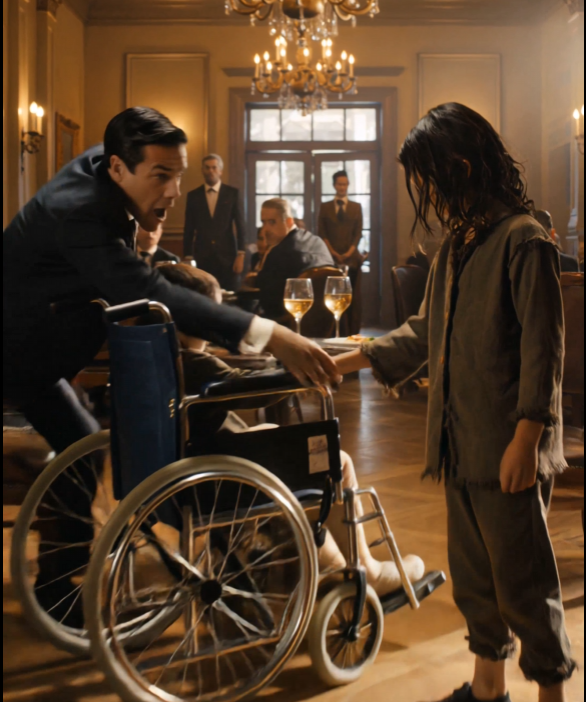
The restaurant was the kind of place where the lighting was designed to make everyone look like the best version of themselves.
Soft amber fixtures over white linen tablecloths. Candles in glass holders. A wine list that came in its own leather folder. The kind of place where the bread arrived warm and the butter was salted and the background music was live piano, understated and perfect, and where the clientele dressed accordingly — not to impress each other exactly, but to honor the shared agreement that tonight was special, that they had all arrived somewhere worth arriving.
Daniel Marsh had booked the table six weeks in advance.
This was his son’s seventh birthday. James had requested pasta with butter — just butter, no sauce, no anything — which the chef had agreed to with more grace than Daniel expected. James was in his wheelchair at the head of the table, which Daniel always arranged deliberately, so that James was never at the side of anything. Never peripheral. The boy wore a blue blazer that was slightly too big for him and a clip-on tie with small dinosaurs on it and an expression of profound satisfaction at the bread basket.
Daniel watched his son eat bread and felt the specific, familiar compound of love and grief and fierce protectiveness that had lived in his chest for six years, since the accident, since the diagnosis, since the long series of rooms with doctors in them who had explained things carefully and kindly and without hope.
James could not walk. He had not walked since he was eleven months old. The myelin in his spinal cord — the doctors had explained it many times in many ways — had simply stopped doing its job. There was no surgical fix. There was no medication. There was therapy, which James did three times a week without complaint, and there was the wheelchair, which James had decorated with stickers of planets and rockets, and there was this: birthday dinners at good restaurants with butter pasta and dinosaur neckties.
Daniel had made peace with it. That was what he told people when they asked, and it was mostly true, and on the nights when it wasn’t true he kept that to himself.
The girl walked in at seven-forty.
Nobody walked in at seven-forty at Aurelius without a reservation. The maître d’ was extremely good at his job and the door was not the kind that opened easily from the outside. Daniel noticed her first because she was simply there suddenly, the way things appeared in peripheral vision — one moment not present, the next moment completely so.
She was eight years old, maybe nine. Small for whatever age she was. She wore a dress that had been good once, yellow with a pattern of small white flowers, now worn soft at the elbows and hem. Her feet were in sandals that had seen significant mileage. Her hair was dark and loose and her face was smudged along the jawline with what looked like honest outdoor dirt, not the theatrical kind.
She stood just inside the restaurant entrance and looked around the room with the calm, methodical focus of someone checking a list.
The maître d’ was already moving toward her, not unkindly but with purpose.
The girl ignored him. Her gaze had found the table. Found James specifically, in his wheelchair with his dinosaur tie and his bread, and something in her expression settled and resolved like a compass needle finding north.
She walked toward them.
Daniel was aware of it happening but didn’t fully react until she was three feet from the table, at which point some paternal alarm system fired and he started to rise.
Her hand came down on the table.
The bang was loud enough that the piano stopped. Not a violent slam — the hand simply met the surface with a force that sent a clean shock through the glassware and silverware and brought the ambient noise of the restaurant down to nothing in the space of a single second. Every face turned. The room went to a specific kind of silence that happened when a large group of people collectively decided to pay attention.
The girl was looking at James.
Not at Daniel. Not at the stunned table of birthday guests — Daniel’s sister Carol, her husband Pete, James’s school aide Michelle who’d been invited because James had specifically requested her. At James.
“Feed me,” the girl said. Her voice was clear and unhurried. “And I’ll heal him.”
The silence in the restaurant had weight. Daniel could feel it pressing.
He looked at this small, dirty, absolutely certain child standing at his son’s birthday table in a Michelin-starred restaurant and felt the full range of human responses cycle through him in approximately two seconds: alarm, confusion, irritation, protectiveness, and something else at the very back that he immediately pushed down because it had no business being there.
He stood. He was a tall man, and standing in this context was both instinctive and slightly theatrical, and he was aware of both things.
“You’ll heal my son?” he said. He heard the mockery in his own voice before it finished leaving his mouth — not cruel exactly, but the defensive reflex of a parent who had sat in too many offices with too many people who had promised too many things.
The girl didn’t look at him.
She moved around the edge of the table toward James, and Daniel was so surprised by the continued ignoring that he didn’t immediately stop her. She pulled out the chair beside James and knelt on the floor next to the wheelchair, which put her at exactly his level, and looked at him with an expression that Daniel would spend a long time afterward trying to accurately describe.
It was not pity. He was certain of that. James received pity with some regularity and had a specific way of going slightly flat when it arrived, a subtle withdrawal. He did not go flat now.
It was not performance either. There was nothing in the girl’s face that was arranged for an audience. The restaurant full of watching people did not appear to register with her at all.
It was simply — attention. Complete and specific and directed entirely at James, the way very few people’s attention ever was.
“Do you want to stand?” she said.
Her voice was quiet now. The earlier projection was gone. This was for James only, though the silence in the room meant everyone heard it.
James looked at her. He was a thoughtful child, deliberate in his assessments, slow to trust and careful about it. He had his mother’s eyes — dark brown, slightly tilted at the outer corners — and he used them now the way he always did, steadily and without hurry.
He didn’t answer immediately.
His right hand lifted slightly off the armrest. Just slightly. An inch, maybe less. It was the kind of small movement that meant something only if you knew what it had cost, what the muscles involved had been asked to do and failed to do and been asked again, three times a week, for years.
The room breathed in.
Daniel’s sister Carol made a sound beside him. He couldn’t look at her. He was watching his son’s hand.
“What did you do?” Daniel said. His voice was different now. The mockery was gone. Something he didn’t have a prepared response for had replaced it.
The girl looked up at him briefly. “Nothing yet,” she said.
The heartbeat in Daniel’s ears was his own. He became aware of it the way you became aware of your own heartbeat only when something had made it loud.
The girl had taken James’s hand. Both of hers around his one, gently, the way you held something you intended to help and not to force. She wasn’t pulling. She wasn’t performing. She was simply holding his hand and looking at him with that complete attention.
James was looking back at her.
“I’m scared,” James said quietly. He said it to the girl, not to his father. The directness of it, the ease of the admission, was something Daniel had never heard from his son in six years of therapy rooms and medical appointments and careful conversations. James did not say he was scared. James said he was fine, or that he wanted to try, or that it hurt a little but not too much. He did not say he was scared.
“I know,” the girl said. “That’s okay.”
“What if I fall?”
“I’ll catch you.”
She said it with the specific confidence of someone making a promise they knew they could keep. Not bravado. Certainty.
James looked at her for another long moment.
Then his foot slipped off the footrest.
Not a spasm — James had spasms, Daniel knew exactly what those looked like. This was deliberate, or something close to deliberate, the foot moving with an intention that made Daniel’s throat close completely. The leg followed it, shifting, the knee bending with a stiffness that was years of disuse and three times a week of trying.
Daniel lunged forward.
Not toward the girl. Toward James, the instinct of six years, the automatic catch. Carol grabbed his arm. He didn’t know when she’d stood up.
The girl held James’s hand and did not flinch.
James’s other hand found the armrest. His arms shook. Everything in his small body that had been asked to do this thing and couldn’t, couldn’t, couldn’t — was being asked again.
The room was not breathing.
Daniel was aware, distantly, of the piano player standing up from the bench. Of Michelle with both hands over her mouth. Of Pete frozen with a dinner roll halfway to his plate.
James made a sound — not pain, something more complicated than pain, the sound of enormous effort meeting its absolute limit — and then he was standing.
Not steadily. Not for long. Three seconds, maybe four, before his legs gave and Daniel caught him and held him up and James grabbed his father’s jacket with both fists and pressed his face into Daniel’s shoulder and made a sound that Daniel would carry in his chest for the rest of his life.
The restaurant did not applaud. That would have been wrong and collectively everyone understood it was wrong. The silence held, and inside that silence something passed through the room that none of them would describe accurately at dinner parties later, though they would all try.
Daniel held his son and looked at the girl over James’s shoulder.
She was standing beside the wheelchair, calm, her yellow dress with its worn elbows and her muddy sandals and her dirt-smudged jaw, watching them with an expression that was simply peaceful. The way you looked when something had gone the way it was supposed to go.
“Who are you?” Daniel said. His voice was unrecognizable to himself. “How did you—” He stopped. Tried again. “How does he know you? James. How does he know you?”
James’s face was still against his father’s shoulder.
“He doesn’t,” Daniel said. “He’s never met you. We’ve never—”
“He knows me,” the girl said.
She said it quietly. Without explanation or elaboration or any of the things Daniel needed urgently in this moment. Just those three words, certain and simple, the way she’d said everything since she walked in.
Daniel stared at her.
“How?” he said.
The girl looked at James, who had lifted his face from his father’s shoulder and was looking back at her with those dark, thoughtful eyes.
She smiled at him — the first smile she’d produced since she walked in, small and real and entirely for him.
Then she turned and walked back toward the door.
The maître d’ stepped aside.
The door opened.
She was gone.
The restaurant remained silent for a long moment after. Then, slowly, the piano player sat back down and found a note — a single, quiet note — and held it.
James was still in his father’s arms, feet not quite on the floor, the wheelchair behind him.
“Dad,” he said.
“Yeah, buddy.”
“She said she’d come back.”
Daniel pulled back enough to look at his son’s face. James was calm. More calm than Daniel, certainly. Calmer than anyone else in the room.
“When?” Daniel said.
James considered this with his usual deliberateness.
“When I’m ready,” he said.
He reached for the wheelchair armrests. He lowered himself back into the seat with the careful, practiced motion of a child who had done it ten thousand times. He straightened his dinosaur tie.
He picked up a piece of bread from the basket.
“Can we have the pasta now?” James said.
Daniel sat down. His hands were not entirely steady. He put them flat on the table the way he’d seen doctors do when they needed a moment to compose themselves, and he breathed, and he looked at his son eating bread on his seventh birthday in a blue blazer that was slightly too big.
“Yeah,” Daniel said. “Yeah, we can have the pasta.”
Nobody at the table spoke for a while.
Nobody needed to.
Outside, through the restaurant window, the city moved through its Tuesday evening — loud and indifferent and entirely unaware that something had happened here. Something that had no clean explanation. Something that seven people in a Michelin-starred restaurant on an ordinary November night would spend the rest of their lives turning over carefully, like a stone with something living under it.
The piano played.
The candles burned.
James ate his pasta with butter, just butter, no sauce, no anything.
And Daniel watched his son and tried to remember, for the first time in six years, how to imagine what came next.
