The sound came first.
Not a crack. Not a slip. A SMASH — sudden, violent, absolute — the kind that splits a room open and drops every jaw inside it. The kind you feel in your chest before your brain catches up.
Darkness. Then light, flooding in too fast.
Crystal — fine Bohemian crystal, etched with patterns that took artisans three days each to carve — erupting outward in slow motion. Fragments spinning like stars born in reverse. Each shard catching the golden ambient light of the Elara showroom and throwing it back in a thousand tiny directions, a constellation made of wreckage, tumbling across forty thousand dollars worth of polished Calacatta marble.
For two seconds, it was the most beautiful thing in the room.
Then the silence hit. And it was louder than the crash.
He was standing in the middle of it all.
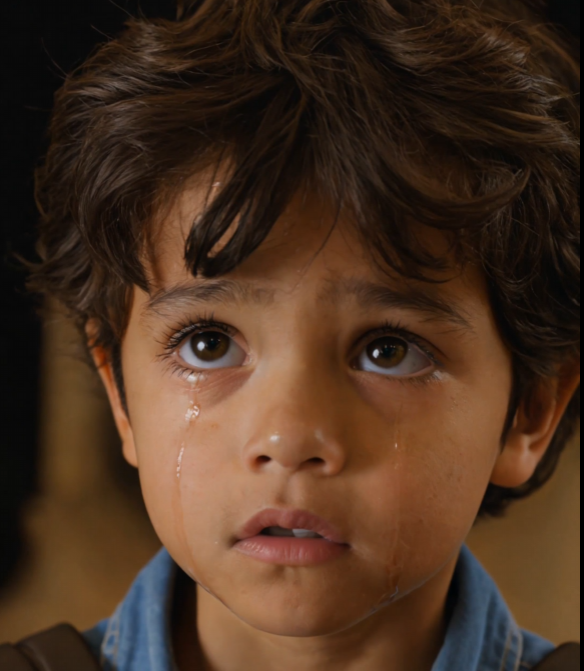
Five years old. Maybe five and a half — the age when children still believe adults are fundamentally good, when the world hasn’t yet given them reason to doubt it. He wore a blue jacket, the kind bought on clearance, the left sleeve torn at the elbow in a rough diagonal that someone had tried to fix with a safety pin and failed. His jeans were faded at the knees. His sneakers were clean — his mother had made sure of that, at least, had wiped them down that morning before dropping him at the curb with a folded piece of paper tucked carefully into his backpack.
“Don’t lose this,” she had said. “It’s important. Give it to the manager. Only the manager.”
He hadn’t understood what that meant. He was five.
Now he stood frozen among the crystal ruins, his hair sticking up on one side from a morning spent pressed against a car window, watching the city go by. His small hands were pressed flat against his thighs. His eyes — enormous, dark brown, the kind of eyes that adults describe as soulful when they are trying to say sad without knowing why — were fixed on the floor. On what he had done.
The wealthy customers turned. They were draped in cashmere and silk, carrying bags that cost more than most people’s car payments. They turned in the slow, theatrical way that people turn when they already know they’re going to be disgusted by what they see.
They were not disappointed.
Her heels announced her before she arrived.
Click. Click. Click. The sound of authority moving at speed across marble — the showroom manager, her name tag reading DIANE in small gold letters, a woman whose entire career had been built on the principle that certain people did not belong in certain spaces, and who had built a kind of genius around identifying which was which. She wore charcoal-gray, precisely tailored. Her expression was the particular brand of fury that tries to look like professionalism.
The boy heard her coming and seemed to fold inward, like paper in rain.
“I — I’m sorry… I didn’t mean to…”
His voice broke on the last word. Not dramatically — children don’t perform grief, they just have it. It cracked the way thin ice cracks: quietly, completely.
From the far side of the display, a woman in a champagne-colored coat lifted her phone. She was perhaps forty-five, her diamonds catching light, her expression carrying that specific cruelty that lives in people who have never once worried about money and have therefore mistaken their luck for merit.
“He probably can’t even afford one.”
She said it to the woman beside her, but not quietly. Not by accident. The words were placed, like a heel on something small.
A few people smiled. A few looked away. Nobody said anything.
Nobody ever says anything.
He reached for the zipper.
His hands were shaking — not the theatrical trembling of someone performing distress, but the real kind, the involuntary kind, the kind that belongs to a child who is scared and exhausted and very far from home and his mother’s voice. The zipper caught. He worked it loose. His jaw was tight.
Inside the backpack: a granola bar, half-eaten and re-wrapped. A library book with a dragon on the cover. A drawing — crayon on construction paper, rough and vivid — of a woman and a small boy holding hands beneath a yellow sun. And at the very bottom, nestled in the corner as if placed there with great deliberateness:
Coins. A handful of quarters, dimes, a few nickels. The accumulated weight of an allowance, carefully saved.
And beside the coins — an old wristwatch. The kind that hadn’t been manufactured in decades. The kind that didn’t need a battery, that wound itself on the motion of the wrist that wore it. The crystal face was scratched. The leather band was worn smooth. Someone had worn it every day for a very long time, and then — at some point, for some reason — had stopped.
The boy looked at the coins. He looked at the watch. He looked up at Diane.
He did not fully understand the arithmetic of the situation — did not know that the crystal plates cost $340 apiece, that the display had held twelve, that the math was not in his favor. But he understood, with the clarity that children sometimes have and adults usually lose, that he had broken something important, and that he needed to make it right.
His tears fell without announcement. He didn’t wipe them. He just stood there with his backpack open and everything he had visible to the whole room, and the silence in Elara became the kind of silence that fills a person’s chest like water.
Diane reached into the backpack — not unkindly, which surprised even her — and took the folded piece of paper from the front pocket.
She unfolded it.
She read.
The showroom hummed softly. Someone coughed. The woman with the champagne coat was still filming. The ambient lighting continued its warm, indifferent glow over all of it — the marble, the crystal shards, the boy, the manager.
Diane’s face changed.
It happened in layers. First: confusion — the kind that comes when information doesn’t fit the story you’re already telling yourself. Then: recognition. Then something rarer — something that moved beneath the surface of her professional composure like a fault line shifting.
Fear. Pure, unperformed, involuntary fear.
Her hand, the one holding the paper, trembled once.
“…Your mother is Anna?”
The whisper left her like something she had not meant to say out loud. Like a confession. Like a name she had spent a long time hoping she would never have to say in a room like this, in front of people like this, under circumstances like these.
The boy looked up at her.
His face held what it had held the whole time — fear, and sadness, and the particular weariness of a child who has been carrying something too heavy for too long. But now there was something else in it. Something new.
Confusion.
Because his mother’s name was known, apparently, to this sharp-dressed woman in this impossible room. His mother’s name meant something here. His mother’s name had changed the air.
He didn’t know what that meant. He was five. He knew his mother’s hands, the sound of her voice reading to him in the dark, the way she smelled of lavender soap and something warmer underneath. He knew she had sent him here with a paper he didn’t understand, had told him to find the manager, had held his face in both her hands before he left and looked at him very seriously and said:
“Everything will be fine. I promise. Trust me.”
He had trusted her. He always trusted her.
He looked at Diane, whose hand was still shaking, whose eyes had gone to some middle distance where answers lived that he wasn’t old enough to reach. He looked at the paper. He looked at the crystal on the floor.
He opened his mouth.
The question hangs in the air, unresolved.
The answer belongs to Anna alone.
