Linda Marsh had been running on four hours of sleep and gas station coffee for eleven days straight.
This was not unusual. This was November, which meant holiday staffing shortages, which meant doubles, which meant her register never went cold and her feet never stopped aching and the fluorescent light directly above lane seven — her lane, always her lane — flickered every forty seconds with the reliability of a bad heartbeat. She had counted it once during a slow Tuesday. Forty seconds. She could set a watch to it, if she still owned a watch worth setting.
Her phone sat in her apron pocket, face-up out of habit, the way you keep a wound where you can see it. The balance had read $23.17 that morning. She had not checked it since because checking it would not change it and she needed to get through the night without crying in front of strangers, which was already requiring significant effort.
The store smelled like it always did at this hour — antiseptic and old produce and the particular loneliness of places that stay open when most of the world has gone home. A few customers moved through the aisles with the slow, deliberate energy of people who came here not entirely for groceries. An elderly man in the cereal aisle. A young couple arguing quietly near the frozen foods. The usual.
Linda scanned a box of crackers. Then a bottle of wine. Then three cans of something she didn’t look at closely enough to name.
That was when she heard it.
Small. Uncertain. The voice of someone who had practiced the sentence many times before finally saying it out loud.
“Please… can I pay tomorrow?”
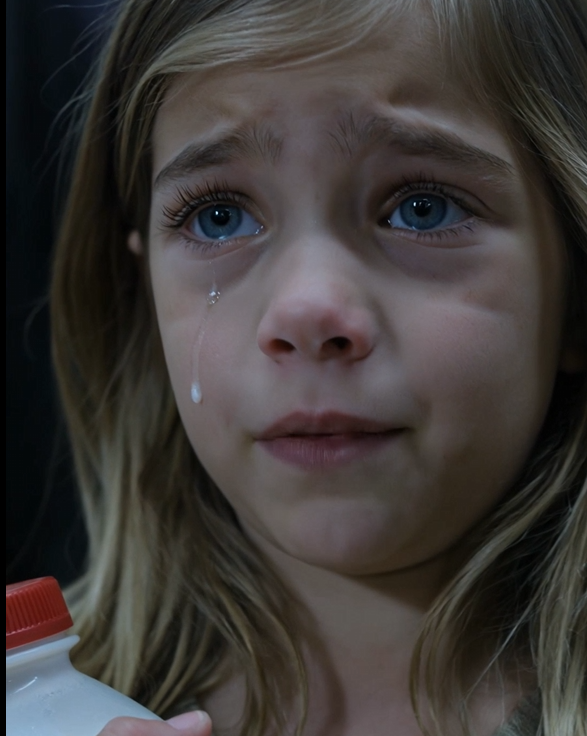
The girl was eight years old, maybe nine. It was hard to tell with children who weren’t eating enough — hunger has a way of keeping them small, stretching the baby out of their face and replacing it with something older and more careful. She had blonde hair that hadn’t seen a comb recently, and blue eyes so pale and direct they were almost uncomfortable to look at, the kind of eyes that haven’t yet learned to look away from things.
She was holding a bottle of milk.
Not cradling it. Not carrying it. Holding it the way you hold something you are afraid someone will take from you — both arms wrapped around it, chin tilted down, the plastic pressed against the worn front of her sweater like it was the most important object in the world.
Because tonight, it was.
Linda looked at the girl. Then at the milk. Then at the register, which didn’t care about any of this, which was simply a machine waiting to be told what to do.
Behind the girl, the line stretched back five, six people. It was late, everyone was tired, and the particular tension of a grocery line in a low-income neighborhood at ten-fifteen at night is its own specific atmosphere — thick with exhaustion, with the quiet math of people calculating what they can and cannot afford, with the low simmer of a day that has been too long and isn’t over yet.
Someone shifted their weight. Someone exhaled through their nose. The fluorescent light above lane seven flickered.
The girl whispered again, leaning slightly forward, as if she could make the words reach Linda and no one else.
“My twin brother cries all night. We don’t have anything left.”
The checkout line does something to a person, if you stand in it long enough. Not as a customer — as the person on the other side of the register. You start to see things other people miss because they are looking at their phones, because they are thinking about their car, because they are simply somewhere else in their head while their body waits to pay for dinner.
Linda had been standing on this side of the register for nine years. She had seen things.
She had seen a man buy diapers with a credit card she could tell was already maxed out, the particular way his jaw set when the machine paused before approving. She had seen a woman count coins from a ziplock bag, twice, and still come up short, and then quietly put the orange juice back without making eye contact. She had seen veterans with shaking hands and teenagers with hollow cheeks and elderly women buying single-serving everything because there was only one of them left.
She had seen enough to know, with a precision that no algorithm could match, the difference between someone performing hardship and someone living inside it.
This girl was not performing anything.
Her hands were red. Not flushed-from-cold red — the deeper, persistent red of hands that spent a lot of time outside without adequate gloves. Her sweater had a small hole near the left cuff that someone had attempted to mend with thread that didn’t quite match. Her shoes were a size too large, stuffed at the toe. These were not details a child arranges. These were details that accumulate.
Linda’s phone was in her apron pocket.
$23.17.
She thought about that number. She thought about her own refrigerator, which had eggs and half a block of cheese and some leftover rice she’d been eating for three days. She thought about her landlord, who had been very patient for two months and was running out of patience. She thought about her car insurance, which lapsed on the fifteenth.
Then she stopped thinking about all of it.
She didn’t decide so much as move.
That was how she would describe it later, to herself, in the dark of her apartment — not a decision but a motion, the body doing what it knew was right before the mind could talk it out of it. She told the girl to wait. She came around the register. She walked fast, the way you walk when you don’t want to second-guess yourself, down the bread aisle and then the soup aisle and then the small pharmacy section near the back where they kept the children’s medicine.
Bread. Two cans of chicken soup. Children’s fever reducer. A small bag of apples. Crackers, peanut butter — protein, she was thinking, he needs protein, the brother, the one who cries all night. She grabbed it all with the focused efficiency of a person who has spent years moving things quickly from one place to another and carries it back to her register in both arms, stacking it on the belt beside the milk.
Her hands were steady while she scanned it. Her face was neutral — the face she wore the way other people wore armor — while the total climbed. Twenty-six dollars and forty cents.
She pulled her card from her apron.
The machine paused before approving.
It approved.
She bagged everything herself, fast and tight, the way she knew it needed to be packed so nothing would shift or spill on the walk home, wherever home was. She handed it to the girl without ceremony, without making a speech, because the girl didn’t need a speech, the girl needed the bag.
The girl took it.
She looked up at Linda and her pale blue eyes filled with the specific tears of a child who has been trying very hard not to cry in public and has just lost the battle — not from sadness but from the relief of being seen, which can undo a person faster than any grief.
“Thank you,” she whispered.
Then she turned and walked out through the automatic doors into the cold November dark, and the doors slid shut behind her, and she was gone.
Linda stood at her register and breathed once, slowly, and then looked up at the line.
The man was well-dressed.
Not ostentatiously — not the kind of wealth that announces itself. The kind that reveals itself in small, precise details: the particular cut of his coat, the quality of his shoes, the way he carried himself with the ease of someone for whom the world has generally arranged itself cooperatively. He was perhaps fifty-five. Silver at the temples. A face that would have been handsome if it weren’t doing something strange.
He stepped forward.
He placed a single pack of gum on the counter.
He did not look at the gum.
He looked at Linda.
The line had relaxed after the girl left — that particular collective held breath released, people returning to their phones and their thoughts. But this man had not relaxed. He had been still the entire time with the focused stillness of someone who is processing something, running something through a mental sequence he cannot stop.
He looked at Linda the way you look at someone standing on ice you know the thickness of, and they do not.
And then he said it, quietly, the way you say something you wish you didn’t have to say:
“You shouldn’t have done that.”
Not angry.
Not cold.
Disturbed. The word arrived in Linda’s chest before her mind had time to translate it. His expression was the expression of a man who had recognized something — not her, not the girl, but the situation itself — and what he recognized frightened him in a way that had nothing to do with twenty-six dollars and forty cents.
Linda’s hand was still on the register.
The fluorescent light above lane seven flickered.
“What?” she said.
He opened his mouth. Closed it. Looked at the door where the girl had disappeared. Then back at Linda, with that same expression — careful, unsettled, the look of a man deciding how much to say and to whom.
He picked up his gum.
He paid.
He walked to the exit and stopped with his hand on the door, his back to her, the November dark pressing cold against the glass.
He stood there for three full seconds without moving.
Then he walked out.
The doors slid shut.
The line moved forward.
The light flickered.
Linda stood at her register and felt, for the first time in nine years of standing in this exact spot, that something had just begun — and that she did not know what it was, and that the not-knowing was the part she should be afraid of.
Her phone was in her apron pocket.
She did not check the balance.
She scanned the next item.
The girl’s name was not on any school roster within four miles of that supermarket.
The twin brother the county welfare office checked for the following morning — didn’t exist.
And the man in the good coat had been standing in that line for twenty-two minutes before the girl arrived, holding nothing but a pack of gum he never intended to buy.
He had been waiting.
The question Linda would spend the next six months trying to answer was simple: for what? For her — or for the girl?
And the answer, when it finally came, was neither.
