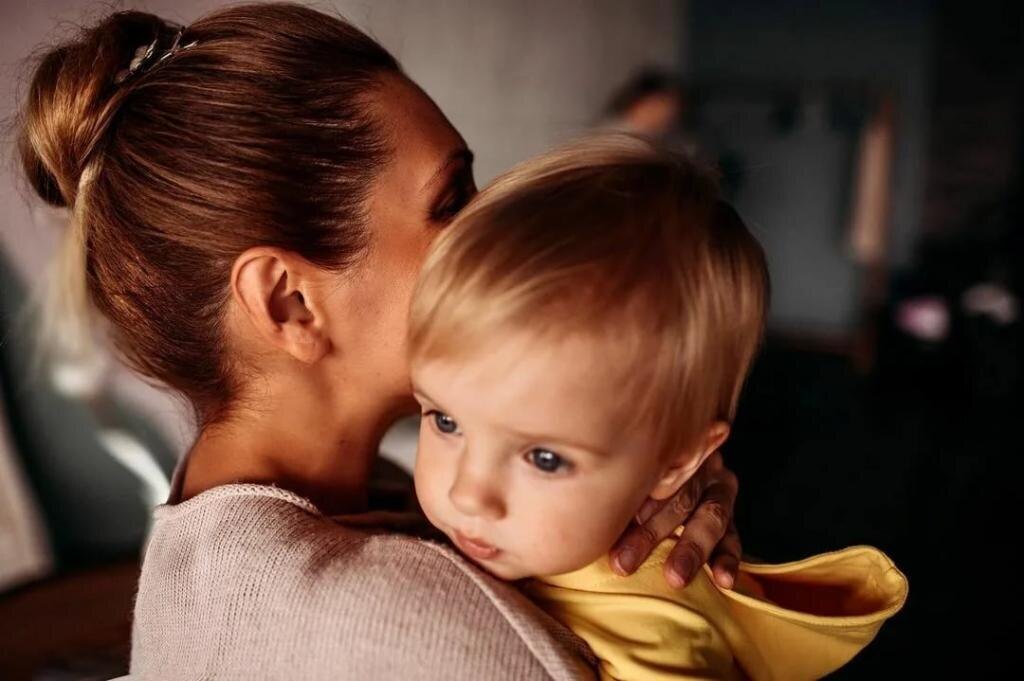
They met in their final year of medical school. Ilya was a future surgeon, Lena a pediatrician. A year later, the couple married.
Misha was the first child born, followed a few years later by Dania.
To say the young parents were happy would be an understatement.
When her youngest son turned two and a half, Lena suspected something was wrong: Dania had stopped gaining weight, had become lethargic, and was often ill.
They ran tests. They waited three weeks. When Lena went to get the results, Ilya was undergoing surgery. She entered the geneticist’s office alone.
“Spinal muscular atrophy,” the doctor said. “The second form. The prognosis… well, you know…”
Lena didn’t understand. Of course, she knew what it was, but she couldn’t apply that knowledge to her own son.
So she nodded silently, left, and sat in the hallway.
Nurses walked past, someone dropped a gurney, someone laughed. Lena sat motionless, like a statue, clutching the piece of paper she’d received, barely breathing.
Ilya learned everything that evening. He listened silently and went into the garage. Lena didn’t follow him – she was afraid of what she would find.
Ilya returned with red eyes and said in a level, too-level voice:
“We’ll fight. There are medications, there are clinics. I’ll find the money.”
And he did. He sold the car, took out a loan, and borrowed from his parents.
Lena quit her job. She took her eldest, Misha, to his grandmother’s so she could focus on her sick son.
Danya was rapidly weakening. First he stopped walking, then crawling, then sitting. His arms still obeyed, but Lena knew it wouldn’t last.
She gave her son massages, took him to physical therapy, to a speech therapist—even though he could barely speak anymore.
Every day was a battle. Every small success was a celebration. Dania smiled when she turned on cartoons for him. He cried when she went into the kitchen. He became the center of her universe.
Ilya helped at first. He drove him to the hospital, looked after the child at night so Lena could get at least a couple of hours of sleep.
But after six months, everything changed. He started staying late at work, then disappearing into the evenings, then not coming home at night. Lena didn’t ask. She had no time for him.
One day, he came home in the early morning, drunk, sat in the kitchen, and said:
“I can’t do this anymore. I don’t know how to be strong. I’m tired of being afraid.”
“Aren’t I tired?” Lena asked quietly.
“You’re different. You’re a mother. And I… I just can’t cope.”
She didn’t argue. She packed his bag, put in a toothbrush, a couple of T-shirts, and a spare pair of glasses.
“Do you have someone?” she asked indifferently.
“Yes,” he replied, not looking at her. “But I’m not leaving because of her…”
Lena closed the door behind him, leaned her back against the frame, stood there for five minutes, wiped her face, and went to Danya—he was already awake and calling her.
Then came the longest year and a half of her life.
She learned to sleep in snatches—two hours at night, an hour in the morning, and an hour during the day while Danya watched cartoons. She learned to eat on the go, without even tasting it. She learned not to feel the pain in her back when she picked up her son for the hundredth time. She learned to smile when everything inside her was torn apart by pain.
And she never cried. She saw that Danya understood everything, he just didn’t say anything. Sometimes, when he looked at her with those huge brown eyes (like hers), she wanted to sink into the ground with shame at her weakness. But Dania wasn’t asking her to be strong. He just wanted his mother to be there. Always.
There were days when Lena hated Ilya. Not because he cheated on her, but because he left her alone with all of this.
There were others, when she realized he couldn’t take it anymore, broke down, ran away.
But most often, she simply didn’t think about him. Because there was no time.
In the morning – getting up, injections, tube feedings, gymnastics, changing clothes, medications.
During the day – physical therapy, massage, a walk, if Dania had the strength.
In the evening – bathing, injections, bedtime stories.
And so on, every day.
No days off.
No holidays.
No room for error.
Lena hardly interacted with anyone. Her friends called, but she’d say, “Everything’s fine,” and turn off her phone.
Her mother came once a week—she’d sit with Danya while Lena washed and slept for three, sometimes four, hours straight.
Misha, the eldest son, continued to live with his grandmother. He’d come over on weekends, stroke his brother’s head, play with him, but increasingly he’d ask to go back—”to his friends.”
Lena wasn’t offended. She understood: it was hard for the boy to see his brother like this. And even harder to see his mother like this.
One day, he asked her point-blank:
“Mom, do you not love me anymore?”
Lena froze.
“Why do you think that?” she asked quietly.
“You’re always with Danya. You talk to him, you smile. But when I come, you don’t even look at me.”
Lena almost said, “I’m tired.”
She wanted to say, “Danya will leave us very soon, and you’ll stay, so I have to be with him now.” But she couldn’t.
Instead, she hugged her son and whispered,
“Misha, my son, I love you very much. Very much. It’s just… it’s just hard now. But it won’t be forever. I promise.”
He didn’t believe it. Or maybe he believed it, but he was hurt. She felt it. And there was nothing she could do.
Danya was dying slowly. Each day became lighter, more transparent, as if melting. Lena saw it, but she didn’t allow herself to think about the worst. She lived for one thing.
