The Rain Doesn’t Stop
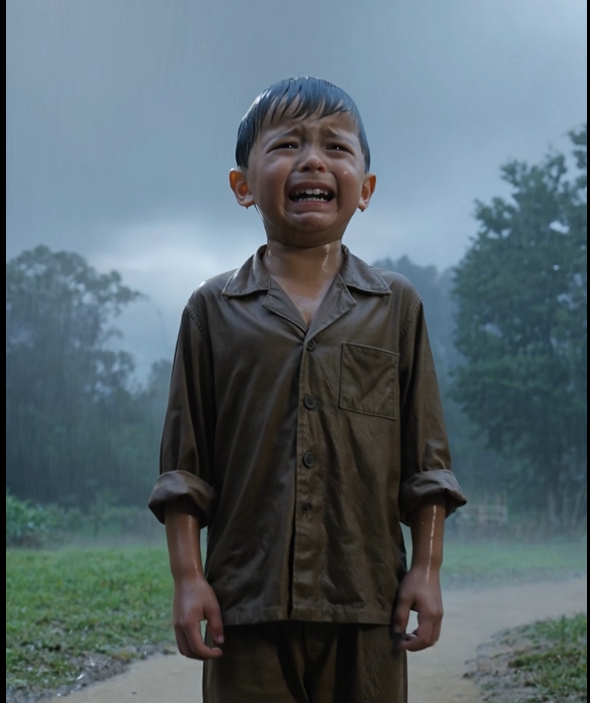
The boy had been standing in the yard for eleven minutes.
His mother didn’t know. She was inside, in the bedroom, with the door closed and the lamp on low, and the rain was loud enough on the tin roof to cover everything — the thunder, the distant highway, the sound of a five-year-old boy crying in the mud because he’d had a nightmare and called for her twice and she hadn’t come.
His name was Danny. He was five years and four months old, small for his age, with his father’s dark eyes and his mother’s stubborn chin and a green raincoat he’d forgotten to put on because he’d come outside in a panic, in his pajamas, in the dark. The rain had found him immediately. It always does. It doesn’t make exceptions for small boys or broken families or the particular kind of Thursday night that changes everything.
He stood in the center of the yard with his arms slightly out from his sides the way children stand when they don’t know what to do with their bodies, and he cried the way five-year-olds cry when no one is watching — completely, without embarrassment, without performance. The rain mixed with it and took it away and the yard filled up with the sound of water hitting mud and the distant rolling of thunder and one small boy calling for a father who had been gone for eight months.
He didn’t really expect an answer.
Staff Sergeant James Calloway had been on a transport plane for nineteen hours.
Before that, a forward operating base in a country where the dirt was the wrong color and the heat was a living thing that pressed against you like a hand. Before that, eleven days in a field hospital with shrapnel in his left side and a satellite phone that got two bars if he stood in the exact right corner of the tent and held it at a specific angle, like praying in a direction nobody had mapped yet.
He’d called home four times from that corner.
Sarah had answered twice. The conversations were short and careful, the kind of conversations that have been rehearsed, that exist inside a shape somebody else made. She asked about his injury. He said he was okay. She said good. He asked about Danny. She said he was good too, growing so fast, missing you. He said tell him I love him. She said I will.
She never asked when he was coming home.
He’d noticed. He’d filed it in the same drawer where he kept the other things he’d noticed — the calls that went to voicemail, the texts that were answered hours later with something short and slightly off, like words chosen by someone who was thinking about something else. He’d filed it all carefully and closed the drawer and focused on surviving, because surviving was the job, and the job was the only thing he could actually control.
Now he was in a taxi on a county road in Tennessee with rain hammering the roof and his duffel bag on the seat beside him and his hand pressed flat against the cold window, watching the familiar landscape come back to him in pieces. The gas station. The grain elevator. The turnoff by the old Miller property.
Home.
He hadn’t told Sarah he was coming. He’d thought about it — had started the text three times on the plane and deleted it each time. He wanted to surprise Danny. That was what he told himself. He wanted to see his son’s face light up the way it had at the airport eight months ago, before the deployment, when Danny had run the full length of the terminal in his sneakers and hit James at full speed and held on with both arms like he intended to never let go.
He needed that. After everything. He needed to be somewhere he was completely known.
The taxi turned onto his road. The headlights swept across the familiar bend in the fence, the oak tree he’d planted the year Danny was born, the mailbox with the dent in it from backing out too fast in 2019. His chest did something complicated.
He was home.
He saw Danny before the taxi fully stopped.
At first he didn’t understand what he was seeing — a small figure in the middle of the yard, standing in the downpour, pale against the dark. Then the headlights caught the boy’s face and James was out of the car before it stopped moving, door swinging open, one hand already on the gate.
“Danny.”
The boy looked up. His face in the rain was a destroyed thing — red and wet and completely open, the way children’s faces are before they learn to close them. He blinked against the headlights, confused, not sure he was seeing what he was seeing.
“Daddy?”
The word hit James somewhere below language.
He crossed the yard in four steps and dropped to his knees in the mud and pulled his son against his chest and felt the boy’s arms go around his neck with that same full-body grip, that same total commitment, the grip of someone who has been holding on to nothing for a long time and has finally found something solid.
Danny was soaked through. He was shaking — cold or crying or both. James held him tighter and felt the shaking move through him like a current.
“I’m here,” he said into the boy’s wet hair. “I’ve got you. I’m here.”
The rain came down around them. James didn’t move. He knelt in the mud of his own front yard in his military uniform, eight months of war still on him, and held his five-year-old son and let the boy cry himself out, and didn’t rush it, didn’t say it’s okay, stop crying — because it wasn’t okay yet, and the boy wasn’t wrong to cry, and sometimes the most important thing a father can do is simply absorb what his child needs to release.
When Danny finally went quiet, he pulled back just far enough to look at his father’s face. He put both small hands on James’s cheeks — muddy hands, cold hands — and looked at him with complete seriousness.
“I called for Mama,” he said. “She didn’t come.”
James looked at his son’s face for a long moment.
“I know, buddy,” he said quietly. “I’ve got you now.”
He picked Danny up — all thirty-eight pounds of him, heavier than eight months ago, growing so fast — and carried him toward the front door. Danny pressed his face into James’s neck and held on. James felt the boy’s heartbeat against his chest, fast and small and steadying.
He should have been relieved. He was home. His son was in his arms. He had survived.
But something was wrong. He could feel it the way you feel a change in pressure before a storm — not with your eyes, not with your ears, but with something older than either of those things. Something that had been trained by eleven years of marriage to read the particular frequency of this house, this life, and knew when a note was off.
The lights were on in the bedroom. He could see them through the curtain from the porch.
He settled Danny on the couch with a blanket and turned the lamp on low and said I’ll be right back, don’t move. Danny curled into the blanket and watched him with those serious dark eyes that were his own eyes given back to him, and James crossed the living room toward the hallway.
The floorboards knew him. They didn’t creak — they remembered the specific way he walked, the weight of him, the particular distribution of a man who’d grown up in this house and learned to move through it in the dark. He walked without sound. He walked the way he’d learned to walk in places where sound was the difference between coming home and not.
The bedroom door was not fully closed. A strip of lamplight fell across the hallway floor.
He could hear movement. Low voices. The particular silence of people who have just heard something and gone still.
He stood outside the door for three seconds. He thought about Danny on the couch with the blanket pulled up. He thought about the text messages he’d drafted and deleted. He thought about the calls that went to voicemail and the answers that arrived hours late, chosen carefully by someone thinking about something else.
He thought about kneeling in the mud with his son in his arms and the rain coming down.
He pushed the door open.
The lamp was on the left side of the bed. It threw a warm circle of light that made everything inside it look like it belonged somewhere gentler than this — a painting, maybe, or a dream. Sarah was sitting up against the headboard. Her hair was loose. Her face, when she saw him, went through five expressions in two seconds — shock, guilt, fear, something that might have been relief, and then nothing. Her face went to nothing, which was the worst of all of them.
The man beside her was someone James had seen before. That was the thing that landed last and hurt most — not a stranger, not an abstraction. Someone with a name and a face and a history in this town, in this life.
James stood in the doorway.
He didn’t speak. He didn’t move. He was aware of the water dripping from his uniform onto the hardwood floor — a slow, steady sound, indifferent to everything. He was aware of his own breathing. He was aware of his hands, which were completely still at his sides, which surprised him, because he’d expected something else from his hands.
He looked at his wife. He looked at the man. He looked at his wife again.
She opened her mouth. He saw her do it — saw the beginning of language, the preparation of explanation, the architecture of whatever she had built to say if this moment ever came.
“James—”
He held up one hand. Flat. A simple gesture that stopped everything.
He turned around. He walked back down the hall. He didn’t look at the bedroom again.
Danny was on the couch, half-asleep now, the blanket pulled to his chin. He opened his eyes when James came back into the room and looked at him with that total, uncomplicated trust that children carry before the world teaches them not to.
“Is Mama okay?” he asked.
James sat down on the edge of the couch. He pulled his son’s blanket up a little higher. He put his hand on the boy’s head the way his own father had done — steady, warm, here.
“Yeah,” he said. “She’s okay.”
Danny looked at him for another moment, then closed his eyes.
James sat in the lamplight and listened to the rain and did not move for a very long time.
Outside, the storm was passing. The thunder had gone somewhere else, taking its noise to other towns, other yards, other lives. The rain was thinning. Through the window, James could see the oak tree he’d planted the year his son was born, moving slowly in the last of the wind.
He’d survived a war. He’d come home.
He just hadn’t known, until tonight, that the hardest thing he would ever have to do wasn’t over there, in the wrong-colored dirt, in the heat that pressed against you like a hand.
It was here. In this lamplight. With this sleeping boy. With the sound of water on a roof that was still, somehow, his.
He looked at his son’s face — peaceful now, the crying done, the shaking gone — and he made the only decision that actually mattered.
He stayed.
