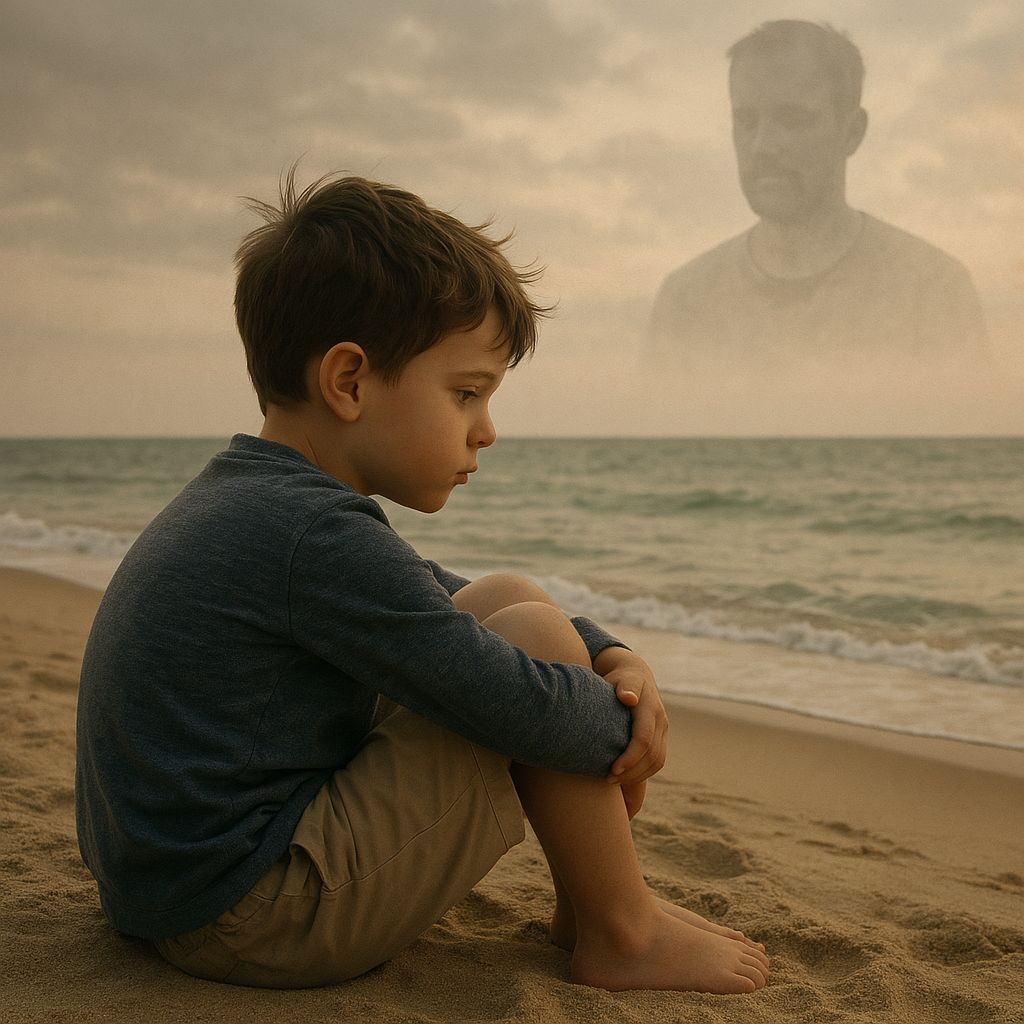
Every summer, Cole’s mother drove him to the same stretch of beach on the Georgia coast — the one with the pale brown sand and the greenish water that smelled like salt and distance. She always brought exactly two towels, two bottles of water, and a paperback she never actually read. She spread her towel, lay on her stomach, and watched her son from behind her sunglasses while he walked to the water’s edge and sat down alone.
He was nine years old the summer it started. Old enough to understand that his father was gone, too young to understand what that really meant. Gone was a big word that had swallowed a whole person. It had swallowed weekend mornings and the smell of coffee and someone who called him “buddy” like it was his only name. Gone had happened on a Tuesday in February, quietly, with a bag and a car and a phone call that lasted four minutes.
Cole didn’t cry when his mother told him. He went to his room and sat on the floor between the bed and the wall — the narrow space where he kept his flashlight and his best rocks — and he stayed there until dinner. When he came out, his face was dry and his mother’s was not, and they ate macaroni and cheese without saying very much, and after that the subject of Dad became a room in the house where the door stayed shut.
But at the beach, Cole felt him.
He couldn’t explain it and he would never try to, not to his mother, not to his friend Marcus at school who had also lost his dad but to death, which seemed different and worse and more absolute. This was different. Cole’s father was somewhere. He had a phone number and a new address in Savannah and a woman named Diane who Cole had met once at a Chili’s and found perfectly nice and perfectly devastating. His father existed. He just existed somewhere else now, in a life that had been carefully rebuilt with Cole in the occasional-weekend slot and the holidays-we’ll-figure-out column.
~ ~ ~
What Cole felt at the beach was not his father’s presence exactly. It was more like the shape of him — the outline left behind when someone stands in front of a bright window and then steps away. You can still see it. The air still holds the memory of the form. Cole would sit with his knees pulled to his chest and stare at the flat gray line where the water met the sky, and just behind his left shoulder, slightly above and behind, he could feel the shape.
It never spoke. It never touched him. It was just there, the way grief is just there — not demanding anything, not going anywhere, simply present in the way that certain absences are more present than most things that actually exist.
“Dad,” he said once, out loud, to the ocean. He was ten by then. The word felt strange in his mouth, both too small and too heavy, like a stone you’ve been carrying so long you forget it’s there until you set it down.
A wave came in and erased the line his toe had drawn in the wet sand. He watched it go.
His mother, watching from behind her sunglasses, turned a page she hadn’t read.
~ ~ ~
He saw his father four times that year. Once in February for his birthday — they went bowling and his father bought him shoes that were a size too big because he’d guessed wrong and Cole wore them anyway without saying anything. Once in the spring, a weekend at the Savannah apartment where Diane made pasta and everybody tried very hard. Twice over the summer, brief visits that felt like job interviews for a relationship neither of them knew how to apply for.
His father was not a bad man. Cole understood this in the complicated way that children understand things — not with forgiveness, exactly, but with a kind of weary accuracy. His father was someone who had wanted a different life and had gone to get it, and the getting had required leaving, and the leaving had required Cole to learn how to be a boy without a daily father, which was a skill nobody teaches you and everybody eventually grades you on.
What Cole minded most — more than the absence, more than the birthday shoes, more than the Chili’s lunch with Diane — was the way his father talked to him now. Carefully. Like Cole was a thing that might break. Like every sentence had been reviewed by some internal legal team before being released. His father used to be loud and careless and funny in the random unpredictable way that made Cole laugh until his stomach hurt. Now he was measured. Considered. Kind in the exhausting way that guilty people are kind.
Cole missed the loud, careless version. He would have taken that version, with all its mess, over the careful one every single time.
~ ~ ~
The summer he turned eleven, Cole started writing letters he never sent. Not on paper — he wasn’t a paper kind of kid — but in his head, at the beach, while the water came and went and the shape hovered at his shoulder. He’d compose them carefully, the way you compose something you know will never be read, which meant he could say exactly what he meant.
He told his father about the soccer game where he scored twice and looked to the sideline before he remembered. He told him about the time Marcus’s dad showed up and took them both for ice cream and how that felt like borrowing something that belonged to someone else. He told him about the nightmare he’d been having, the one where his father was in the next room but the door had no handle from Cole’s side. He told him that he didn’t hate him. He told him that some days he almost wished he did, because hate would have been simpler and easier to carry than this thing he actually felt, which had no name and no season and no clean edges.
He told him about the shape. How he felt it at the beach. How it never left, how it never spoke, how it was the most faithful thing his father had ever given him — this ghost made of love and loss and all the ordinary mornings that never happened.
“I don’t know if I’m supposed to let go of you,” he said once, to the water. “Nobody tells you that part. They tell you it gets easier. They don’t tell you what to do with the part that doesn’t.”
The wave came in. The wave went out.
~ ~ ~
On the last day of that summer, Cole’s mother sat down next to him in the sand. She didn’t say anything for a long time. She just sat with her knees pulled up, looking at the water, and for a moment they looked exactly the same — the woman and the boy — both of them carrying the same thing in different-shaped containers.
“You doing okay?” she asked finally.
“Yeah,” he said.
She put her arm around his shoulders and pulled him into her side. He let her. The shape behind him shifted — softened — became something less like absence and more like memory, which is what absence becomes when you finally decide to carry it instead of fight it.
The sun was going orange over the water. Somewhere down the beach, a family was packing up their umbrella and calling a child’s name over and over in that tired-happy way parents call children at the end of a good day. Cole watched them. He watched the father lift a little girl onto his shoulders and hold her ankles while she shrieked with laughter, and he watched it the way you watch a country you’ve never been to — with curiosity, with wistfulness, with a homesickness for something you aren’t sure you ever had.
But he did not look away. That was the thing. He watched until they were gone, until the beach was nearly empty and the sky had turned the color of old roses, and then he stood up and brushed the sand from his shorts and picked up his shoes.
“Ready?” his mother asked.
“Yeah,” he said.
He took one last look at the water. The shape was there, faint as always, made of light and salt air and the particular grief of a boy who is loved by a father who simply could not figure out how to stay. Cole looked at it for a long moment. He didn’t ask it to leave. He didn’t ask it to speak. He just let it be what it was — the truest, saddest, most permanent thing his father had ever left him — and then he turned and followed his mother up the sand toward the car, toward home, toward the long ordinary life still waiting to be lived.
The waves came in behind him. The waves went out. The beach kept no record of who had sat there or what they had carried. The water had no opinion about fathers or sons or the impossible distances between them.
But Cole knew. He would always know.
And somehow — slowly, the way the tide moves, without announcing itself — that was enough to keep walking.
“Some absences stay with you not because they haunt you,
but because you loved them too much to let them go.”
— End —
