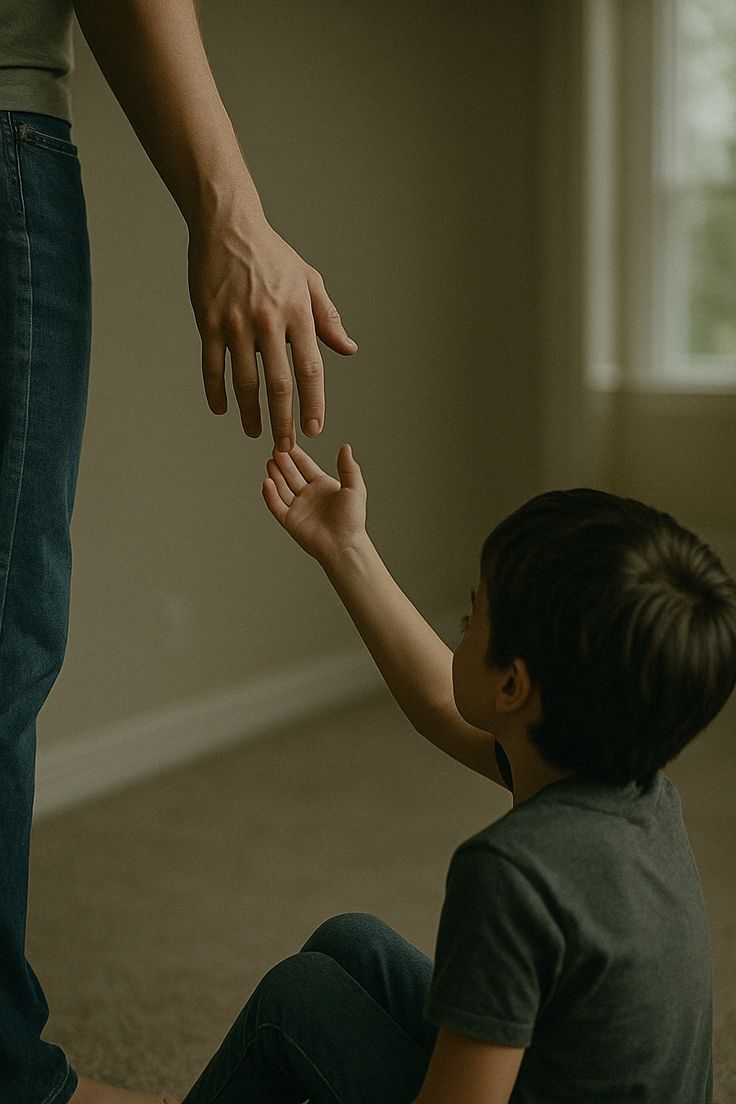
The room was empty in the way that only recently emptied rooms can be — not peaceful, not clean, but hollow. The kind of empty that still holds the shape of everything that used to be there. A darker rectangle on the wall where a television had hung. Four small indentations in the carpet where a couch had stood for years. A single crayon — red — wedged against the baseboard, overlooked in the rush.
Marcus, seven years old, sat in the middle of the floor and looked at that crayon for a long time.
Three hours ago this had been their living room. Their apartment. Their home on the second floor of a tan brick building on Clearwater Drive in Columbus, Ohio, where Marcus had lived his entire life, where he had learned to walk by pulling himself up on that very couch, where he had memorized every sound the radiator made and every crack in the ceiling above his bed and every squeaky floorboard between his bedroom door and the bathroom, useful knowledge for Christmas Eve navigation.
Now it was just a room.
His mother, Lynn Calloway, stood near the door with her phone pressed to her ear, speaking in the low, controlled voice she used when she was trying not to fall apart in front of him. She’d been using that voice a lot lately. Since the papers. Since his dad’s truck disappeared from the parking lot one morning and didn’t come back. Since the letter from the landlord that she’d tried to hide under a dish towel but that Marcus had already seen and partially read, enough to understand the words thirty days and vacate.
He didn’t fully understand vacate. But he understood thirty days. He was good at math.
He had counted.
Today was day thirty.
Lynn hung up the phone and stood very still for a moment with her back to him. He watched her shoulders rise and fall — once, twice — the deliberate breathing of someone constructing themselves from the inside out. Then she turned around, and her face was the face she always showed him: steady, present, a little tired around the eyes but warm in the way a lamp is warm, reliable and constant.
She crossed the empty room and sat down on the floor beside him, which surprised him. His mother was a stand-up kind of person. She cooked standing, she talked on the phone standing, she paid bills at the kitchen counter standing, as if sitting down might give whatever was chasing them a chance to catch up.
But she sat down now. Right there on the carpet with its four ghost-indentations, and she sat close enough that their arms were touching.
“Hey, buddy,” she said.
“Hey,” he said.
They looked at the red crayon together.
“You know what that is?” she asked.
“A crayon.”
“Which one?”
He squinted. “Red. Maybe scarlet. Could be crimson.” He was particular about colors. Had been since he was four and his kindergarten teacher had the audacity to call his careful sky drawing blue when it was obviously cerulean. He hadn’t forgotten it.
Lynn smiled. A real one, not a constructed one. “Could be vermillion.”
“Vermillion,” he repeated, testing it. “Yeah. Maybe.”
She didn’t say anything for a minute. Outside, a truck rumbled past. Somewhere below them, the family on the first floor was having dinner — Marcus could smell it, something with garlic and onion, a smell so ordinary and domestic that it made his chest hurt in a way he didn’t have vocabulary for yet.
“Mom,” he said.
“Yeah.”
“Where are we going tonight?”
She took a slow breath. “Aunt Patrice’s. Just for a little while.”
Marcus considered this. Aunt Patrice lived forty minutes away in a house that smelled like lavender and had a cat named Gerald who regarded all visitors with profound suspicion. It wasn’t bad. It wasn’t home. “How little is a little while?”
“I don’t know exactly.”
He appreciated that she didn’t make something up. His father had been a maker-upper — just a few minutes, buddy, just a short trip, just a small change, it’ll be fine — and none of those things had been true. His mother was different. When she didn’t know, she said so. It scared him and comforted him at the same time, the way the truth usually does.
“Okay,” he said.
She looked at him sideways. “Just okay?”
“What do you want me to say?”
“I don’t know.” She rubbed her face with both hands. “Something. Yell at me. Ask me why. Be mad.” She dropped her hands into her lap and looked at the ceiling. “You’re allowed to be mad, Marcus. This is — this isn’t how it was supposed to go. I know that.”
He thought about it seriously, the way he thought about most things. Was he mad? He felt around inside himself the way you check a pocket for a missing thing — carefully, reaching into all the corners. He found sadness. He found a low, persistent anxiety that had been living just behind his sternum for three months like a tenant who’d stopped paying rent but wouldn’t leave. He found something tired and something confused and something that felt almost like relief, which confused him, because what was there to be relieved about?
He didn’t find mad.
“I’m not mad at you,” he said.
“Marcus—”
“I’m not.” He picked at the carpet. “Dad left. The landlord did the letter. Those aren’t your faults.”
She made a sound that wasn’t quite a word. Her jaw tightened.
“Are they your faults?” he asked. He genuinely wanted to know.
“No,” she said, and her voice only broke a little. “No, baby, they’re not.”
“Then I’m not mad at you.”
Lynn looked at her son — really looked at him, the way parents sometimes do when their children say something that rearranges their internal furniture. He was small for seven, dark-haired, with her own eyes and his father’s stubborn jaw and a quality of attention that had always seemed too large for his body, like he’d been given a grown person’s capacity for observation but a child’s frame to carry it in.
She thought: I have to protect him.
She thought: I don’t know how to protect him from this.
She thought: He is already protecting me.
That last thought was the one that broke her open.
She didn’t sob. She wasn’t a sobber. But her eyes filled and overflowed and she didn’t wipe them away, just let the tears run down her face in the empty room while her son sat beside her on the carpet and pretended to study the vermillion crayon so she could fall apart without an audience.
That was when Marcus reached up.
He didn’t plan it. Didn’t think about it. His small hand simply rose and found hers where it rested in her lap, and he held it — held her hand the way she had held his a thousand times crossing parking lots and doctor’s office waiting rooms and the scary dark stretch of sidewalk between the bus stop and their building, the automatic clasp of someone who understands that being held is the whole thing, the entire point, the one answer that fits every question grief can ask.
She held back.
They sat like that in the empty room for a long time, not talking, the evening going gray around them, the garlic smell drifting up from below, the vermillion crayon exactly where it was.
Aunt Patrice’s house was warm and smelled like lavender and had a cat named Gerald who came and sat on Marcus’s feet at 11 PM, which Marcus chose to interpret as acceptance rather than coincidence.
He slept on a fold-out couch with a bar that pressed into his back and a quilt that smelled like a cedar chest, and before he closed his eyes he stared at the unfamiliar ceiling and catalogued what he knew for certain, which was a thing he did sometimes when the world felt unstable — a personal inventory of solid facts.
He knew his mother was in the next room.
He knew her name was Lynn Marie Calloway and she was thirty-four years old and she could make a meal out of almost anything in a refrigerator and she had never once, not in seven years, failed to show up.
He knew Gerald was a gray tabby who was pretending to be indifferent but was clearly not.
He knew the word vermillion.
He knew that his mother’s hand, when she held his, had stopped shaking.
He held onto these facts the way you hold a railing in the dark — not because you can’t walk without it, but because the railing is there, and solid, and why wouldn’t you hold it.
Four months later, Lynn Calloway signed a lease on a two-bedroom apartment on Fenwick Street, six blocks from Marcus’s school. It was smaller than Clearwater Drive had been, with a galley kitchen and windows that let in the afternoon light at a long, generous angle that turned everything gold from three to five PM.
On moving day, Marcus carried boxes. Real ones — he insisted. Not the light stuff, not the bags. Boxes. His mother kept trying to redirect him to the pillows and he kept ignoring her, which she eventually gave up on with the quiet respect one gives to a force of nature.
When his room was done — bed assembled, bookshelf built, curtains hung — he stood in the doorway and looked at it for a long time.
“Well?” Lynn said from behind him.
He walked to the window and looked out at Fenwick Street. A kid about his age was riding a bike with training wheels on the sidewalk below, very seriously, tongue between teeth. Two old men were playing chess at a folding table outside the corner store. A woman in scrubs was walking a dog so large it was practically a geographical feature.
“I can see everything from here,” Marcus said.
Lynn came and stood beside him at the window. Their reflections looked back at them faintly in the glass — a woman and her son, the same eyes, different heights.
“Marcus,” she said.
“Yeah.”
“Thank you.” She paused. “For the floor. That night. For—” She shook her head, couldn’t quite find the rest of it.
He looked up at her. “I just held your hand.”
“I know.” She put her arm around his shoulders and pulled him in. “That was everything.”
He leaned against her and looked back out at Fenwick Street, at the kid on the bike, at the chess players, at the enormous dog, at the afternoon light turning the whole ordinary scene gold.
He didn’t say anything.
He didn’t need to.
Some things, he was learning, don’t need words. They just need presence. Just need someone willing to sit down on an empty floor and stay there. Just need a hand reaching up in the half-dark and another hand reaching down, fingers barely touching, the fragile and complete circuit of two people deciding — without discussion, without negotiation, without any guarantee of what comes next —
not to let go.
