The hallway outside Suite 14-North smelled like money.
Not literally, of course — it smelled like fresh eucalyptus and the particular brand of antiseptic that private hospitals use when they want their patients to forget they’re in a hospital at all. It smelled like heated towels and imported wood panels and the faint ghost of whatever catered meal had been delivered two hours earlier in a covered silver dish. But Tommy Vega, eleven years old, with holes in both knees of his jeans and suspenders his grandfather had worn before him, had grown up in a neighborhood where the air tasted like exhaust and fryer grease and bus exhaust, and he knew the difference immediately. The difference was money. It had a smell. Clean and cold and unearned.
He walked through it like it was nothing.
The nurses at the station looked up when he passed. A boy like him in a place like this produced a particular kind of attention — not hostile, not yet, but watchful. Alert. The way people look at something that doesn’t fit the pattern. He was small for eleven, dark-eyed, with his mother’s jaw set at an angle that her sister always said meant don’t try me, and he carried the metal rod — a length of pipe from a busted curtain rail, retrieved from the dumpster behind their building on Ardmore Street — down at his side like he knew exactly what he was going to do with it.
He did.
Room 1408. Victor Hale. The Victor Hale, founder of Hale Capital Group, net worth listed at $2.3 billion on the Forbes page Tommy had looked up on the library computer three weeks ago, sitting perfectly still in the plastic chair while the printout cooled in his hands. The man had a floor-to-ceiling window overlooking the Chicago skyline. The man had a private nurse named Bev who brought him sparkling water with lemon every two hours. The man had a leg — his left leg, shattered in four places in a skiing accident in Aspen six weeks ago — suspended in an enormous plaster cast above the bed by a pulley system that looked, to Tommy, like something designed to hold a whale.
The man also had never, not once in eleven years, called.
Tommy pushed the door open.
Victor Hale was fifty-one years old and looked, in this moment, like a man who had never once considered that the universe might have opinions about him. He was propped against four pillows in a bed that probably cost more per night than Tommy’s mother made in two weeks of double shifts at the laundry. His silver hair was perfectly arranged. He was on the phone, speaking in the flat, bored voice of someone for whom all conversations are negotiations. His suspended leg hung in the air above him like a proclamation.
He didn’t look up when the door opened.
He looked up when Tommy swung.
The pipe connected with the cast with a sound like a gunshot — a hard, percussive crack that split the plaster down the middle and sent a cloud of white dust exploding into the room in a slow, perfect billow, particles catching the last gold light coming through the panoramic window and turning briefly, impossibly beautiful before the screaming started.
Victor screamed. The phone hit the floor. Bev, the private nurse, screamed from the corner. Dr. Anand Chen, who had been reviewing charts by the window, dropped his tablet and pressed himself against the wall. Two orderlies appeared in the doorway, frozen.
Tommy stood in the center of it all, in the settling dust, breathing hard.
He was trembling. He hadn’t expected to tremble. He had planned this for three weeks — had stood at the bathroom mirror and practiced his stillness, had told himself he would be stone, would be the kind of person who does not shake — but his hands were shaking and his jaw was tight and he was absolutely not going to cry, he was not.
Victor’s screaming descended into a ragged, furious silence. His face had gone the color of the plaster dust. His eyes, gray and sharp and accustomed to boardrooms and courtrooms and the particular battlefield of men who treat everything as a transaction, found Tommy and fixed on him.
“What—” His voice was barely a sound. “Who are you.“
The room held its breath.
And then something happened that made Dr. Chen stop reaching for his pager.
Inside the ruined cast, fractured and hanging now at a new angle, the toes of Victor Hale’s left foot — the foot the orthopedic team had been quietly, carefully concerned about for six weeks, the foot that had shown no independent motor response since surgery, the foot whose stillness had prompted a second opinion and then a third — twitched.
All five of them. A clear, unmistakable flex, like a hand clenching in a dream.
Dr. Chen said, very quietly, “Oh my God.“
Victor didn’t notice. Victor was still staring at Tommy.
Tommy noticed. Tommy saw it and something in his face shifted — the ferocious set of his jaw softened by a millimeter, which on his face was the equivalent of another person weeping openly.
“You said heal you,” Tommy said. His voice came out smaller than he’d practiced. Younger. He hated that. “So feel it.”
Part Two: The Pendant
The silence lasted long enough to become a presence in the room.
Dr. Chen was examining the cast, calling in numbers to someone on his radio in a low, urgent voice. Bev had moved to Victor’s side, checking vitals with hands that were steadier than her expression. The orderlies had retreated to the hallway, uncertain whether they were needed.
Victor had not looked away from the boy.
He was cataloguing him the way the very wealthy catalogue things — systematically, looking for value and origin. The jaw. The eyebrows, thick and straight. The particular way the boy stood, weight forward, slightly asymmetrical, leading with the left shoulder. Something in his chest was going strange, a pressure he was attributing to shock, to pain, to the adrenaline of the last thirty seconds.
“How did you get in here,” Victor said. It wasn’t a question. It was a negotiation opener.
“Library card,” Tommy said, which was not an answer but was also not a lie — the librarian, Ms. Okafor, had helped him find the hospital’s public visiting hours, and he had simply walked in during them.
“I’ll have security—”
“She’s dead.”
Victor stopped.
“My mom.” Tommy’s jaw worked. “Elena Vega. She died six weeks ago.” He watched Victor’s face with a terrible attention, looking for the flinch, the recognition, the tell. “She said you knew her. From before. From when things were different.”
Victor Hale had made a career of keeping his face still. He kept it still now. But something moved behind his eyes — something old and quickly suppressed, the way you push a door shut on a room you haven’t entered in years.
“I don’t know anyone by that—”
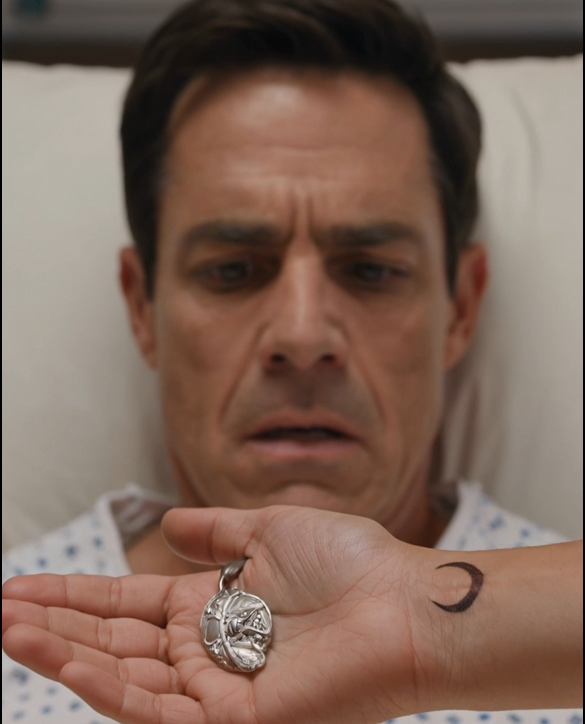
Tommy opened his hand.
The pendant lay in his palm. Small, silver, a crescent moon on a fine chain, worn smooth at the edges from years of handling. The chain was broken — had been broken for as long as Tommy could remember, because his mother had never gotten around to fixing it, or had never been able to afford to, or both. She’d kept it in a small wooden box on her dresser instead, and taken it out sometimes at night when she thought he was asleep, and held it the way people hold things they can’t explain and can’t release.
She’d pressed it into his hand in the hospital three days before the end. Not this hospital. The other kind — the kind with linoleum and fluorescent lights and four patients to a room. “If his leg ever wakes up,” she’d said, in a voice made thin by morphine and years, “go show him this. He’ll know.“
He hadn’t understood what she meant.
He understood now, watching Victor Hale’s face come apart.
It happened slowly and then all at once, the way structural failures happen — a hairline crack, another, and then the whole thing. Victor’s composure, the billion-dollar armor of a man who had insulated himself from consequence for two decades, simply fell. He went pale. His hand came up toward the pendant and then stopped in midair.
“Where did you—” His voice had lost all its register. “That’s—Elena had—I gave her—”
“I know,” Tommy said.
“She told you.”
“She told me enough.”
The memory came for Victor the way memories come when you’ve spent years running from them — not gradually but total, complete, immersive. Elena Vega at twenty-three, laughing in a parking garage in December, her breath making clouds in the cold air. Elena Vega in his kitchen, making coffee, the pendant catching the morning light. Elena Vega saying I’m pregnant, and Victor Hale — twenty-nine and ambitious and terrified of anything that couldn’t be put in a spreadsheet — saying the worst thing a person can say, which was nothing. Which was turning away. Which was writing a check and calling it resolution and never looking back.
He had never looked back.
Until now.
Tommy shifted his weight and the sleeve of his flannel shirt rode up, and the light from the panoramic window fell across the inside of his left wrist, where a birthmark sat — small, brown, crescent-shaped, exactly like his mother’s, exactly like the pendant — exactly like the one Victor Hale had noticed, years ago, on a woman he’d told himself he’d forgotten.
Dr. Chen was saying something. Bev was saying something. The city glittered forty floors below, indifferent and enormous.
Victor Hale, billionaire, looked at the mark on his son’s wrist.
He looked at the boy’s eyes — his own eyes, his mother’s jaw, Elena’s stubborn, beautiful, unbreakable spirit standing in a cloud of plaster dust with a curtain rod and eleven years of unanswered questions and a broken silver pendant—
And for the first time in longer than he could calculate, Victor Hale had nothing to say.
Tommy looked at him steadily. He was still trembling, slightly. He was absolutely not going to be the first to look away.
“She said,” Tommy said, very quietly, “that you weren’t a bad man. She said you were just a scared one.”
Victor’s hand was still raised between them, reaching for nothing, reaching for the pendant, reaching for twenty-nine years ago, reaching — maybe — for something that could not be taken back but might, if the world was still capable of such things, be slowly, imperfectly, painfully built forward into something resembling what it should have been from the start.
His toes moved again.
The doctors would say later it was coincidence. Trauma stimulus. The physiological shock of impact causing involuntary motor response in a nerve pathway previously compressed.
Tommy would never believe that.
He believed what his mother had told him: that some things in the body don’t heal until they’re ready. That sometimes being ready requires someone willing to break down the wall around the wound.
That sometimes love — even furious, grief-stricken, eleven-year-old love — is exactly the right kind of hammer.
The pendant lay in his open palm.
The city burned gold outside the window.
Neither of them spoke.
Neither of them left.
