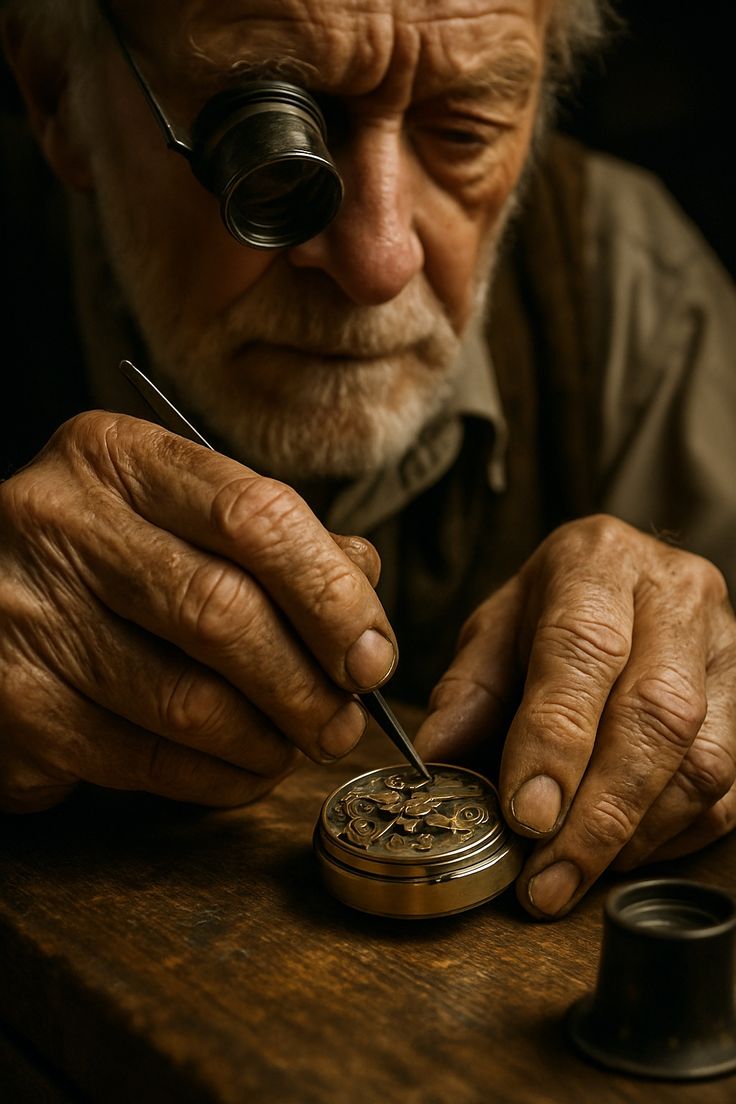
The watch had not belonged to anyone living for seventy-three years.
Elias Vorn knew this because he knew the watch — had known it, in fact, since the afternoon in 1962 when his father had placed it on the workbench between them and said, in the careful voice he used for important things: this one we do not repair. This one we only keep. Elias had been fourteen years old and the instruction had struck him as strange, because the Vorn workshop on Halsted Street in Chicago had been repairing watches since his grandfather’s time, and the entire grammar of the place — the smell of oil and metal, the rows of movements in their velvet trays, the loupe his father wore like a third eye — was built around the premise that broken things existed to be made whole. A watch you kept but did not repair was a contradiction the shop had no category for.
He had not asked questions. His father had not invited them.
Now Elias was seventy-six years old and the shop on Halsted Street was his, had been his for thirty-one years since his father’s death, and the watch sat in the same drawer it had always sat in — the third drawer on the left, the one with the green felt lining — and Elias had kept it the way his father had told him to keep it, without understanding why, because some instructions from the dead require obedience before they yield their reason.
Today he had taken it out.
He had taken it out because of the letter, which had arrived on a Tuesday in November from an address in Zurich and which he had read four times before setting down and going to the kitchen to make coffee and then reading again. The letter was from a woman named Clara Herrmann, who identified herself as a historian of wartime cultural property — the careful academic phrase for the things that were taken — and who had spent, she wrote, eleven years tracing the provenance of a pocket watch believed to have belonged to a man named Josef Adler, a watchmaker in Vienna, who had died in 1943. The watch, she wrote, had a distinctive case — gold, engraved with a scene of a horseman that was the maker’s personal mark, found on no other piece — and the last known record of it placed it in Chicago in the mid-1940s, in the possession of a watchmaker on the North Side. She was writing, she said, on behalf of Josef Adler’s granddaughter, who was eighty-one years old and lived in Tel Aviv and had been looking for her grandfather’s work her entire adult life, because it was the only thing of his that had survived, and because her mother had described it to her in such detail, so many times, that she felt she would recognize it by sight even though she had never seen it.
Elias had read the description of the engraving.
The horseman. The particular stance of the horse, one front leg raised. The specific style of the border, a repeating vine pattern. The initials J.A. on the inside of the case back, small and precise, the way a craftsman marks what is his.
He had gone to the third drawer. The green felt. He had taken out the watch and set it under his loupe and looked at it the way he had looked at a thousand watches across sixty years of this work — carefully, completely, with the full attention of a man who understands that the things he examines contain more history than they appear to.
The horseman. One leg raised. The vine border. And on the inside of the case back, almost too small to read without the loupe: J.A.
He sat for a long time.
His father had told him, once, very late in his life, that the watch had come to the shop through a man who could not adequately explain how he had come to possess it, and that his father had accepted it and put it in the drawer because a watch that cannot explain itself deserves, at minimum, to be preserved against the day when its story becomes possible to tell. That was the sentence. Elias had written it in the small notebook he kept of the things his father said that seemed to require preservation. He had not fully understood it until now.
He picked up the tweezers out of habit — the gesture of a man about to work — and then set them down again, because this was not work. This was something else. This was the end of a seventy-three-year waiting, and it required not the precision of a craftsman but the care of a person returning something to its rightful place in the world.
He looked at the watch through his loupe.
Josef Adler had made this. Had sat at a bench somewhere in Vienna — a bench not unlike this one, with tools not unlike these, with the same loupe, the same tweezers, the same absorption in the small mechanical world of a movement — and had made this case, had engraved this horseman with these hands, had pressed these initials into the case back with the quiet satisfaction of a man marking what he had made. He had had a daughter. The daughter had had a daughter, and that daughter was eighty-one years old in Tel Aviv and had been told about this watch her whole life, described it so many times by her mother that she felt she would recognize it by sight.
Elias thought about what that meant. To carry the description of a thing you have never seen. To know something so completely through someone else’s telling that it becomes its own kind of possession, its own kind of grief.
He thought about his father’s drawer. The green felt. The thirty-one years of keeping without understanding why.
He thought about how long the right things sometimes take to find their way home.
He set the watch down gently on the bench, in the circle of light from his lamp, and looked at it — the horseman frozen mid-stride, the vine border, the life’s work of a man who had not survived to know whether anyone was still looking for it.
Someone was.
Elias reached for his pen and began to write the reply to Clara Herrmann in Zurich, and through her to the eighty-one-year-old woman in Tel Aviv who had her grandfather’s description of this watch memorized by heart and had been waiting, in one form or another, her entire life.
He wrote slowly, with the same care he brought to the movements on his bench, because some things deserve to be said precisely, and the sentence he was trying to write — the one that began with I have it, it is here, it has been kept — was the most important thing his hands would do today, and possibly the most important thing they had ever done.
Outside on Halsted Street the November wind moved through Chicago with its particular cold authority, and the shop was warm and still, and the watch sat in the lamplight with its horseman and its vine border and its seventy-three years of silence that was about to, finally and completely, end.
Elias wrote.
The watch waited, as it had always waited, with the patience of a made thing that knows its maker gave it time enough.
