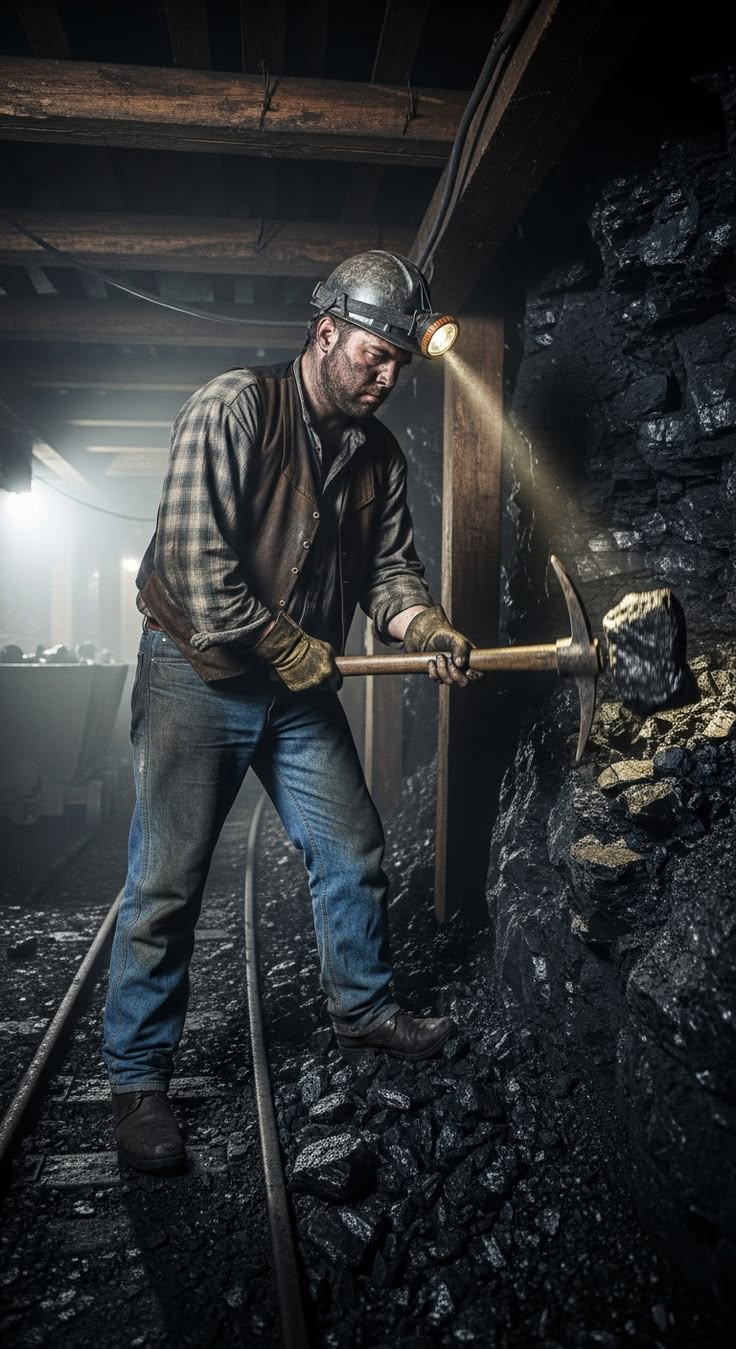
He had been underground for so long that sunlight had become something he only remembered, like a childhood song you can hum but never quite recall the words to. Dale Mercer, forty-three years old, third-generation coal miner from Harlan County, Kentucky, pressed his pickaxe into the black wall and felt the familiar shudder travel up through his arms, into his shoulders, settling somewhere deep in his chest where all the old aches lived.
His father had worked this same mine. His grandfather before that.
The lamp on his helmet threw a cone of orange light against the coal face, and in that pale glow, Dale could see the seam he had been chasing for three days running. It twisted through the rock like a dark river, promising everything, delivering nothing. That was coal mining in a nutshell, he always said. You chase what you cannot see, guided by nothing but instinct and stubbornness and the kind of faith that churches never talk about.
“You still at it?” Bobby Crane called from twenty feet back, his voice bouncing off the tunnel walls.
“Still at it,” Dale answered without turning around.
Bobby was thirty-one, new enough to still have questions, old enough to know when not to ask them. He leaned against a support beam and watched Dale work with the quiet respect that younger miners gave to the ones who had survived long enough to develop a rhythm. There was an art to it that no foreman ever taught and no training video ever showed. It lived in the hands. It lived in the spine.
Dale pulled back the pickaxe and swung again.
The mountain groaned.
That sound — low, resonant, like something enormous clearing its throat — made Bobby straighten up immediately. Every miner knew that sound. It was the earth reminding you of the agreement you had made when you first stepped underground. You could take what it offered, but it was never going to pretend that you were welcome.
“Dale.”
“I heard it.”
“We should call it.”
“Give me ten more minutes.”
Bobby looked at his watch, then at the ceiling, then back at Dale’s broad shoulders hunched over the work. He had seen older men make this calculation before. The ten more minutes calculation. Sometimes it paid off. Sometimes it became the last ten minutes a man ever had.
“Ten minutes,” Bobby agreed, because there was nothing else to say.
Dale worked in silence. His hands were the color of the coal itself now, permanently stained despite every scrubbing, as though the mine had tattooed its claim on him years ago and he had simply stopped fighting it. His wife, Linda, used to hold those hands at the dinner table and trace the dark lines in his palms like she was reading a map of somewhere she had never been and was not sure she wanted to go.
Linda had left four years ago. Not because she stopped loving him. That was the part that still sat wrong in his gut. She left because she did, in fact, still love him, and she could not spend another decade standing at the kitchen window at shift-change time, watching the road, waiting to find out which version of the day she was going to get. The version where his truck came up the drive, or the version where a different vehicle came instead, slower, with men in it who held their hats in their hands.
He did not blame her.
He had thought about quitting after she left. Thought about it the way a man thinks about stopping drinking — seriously, repeatedly, and without ever quite doing it. The mine was the only language Dale Mercer spoke fluently. Everything above ground had always felt like a foreign country where he could manage the basics but would never belong.
His son, Tyler, was seventeen now. Talked about college. Talked about engineering, maybe, or environmental science. Dale listened to these conversations with a pride so fierce it embarrassed him, and a loneliness so deep he could not find the bottom of it. Tyler was going to be the first Mercer in three generations to build something above the earth instead of carve through it below.
That was worth everything.
The mountain groaned again, longer this time.
“Dale. That’s it. We’re done.”
This time Dale stepped back. Not because he was afraid — fear had become so routine underground that it had lost its urgency years ago — but because he was not reckless. Reckless men did not make it to forty-three in a Kentucky coal mine. Reckless men became the stories foremen told new hires on their first day.
He pulled the pickaxe free, rested it against his thigh, and looked at the wall one last time. In the beam of his lamp, something caught the light differently. A line in the coal face, thinner than a finger, running horizontal for about two feet before disappearing into the rock.
Gold.
Not actually gold. He knew that. But miners called it that sometimes, informally, among themselves. The tell-tale shimmer that meant the seam had shifted, that the vein was about to widen, that three days of chasing had not been madness after all.
He stood there a moment longer than he should have.
Then he turned and followed Bobby toward the light.
