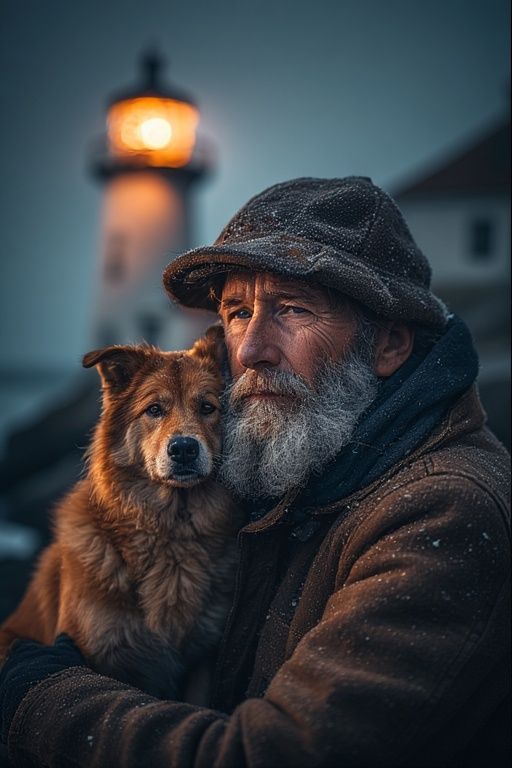
Every night at dusk, Henry Marsh climbed the lighthouse stairs alone.
Except that he was never entirely alone, because Rufus came with him — had come with him every evening for nine years, padding up the iron spiral with the patient deliberateness of a dog who has long since accepted that his person’s peculiarities are simply the terms of the arrangement. Rufus was a large red mixed breed of uncertain ancestry and absolute loyalty, and he had appeared at the lighthouse door in the February of Henry’s third year on Carver Point the way certain things appear in a man’s life — without warning, without explanation, in weather that made their arrival feel like something more than coincidence. Henry had fed him once and that had been the end of the question. Some decisions make themselves.
Henry was sixty-seven years old and he had been the keeper of Carver Point Light for eleven years, which made him one of the last working lighthouse keepers on the Maine coast and something of an anachronism, a word the journalist from Portland had used in the article she’d written about him two years ago, which Henry had read once and found accurate without finding it complimentary. The light was automated. Had been for decades, like almost all of them. Henry’s official title was Facility Maintenance Supervisor, which was the Coast Guard’s way of saying someone needs to live here and keep the building from falling into the sea, and we’d rather not pay for that person to have an interesting job title. He maintained the structure. He logged the weather. He reported anomalies. He kept the grounds.
And every evening at dusk he climbed the stairs and stood at the top and watched the light come on and looked out at the water.
He could not have explained this to anyone’s satisfaction, including his own. The light came on whether he watched it or not. The sea required no witnessing. The fog and the rocks and the dark water of Penobscot Bay had been conducting their business without a human audience for considerably longer than Henry Marsh had been alive and would continue to do so long after. There was no practical reason for the nightly vigil. He went anyway. Rufus came with him. The light came on. Henry looked at the water. Something in him that was tightly wound through the days of maintenance and logging and the small practical business of his solitary life came loose for a little while, and then he went back downstairs and made dinner and read until ten and slept.
He had been doing this for eleven years.
He had come to Carver Point the winter after his wife, Joan, had died, and his son, Patrick, had suggested — with the careful, pained diplomacy of a thirty-year-old man trying to help his father without knowing how — that perhaps a change of scene would be useful. Henry had agreed not because he believed it would help but because the alternative was staying in the house in Portland where every room contained a version of Joan that the room’s current emptiness was constantly measuring itself against. He had applied for the Carver Point posting on a Tuesday afternoon and been approved by Friday and had driven up the coast on a grey November morning with everything he needed in the back of his truck and had not, if he were being precise about it, come fully back.
That was not as dark as it sounded. He had made peace with that distinction.
He had not made peace with everything. There were things at Carver Point that the sea air and the solitude and the nightly vigil had not resolved. Patrick, for one — their relationship worn to something thin and careful by years of Henry’s removal, both before Joan died and after. A conversation they needed to have, he and Patrick, that kept not happening for reasons that were each individually insufficient and collectively amounted to two stubborn men on opposite ends of a line they both kept failing to pick up. Henry knew this. He thought about it on the stairs sometimes, going up in the last of the light with Rufus ahead of him, the dog’s nails clicking on the iron, the wind working at the glass above.
He thought about it tonight.
The light came on — that great turning amber beam, reliable and indifferent and somehow, despite its indifference, comforting in the way that reliable things are comforting. Rufus sat beside him at the window, his warm weight against Henry’s leg, his eyes on the same dark water. Below, the rocks of Carver Point took the last of the day’s light and gave it back as something colder, something that had passed through stone and come out changed.
Henry put his arm around the dog.
“Getting colder,” he said.
Rufus offered no opinion on this but pressed closer, which was opinion enough.
The beam swung its long arm across the water, out and out and out, reaching as far as light reaches and then conceding the rest to dark. Henry had thought, in his first year here, that the lighthouse’s job was to guide ships safely in. He understood now that this was only part of it. The other part was simply to be visible. To say, from a fixed point in an unreliable dark: here. I am here. Whatever you are navigating toward or away from, whatever the sea is doing to you tonight, here is a point you can take your bearing from. I am not going anywhere.
That was the whole job. Fixed point. Known location. Unwavering.
He had come to think of it, quietly and without sharing this with anyone, as the best description he had of what a person could aspire to be for the people they loved. Not a guide, necessarily. Not a solution. Just a fixed light in a reliable place. Here. I am here. Take your bearing. I am not going anywhere.
He had been better at it for the lighthouse than he had been at it for Patrick.
That was the honest accounting.
He stood at the top of Carver Point Light in the November dark with the beam going out and Rufus warm against him and the water doing what the water always does, which is to refuse to tell you anything while somehow telling you everything, and he made a decision that he had been making and unmaking for two years, in this same spot, in this same light.
He would call Patrick in the morning.
Not with a plan. Not with an agenda. Just to call. Just to say: I am here, on a fixed point, and I am not going anywhere, and I know I have been poor at demonstrating that, and I would like, if you are willing, to do better.
The light swung out again over the dark water.
Below, somewhere in the November sea, some vessel was taking its bearing.
Henry Marsh, sixty-seven years old, keeper of a light he didn’t need to keep and didn’t know how to stop keeping, looked out at the water with his dog beside him and let the decision be made, finally and completely, the way decisions are made when you have been circling them long enough that the circling itself has become exhausting.
In the morning he would call his son.
Tonight, the light was on, and the water was dark, and the beam went out again, steady and faithful, the way the best things go — without drama, without fanfare, simply doing the work of being visible in a world that contains a great deal of dark.
Rufus sighed.
Henry put his hand on the dog’s back and felt the warmth of him, the reliable warmth of a living thing that had chosen him and stayed.
“Good boy,” he said softly.
He meant it in every direction.
