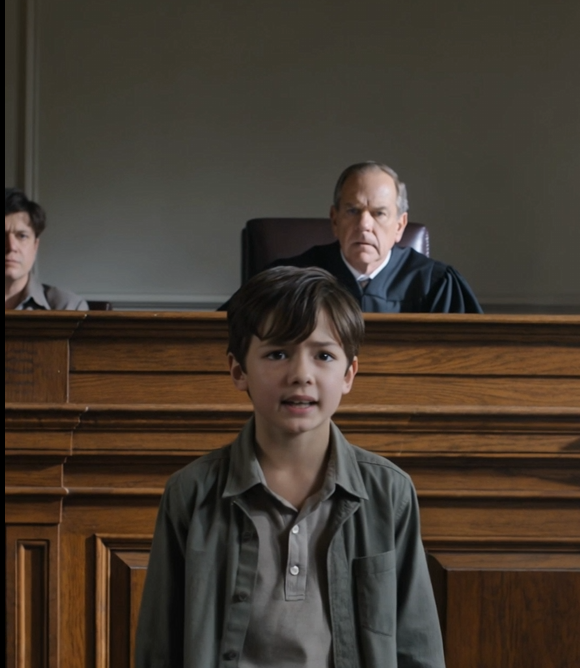
The trial had been going for eleven days when the boy walked in.
Nobody knew his name yet. That was the first thing people noticed — not his age, not the way he was dressed, not the fact that he came in alone and sat in the back row of the gallery without looking at anyone. They noticed that he was carrying a piece of paper folded in quarters, and that he held it in both hands in his lap the way you hold something you’ve been keeping for a long time and have finally decided to use.
His name, the court would learn, was Marcus Hale. He was thirteen years old. He lived four blocks from the parking garage on Renner Street where, on the night of September 4th, a man named Calvin Drewe had been beaten and left for dead, and where Raymond Okafor — twenty-six years old, no priors, a line cook at a place called Lena’s on the east side — was currently on trial for attempted murder.
Raymond Okafor had been sitting at that defense table for eleven days. He had not changed expression much. His mother came every morning and sat in the second row and held her purse in her lap and did not cry, which the people around her found either impressive or heartbreaking depending on who they were.
Marcus Hale unfolded his piece of paper during the lunch recess and gave it to the bailiff. The bailiff read it once, then read it again, then took it to the judge’s clerk. By the time afternoon session began, the paper had traveled from the clerk to the judge’s chambers to the defense attorney, a tired-looking woman named Priscilla Vann, who read it standing in the hallway outside courtroom four and then stood very still for a moment with her hand over her mouth.
The note said, in handwriting that was careful and slightly too large for the lined paper: I was there the whole time. I saw what really happened. The man they’re saying did it wasn’t the one who did it. I can tell you what color shoes the real person was wearing and I can tell you what they said after. Nobody has said any of that in the news so I know I’m the only one who was there. My name is Marcus and I am in the back of the room right now if you want to talk to me.
Judge Catherine Morrow — twenty-two years on the bench, unimpressed by nearly everything — was not unimpressed by this. She called both attorneys to the sidebar before the jury was brought back in, and she used a voice that people who worked in her courtroom described as her this is not a circus voice, low and very clear, and she said that if either of them had known about this witness and failed to disclose, she would find a way to make their year difficult in ways both creative and lasting.
Neither of them had known.
The prosecution — a man named Gerald Fitch, Assistant DA, known for his closing arguments and his dislike of surprises — asked for a continuance to investigate the witness. Judge Morrow denied it. She had the boy brought up.
Marcus Hale walked to the stand like he was walking to the front of a class to give a presentation he had prepared for but was still nervous about. He sat down and adjusted the microphone and looked at the jury — all twelve of them — for just a moment before looking back at Priscilla Vann, who was already on her feet.
“Marcus,” she said. “Tell us why you were in the Renner Street garage on the night of September 4th.”
“I go there sometimes,” he said. “The top level. It’s quiet up there and you can see the river. I was up there reading.”
“Reading.”
“I had a flashlight. I do that sometimes when it’s hot in our apartment.”
One of the jurors — a woman in the third seat who had the air of someone’s grandmother — nodded very slightly.
“What time did you arrive?”
“Around nine-fifteen. I checked my phone when I got there.”
“And what did you see?”
Marcus took a breath. He looked down at his hands once, then back up.
“Two men came up the ramp to the top level at maybe nine-forty. I was over by the far wall behind one of the concrete pillars so they couldn’t see me. One of them I recognized — it was Mr. Drewe, because he used to date my aunt and I’d seen him a bunch of times. The other one I didn’t know. They were already arguing when they came up. Mr. Drewe was the one doing most of the talking. He kept saying something about money that was owed to him.
“The other man had on a red Phillies cap and white Nike Air Force 1s. The kind with the little gray mark on the heel. I noticed because I want those shoes. He was bigger than Mr. Drewe — a lot bigger. Maybe six-two, six-three. Heavyset. He had a beard. He was not the man sitting at that table.”
The jury had gone still the way juries go still when something shifts in a room and everyone feels it at once but no one wants to be the first to show it.
Gerald Fitch was writing something on his legal pad with considerable speed.
“What happened next?” Vann said.
“The big man hit Mr. Drewe twice. The second time Mr. Drewe went down and didn’t get back up. I stayed behind the pillar. I was scared. Then the man stood over him for a second and he said — and I remember this exactly because it scared me bad enough that I wrote it down when I got home — he said, ‘You should’ve left this alone when I told you to.’ Then he walked back down the ramp.”
“After he left, what did you do?”
“I waited maybe five minutes because I was scared he was still around. Then I went down and I called 911 from the street. I didn’t give my name because I was scared. I’m fourteen — I mean thirteen — and I was out past when my mom thinks I’m home and I didn’t want to get in trouble.” He paused. “I know that was wrong. I’ve been thinking about it every day since.”
Gerald Fitch took the podium for cross-examination with the careful energy of a man walking across ice he hasn’t tested yet.
“Marcus,” he said. “You say you didn’t come forward sooner because you were afraid of getting in trouble at home.”
“Yes, sir.”
“But you also — you say you were hiding behind a pillar. It was nighttime. The garage is not well lit. Isn’t it possible you didn’t see as clearly as you think you did?”
“There are lights on the ceiling,” Marcus said. “Orange ones. And the man was standing right under one of them when he hit Mr. Drewe. I could see his shoes clear.”
Fitch paused. He had not mentioned the lights. No one at trial had mentioned the lights. The police report noted them — overhead sodium vapor fixtures, four operational on upper level — but that report had not been entered into evidence and had not been discussed in open court. Fitch knew that. He felt the ice shift under him.
“And the phrase you claim to have heard. ‘You should’ve left this alone when I told you to.’ You’re certain of those words.”
“I wrote them down when I got home.”
“You still have that paper?”
“My mom does. She’s in the hallway. She didn’t want to come in.”
Fitch looked at the judge. The judge looked back at him with an expression that communicated nothing useful.
“Your witness statement —” Fitch started.
“I didn’t give a witness statement,” Marcus said. “I told you. I called 911 and didn’t give my name. This is the first time I’ve told anyone.”
Fitch set his pen down on the podium. It was a small gesture. The gallery noticed it anyway.
He tried three more angles, each one careful, each one looking for the seam in the story. The red cap — Marcus knew the style of it, the way the brim sat flat, the year the Phillies had used that particular script. The shoes — he described the gray mark on the Air Force 1s with the specificity of a boy who had wanted something and looked at it carefully. The ramp — he described the sound of it, the way footsteps echoed on the concrete, the way he’d pressed himself against the pillar and held his breath and watched through the gap.
These were not the details of a story that had been assembled after the fact. They were the details of a night. The kind of thing you remember because you were there and it scared you and you’ve been turning it over ever since, the way Marcus Hale had clearly been turning it over, every day since September 4th, until he finally walked into a courtroom alone with a folded piece of paper and decided that some things weighed too much to keep carrying.
Fitch sat down.
In the second row, Raymond Okafor’s mother opened her purse, took out a folded tissue, and pressed it carefully to the corner of each eye. She did this quietly. She didn’t make a sound.
The judge called a recess.
In the hallway, a woman who could only have been Marcus’s mother was waiting on a bench, her hands folded, her face doing the particular thing that mothers’ faces do when their child has done something both terrifying and correct. She stood up when she saw him. She didn’t say anything. She just put her hand on the back of his head and pulled him into her, brief and hard, and then let him go.
“You have the paper?” he said.
“I have it.”
He nodded. He leaned against the wall and looked at the ceiling for a moment, exhaling slowly, the way you exhale when you’ve been holding something for a very long time.
Inside courtroom four, Gerald Fitch was on the phone with his supervisor. Priscilla Vann was sitting at the defense table with Raymond Okafor, and for the first time in eleven days she was smiling — carefully, just a little, like someone who doesn’t want to trust something yet but can feel the ground becoming more solid under her feet.
The jury would not be out long. Afterward, in the interviews and the think pieces and the local news segments that tried to find a lesson in it, people would talk about the justice system and eyewitness testimony and the randomness of truth, how it sometimes shows up late and unannounced, in the back row, carrying a folded piece of paper.
But Marcus Hale, sitting in a courthouse hallway with his mother beside him, was not thinking about any of that. He was thinking about going home. About the river, and the quiet of the top level of the garage, and whether he could still go there — whether it still belonged to him the way places belong to you before something happens in them.
He thought maybe it still did.
He thought: a thing happened there, and I saw it, and I said what I saw.
He thought that was probably enough.
