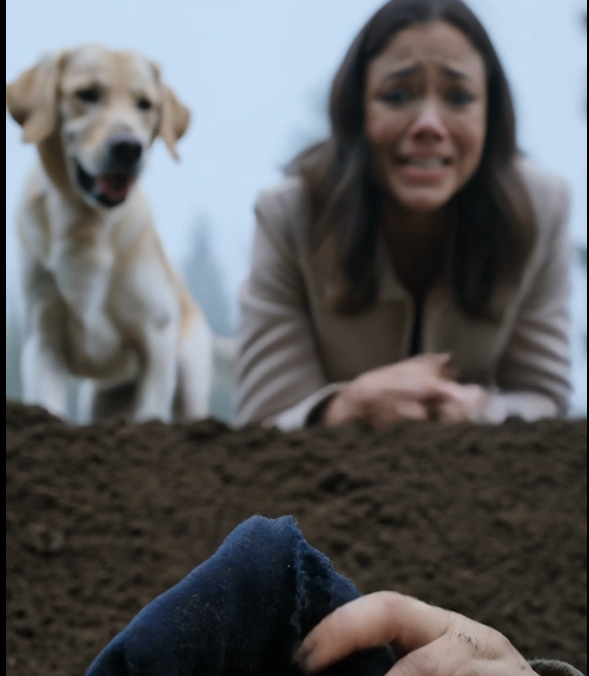
Karen Michaels heard the crying before she even turned onto Birchwood Lane.
It was the kind of sound that crawled under your skin — not quite a howl, not quite a whimper, but something broken in between. The kind of sound that didn’t belong on a Tuesday morning in a quiet Ohio suburb where the biggest drama was usually whose recycling bin had blown into whose driveway.
She almost kept driving.
She had a nine o’clock meeting. A cold coffee in the cupholder. A to-do list that was already two days behind. The last thing she needed was to stop for whatever animal had gotten itself into trouble on the side of Ridgewood Cemetery Road.
But the sound didn’t stop.
And Karen Michaels, for better or worse, had never in her life been able to drive past something that was crying.
She pulled over.
The cemetery was small by most standards — a community plot that had been here since before the town was properly a town. Old oak trees lined the iron fence, thick-rooted and heavy with shade. The gate was always unlocked during daylight hours. Karen had been here exactly once before, four years ago, for her neighbor Harold’s funeral. She remembered it being peaceful. Dignified. The kind of place that felt settled.
It didn’t feel settled now.
She followed the sound through the gate, her heels clicking against the stone path before she gave up and stepped onto the grass. The crying was louder here. More desperate. Coming from the newer section, past the old marble headstones and toward the modest granite markers near the eastern fence.
She saw the dog first.
A golden retriever — big, muddy, ribs showing just slightly beneath his coat, like he hadn’t been eating right. He was sitting beside a grave, his head tipped back, letting out those broken, rhythmic cries that had pulled Karen out of her car and across a cemetery in work clothes on a Tuesday morning.
“Hey,” she called out, more annoyed than concerned. “Hey, dog.”
The retriever’s head snapped toward her. He didn’t run. Didn’t growl. Just looked at her with dark, exhausted eyes, then looked back down at the ground beside the grave.
That’s when Karen stopped.
Because it wasn’t just the dog.
Next to the grave — pressed against the side of the headstone like he had been trying to get as close as possible to whatever was beneath the earth — lay a child.
A little boy.
He couldn’t have been more than five or six years old. He was on his side, curled into himself, his small hands clutching something against his chest. His clothes were filthy. His face was streaked with dried mud and something darker that Karen didn’t want to think about too closely. His shoes were missing. His hair was matted.
And in his hands — pressed tight against his chest like something precious, like something he would not let go of under any circumstances — was a piece of fabric.
Torn. Dirty. But unmistakably recognizable.
Karen had seen that fabric before.
Dark navy. A very specific pattern — small white anchors, evenly spaced, the kind of thing you’d special-order from a boutique and not find anywhere else. She knew that because her neighbor Margaret had mentioned it once, standing in Karen’s kitchen, crying into a paper towel, talking about how she’d had the pocket square made special for her husband’s burial. How he’d always loved the water. How it was the last thing she could do for him.
Thomas Reed had been buried in that fabric eleven days ago.
Karen’s mind went very, very quiet.
She took a step closer. Then another. The dog watched her carefully, not moving, not threatening — just watching, the way dogs watch when they’ve decided you might be trustworthy but haven’t fully committed to the idea yet.
“Hey,” she said softly. Different tone now. All the annoyance gone. “Hey, sweetie.”
The boy didn’t respond.
She crouched down a few feet away, her heart hammering somewhere in her throat. She could see now that he was breathing — slow and shallow, but breathing. His fingers were wrapped so tightly around the fabric that his knuckles were pale.
“Can you hear me?” she whispered.
Nothing.
She pulled out her phone and dialed 911 with one hand, keeping her eyes on the child. The dispatcher picked up on the second ring.
“I need an ambulance,” Karen said, and her voice only cracked slightly. “Ridgewood Cemetery, eastern section. There’s a child. He’s unconscious, I think, or close to it. He’s alone.” She paused. “And I need you to send someone who can tell me something. I need to know whose grave this is.”
She already knew whose grave it was. The headstone was right there, plain granite, freshly placed. Thomas Allen Reed. Beloved husband and father. But she needed to hear it from someone else. She needed someone to tell her she was wrong about what she was thinking, about the impossibility that was forming in her mind like ice water.
The dog made a low sound beside her. Not a cry this time. Something almost communicative. She looked at him, and he looked back, and for one completely irrational moment Karen felt certain the dog was trying to tell her something specific.
“I know,” she said quietly. “I see him.”
She stayed crouched on the ground, not touching the boy, not wanting to startle him if he came around, keeping her hand resting lightly near his until she could hear sirens in the distance. The retriever never moved from his spot. Just kept watch, steady and exhausted, like he’d been here for a very long time.
The paramedics arrived first. Then a patrol car. Then, four minutes later, a second patrol car carrying a detective named Frank Ochoa who had been three bites into a breakfast burrito when the call came in and had the distracted, redirected energy of a man who had mentally already moved on to more important things.
That changed the second he saw the grave.
“Reed,” he said flatly, reading the headstone.
“You knew him?” Karen asked. She was standing off to the side now, wrapped in a silver emergency blanket a paramedic had insisted on, watching them work on the boy with quick, practiced efficiency.
“I worked his case,” Ochoa said, and his voice had shifted into something careful. Measured. “Thomas Reed. Died twelve days ago. Ruled an accident.” He looked at Karen. “You said the kid was holding something?”
“They took it when they started treating him. Fabric. Navy with white anchors.” She watched his face. “It matched what I was told he was buried in.”
Ochoa was quiet for a moment. “Who told you what he was buried in?”
“His wife. Margaret Reed. She mentioned it to me once. Lives three streets over.”
The detective turned back to look at the boy, now on a stretcher, an oxygen mask being fitted over his small face. “You ever seen this kid before?”
“Never.”
“He have anything else on him? Before the paramedics?”
“Just the fabric. He was holding it like—” Karen stopped. “Like someone had given it to him. Like he’d been told to hold onto it.”
Ochoa wrote something in his notebook. His expression didn’t change, but something behind his eyes did — that small, involuntary shift that happens when a case you thought was closed starts opening itself back up.
“The dog,” Karen said. “Is it Thomas Reed’s dog?”
The detective looked at the retriever, who was now sitting near the cemetery gate, watching the paramedics load the stretcher. Nobody had tried to move him. Nobody had quite worked up to it yet.
“Reed had a dog,” Ochoa said slowly. “Golden retriever. Wife said it ran off the night Thomas died. She figured it was the trauma. Animals do that sometimes.” He paused. “We never found it.”
Karen stared at him.
“That was twelve days ago,” she said.
“Yes.”
“So the dog has been here. This whole time.”
Ochoa didn’t answer. He was already walking toward the stretcher, toward the boy, who had just opened his eyes for the first time — glassy, confused, blinking up at the grey Tuesday sky with the particular expression of someone who has no idea where they are or how they got there.
But then his gaze moved past the paramedics. Past Ochoa. Past Karen.
It found the dog.
And the boy’s face, pale and frightened and lost, did something that made every adult standing in that cemetery go very still.
He smiled.
Small. Exhausted. But real.
“Buddy,” the boy whispered.
The retriever made a sound — that same broken cry, but softer now — and took two steps forward before a paramedic gently blocked him.
Karen felt something tighten in her chest so hard it almost hurt.
“Whose kid is this?” she asked, her voice barely above a whisper.
Nobody answered. Because nobody knew yet.
But Frank Ochoa was already back on his phone, already pulling up the Reed file, already thinking about a case he had signed off on less than two weeks ago. An accident. Clean. Straightforward. No reason to look twice.
He was looking twice now.
Because a dog that had disappeared the night a man died had just been found guarding that man’s grave. And beside the grave had been a child nobody could identify, clutching a piece of the burial shroud in his frozen hands, in a cemetery that didn’t open until eight in the morning.
Which meant someone had brought him here before sunrise.
Which meant someone had wanted him found.
Ochoa looked back at the headstone. Thomas Allen Reed. The granite was clean and new, the engraving sharp. But at the base, half-hidden by the displaced soil, he noticed something he hadn’t seen before.
He crouched down.
It was a photograph, laminated, tucked deliberately against the stone. A man and a boy, maybe four years old, on what looked like a fishing dock somewhere green and sunny. The man was laughing. The boy was holding up a fish, grinning so hard his eyes had disappeared.
Ochoa turned the photo over.
On the back, in handwriting that was shaky but deliberate, were five words.
He knows what I saw.
The detective stood up slowly.
Behind him, the ambulance doors closed. The boy was inside, the dog finally allowed to jump up beside him, pressing close, refusing to be separated. Karen stood at the cemetery gate, the silver blanket still around her shoulders, watching Ochoa’s face.
“What is it?” she asked.
He looked at the photograph one more time. Then he looked at the headstone. Then he looked toward the ambulance as it pulled away, lights on, no siren — careful, deliberate, like it was carrying something fragile.
“It means Thomas Reed didn’t die in an accident,” he said quietly.
He pulled out his phone again.
“And whoever buried him knows we’re going to find that out.”
