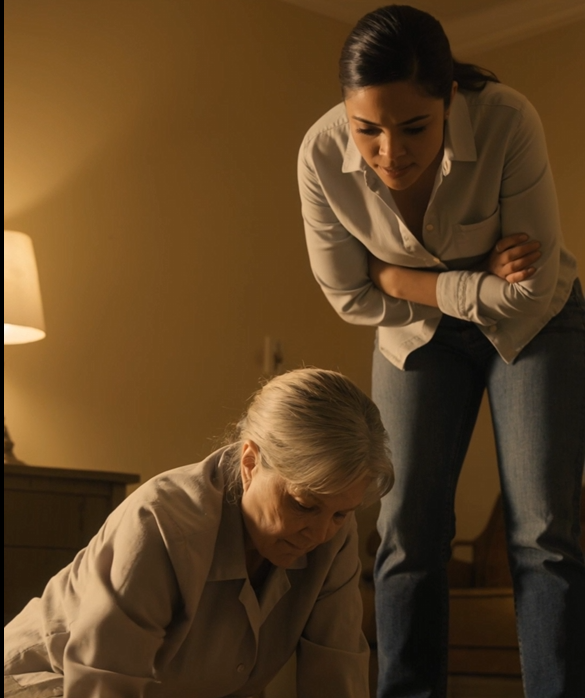
The first thing you notice is the floor.
She’s on her knees, scrubbing. Her hands — the same hands that held him when he had a fever, that rolled dough at 5 a.m. on holidays, that waved goodbye at every airport — are moving in slow circles against the tile. She doesn’t look up. She knows better than to look up.
His wife is standing over her. Feet planted. Voice sharp.
“You missed a spot. Are you even trying?”
The older woman says nothing. Her hands keep moving, slightly shaking. She has learned, somewhere along the way, that silence is the safest answer.
Then the door opens.
There’s a particular kind of frozen moment that happens when someone walks into a room and immediately understands everything. Not through words. Through posture, through atmosphere, through the specific quality of the silence. He’s had half a second — maybe less — and he already knows.
His voice comes out louder than it ever has in this marriage.
“Stop talking to her like that.”
Four words. The room goes still.
His wife turns. And the shock on her face is real — not just surprise, but something closer to disorientation. Because in all the time they’ve been together, in all the moments she has spoken to his mother this way, he has never raised his voice at her. Not once. He has sighed. He has left the room. He has changed the subject and put his hand on her back and quietly steered things somewhere safer. But he has never, not once, said stop.
And that — that — is the part that breaks your heart.
Let’s talk about what we’re really looking at here.
In American culture, we tend to frame this story as being about a difficult daughter-in-law, or about a son who finally grew a spine, or maybe about the complicated mess of in-law relationships that every couple has to navigate. Those framings aren’t wrong, exactly. They’re just not the most important thing.
The most important thing is the son’s silence. Not the four words. The years before them.
Because when he walked in and said “stop” — when his wife turned and her face registered genuine shock — we learned something. We learned this wasn’t a small pattern she’d slipped into without realizing. We learned she knew he wouldn’t say anything. She had counted on it. And he had, whether he meant to or not, been quietly telling her that she was right to count on it.
That’s what years of not saying something actually communicate. They don’t communicate neutrality. They communicate permission.
Here is a truth that’s uncomfortable to sit with: staying quiet in the presence of someone else’s harm is not the same thing as staying out of it. When we watch someone we love be diminished — spoken to like a nuisance, like an obstacle, like someone whose dignity doesn’t quite count — and we find a way to not be in the room for it, or we change the subject, or we pull the other person aside later and murmur something about “being nicer,” we are making a choice. We are choosing our own comfort over someone else’s safety.
Mothers in that position — immigrant mothers, older mothers, mothers who have moved into their children’s homes or become financially dependent, mothers who live in cultures where keeping the peace is considered a virtue — often don’t have a lot of options. They can’t exactly walk out. They can’t create conflict without risking the one relationship they have left in this country, in this phase of life, in this house. So they go quiet. They absorb. They scrub the floors they are told they haven’t scrubbed well enough.
And they wait, maybe without even admitting it to themselves, to see if anyone is going to say anything.
There’s a version of this story that lots of adult children recognize, even if the specifics are different. You grow up. You fall in love. And at some point you have to figure out how to hold two worlds together — the family you came from and the family you’re building — and the distance between those two worlds can feel enormous. Your partner has valid feelings. Your parent has valid feelings. You are standing directly in the middle with no good way out.
The path of least resistance is to keep the peace. Smooth things over. Don’t make it a whole thing. Tell yourself it’s not that bad, that your mother is resilient, that your spouse doesn’t really mean it like that, that you’ll deal with it later when the timing is better.
But the timing is never better. And “later” becomes the shape of your life.
What this man discovered — in the half second before he opened his mouth — is something a lot of people have to learn the hard way: there is no neutral position when someone vulnerable is being harmed in front of you. The choice isn’t between making things uncomfortable and keeping the peace. The peace was never real. The choice is between whose discomfort you’re willing to tolerate.
Here’s something worth noticing about how he said it.
He didn’t say it quietly, in that controlled voice people use when they want to correct someone without actually confronting them. He didn’t pull his wife aside. He didn’t ask his mother if she was okay, or make it about his own feelings, or soften it with some kind of explanation.
He raised his voice. In a room where his mother had gone silent to survive. He raised his voice for her.
That matters. Because sometimes what people need — not always, but sometimes — isn’t careful diplomacy. It’s someone willing to take up space. A mother on her knees, shaking, has been told in a thousand small ways that she doesn’t get to be upset, doesn’t get to be loud, doesn’t get to take up space. And her son, in that moment, was doing something bigger than correcting his wife’s behavior. He was telling his mother: your dignity is worth a fight. I will be uncomfortable for you. You don’t have to absorb this alone.
That’s not nothing. That’s everything.
Now, the hard part.
One sentence doesn’t fix years of silence. Four words don’t undo the accumulated weight of every time he walked out of a room, every time he looked away, every dinner where his mother sat quietly and no one asked her if she was okay. His wife’s shock in that moment is real — but it is also, on some level, a product of what he taught her. He taught her, through his silence, that this was acceptable. That lesson doesn’t un-teach itself in an instant.
What happens next matters just as much as what just happened. Will he follow through? Will he have the longer, harder conversation — the one where he says “this pattern has to end entirely, not just in moments I witness” — or will this be a single flare-up that fades back into silence? Will his mother believe it? After years of learning to be invisible in this house, will she let herself trust that something has changed?
These are not simple questions. Marriages are complicated. Families are complicated. There are people who will read this scene and feel furious at the wife, and people who will feel some sympathy for her — maybe she’s been carrying her own unspoken resentments, maybe there’s backstory we don’t have, maybe she has felt invisible in this dynamic too in ways that don’t excuse her behavior but help explain it. Human relationships are rarely clean villain-and-victim stories.
But none of that complexity changes the baseline. A person on their knees, shaking, being told they’re not trying hard enough — that’s wrong. It is simply wrong. And recognizing that it’s wrong is the beginning of everything else.
There’s a moment, sometimes, when a person finally locates the line they will not let be crossed. They find it the way you find a wall in a dark room — by running into it. This man ran into his line in a doorway, in a half second, looking at his mother’s hands.
Better late than never is a true thing. It is also an incomplete thing. The fuller truth is: better late than never, and now figure out what comes next.
He raised his voice. The room went silent. His wife turned and looked at him with new eyes — or maybe with old ones finally being forced open.
His mother is still on her knees.
Somebody needs to help her up.
