The Calloway estate sat on twelve acres of manicured grounds outside of Charleston, South Carolina, the kind of property that appeared in architectural magazines and whispered of old money and older secrets. Iron gates. Box hedges trimmed to geometric perfection. A fountain depicting Neptune rising from the sea, water cascading from his stone trident in lazy arcs that caught the afternoon light.
Eleanor Voss arrived on a Tuesday in September, her single wheeled suitcase bumping over the cobblestone drive, her credentials tucked neatly in a leather portfolio under her arm. Twenty-six years old. Master’s in Early Childhood Education from Vanderbilt. Three glowing letters of recommendation. She had answered the listing on a private placement agency’s website — Live-in tutor sought for gifted child, ages 7-10, competitive salary, immediate start — and within forty-eight hours she had been offered the position by phone, a clipped woman’s voice giving her an address and a start date and very little else.
She should have asked more questions.
The boy’s name was Thomas. He was nine years old, with his father’s dark eyes and a quietness about him that wasn’t shyness so much as careful observation. He watched everything. He watched Eleanor from the doorway of the library on her first morning, tilting his head slightly as she arranged her teaching materials on the long oak table, and then he walked in and sat down across from her and said, without preamble, “My last tutor left without saying goodbye.”
“That must have been hard,” Eleanor said.
“Father said she had a family emergency.” He paused. “But she left her books.”
Eleanor looked at him. “Well,” she said carefully, “I plan to say goodbye when the time comes.”
He considered this. Then he opened his workbook, and they began.
The family was what the agency had described as prominent. Henry Calloway, the patriarch, was seventy-one years old, silver-haired and precise, the kind of man who wore a suit jacket to breakfast and spoke in complete sentences at all times. He had built the Calloway Group from his father’s modest textile business into a diversified holding company worth somewhere north of four billion dollars, depending on which Forbes estimate you believed.
His son, Dominic, was thirty-eight. He managed the company’s real estate division and possessed the particular handsomeness of a man who had never been told no about anything physical — broad-shouldered, square-jawed, with the slightly unfocused look of someone who had stopped paying full attention to the world some years ago. He was Thomas’s father. Thomas’s mother, Eleanor was told by the housekeeper, Mrs. Gable, in a low voice during her second week, had passed when Thomas was very young.
“How young?” Eleanor asked.
Mrs. Gable pressed her lips together. “Eighteen months. It was a tragedy. We don’t speak of it.”
Eleanor nodded and said nothing more. But she noticed things. The way Thomas never mentioned his mother, not once, as though the subject had been surgically removed from his vocabulary. The way a particular door on the third floor remained always locked. The way Henry Calloway sometimes stood before the large oil painting above the library fireplace — a formal family portrait, rendered in the heavy, self-serious style of someone trying to look like old European aristocracy — and studied it with an expression Eleanor could not quite name.
The painting showed three figures. Henry, younger, perhaps fifty in the portrait’s rendering. Dominic, teenage, uncomfortable in a blazer. And a woman between them, beautiful in a composed, watchful way, her dark hair swept up, one hand resting on Henry’s arm.
On her right hand, an emerald ring. Oval stone. Gold setting. Distinctive.
Eleanor noticed it on her third week, passing through the library after Thomas had gone to bed. She stopped. She looked at the painting for a long moment. Then she looked down at her own right hand, where she wore, as she had worn every day for as long as she could remember, an emerald ring. Oval stone. Gold setting.
Her grandmother had given it to her. Family heirloom, her grandmother had said. Keep it safe.
Her grandmother, who had died when Eleanor was twelve, leaving behind almost nothing — no photographs, no documents, no stories about where she came from or who her people were.
Eleanor stood in the library for a very long time.
She started researching quietly. Carefully. The kind of research you do when you’re not entirely sure what you’re looking for but you’re afraid of what you might find.
The woman in the painting was named Catherine. Catherine Hargrove Calloway, Henry’s wife, Dominic’s mother. She had disappeared twenty-nine years ago, when Dominic was nine years old — the same age Thomas was now. The official record, such as it was, listed her as missing, presumed deceased. There had been an investigation. There had been no body. The case had gone cold within eighteen months.
Eleanor found a single archived newspaper photograph from the society pages, dated four years before the disappearance. Catherine at a charity gala, laughing at something off-camera, her right hand raised in a gesture that caught the light.
The ring.
Eleanor sat in her small bedroom on the estate’s east wing, her laptop balanced on her knees, her heart beating in a way that felt wrong, too fast and too loud. She pulled up her grandmother’s death certificate, which she had obtained after some difficulty from the Tennessee state records office. Margaret Anne Voss, née unknown. Age at death: 47.
Forty-seven. Eleanor had always thought her grandmother seemed young to die. She had assumed it was illness.
She typed Catherine Calloway disappearance into a genealogy database she subscribed to through her university alumni account. Cross-referenced birth records. Cross-referenced the approximate age.
Catherine Eleanor Hargrove, born 1951, Charleston, South Carolina.
Her grandmother’s middle name had been Eleanor.
Eleanor had always been told she was named after no one in particular.
She stared at the screen for a long time. Then she closed the laptop, lay back on her bed, and looked at the ceiling, and tried to decide what to do next.
She should have left. She understood that later. She should have packed her suitcase and wheeled it back down the cobblestone drive and gone somewhere safe and made calls from a distance. But Thomas was downstairs, and he had finally, two nights ago, told her about a dream he kept having, a woman with dark hair who stood at the end of a long hallway and never came closer, and Eleanor had said that sounds like someone who loves you very much but can’t reach you, and he had looked at her with those watchful dark eyes and said how do you know? and she had said I just do.
She couldn’t leave Thomas.
So instead, on a Saturday afternoon when Henry was in town and Dominic was at the estate but occupied with phone calls, Eleanor walked into the library with the ring on her finger and stood in front of the painting and waited.
Dominic found her there twenty minutes later.
He stopped in the doorway. He looked at her. He looked at the painting. He looked at her hand.
His face did something complicated and then went very still.
“Where did you get that ring?” he said.
“My grandmother gave it to me,” Eleanor said. “She said it was a family heirloom.”
“That’s not possible.”
“I know what the painting shows, Dominic.”
He crossed the room in four steps and gripped her arm, not painfully but firmly. “Keep your voice down. You don’t know what you’re talking about. You don’t know what you’ve walked into.”
“Then tell me.”
“You need to leave. Today. I’ll pay you three months’ salary, give you a reference, you never have to—”
The sound of heels on marble. Dominic released her arm and stepped back.
Vivienne Calloway — Henry’s daughter from his second marriage, thirty-four years old, beautiful in the angular, aggressive way of someone who had spent their entire life defending territory — appeared in the doorway. She took in the scene: Eleanor standing before the painting, Dominic with the expression of a man caught mid-confession.
Vivienne’s gaze dropped to Eleanor’s hand.
Something shifted in her face. Something that was not surprise.
“You’re the one they found,” she said softly. Not a question.
“Vivienne—” Dominic began.
“Shut up.” She walked toward Eleanor, and her walk had changed, become something measured and dangerous, the walk of someone who had been waiting for exactly this moment and had prepared for it. “You think you can walk in here and ruin us?”
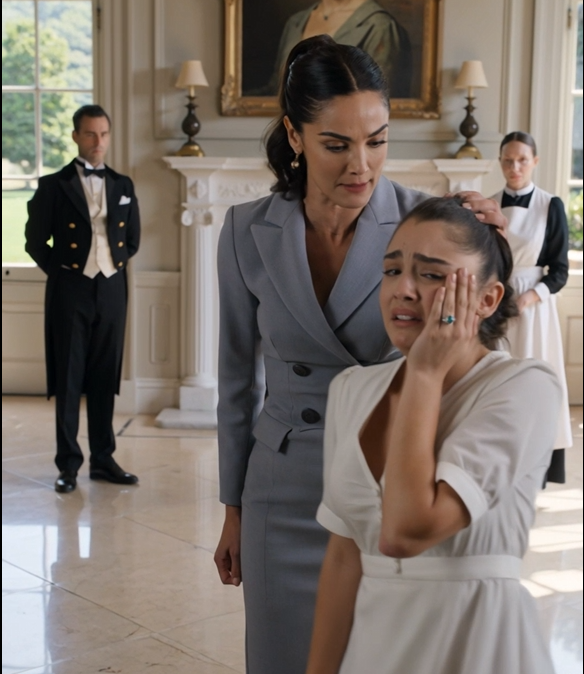
The slap was so fast Eleanor didn’t see it coming. The sound of it cracked through the library like a gunshot. Eleanor staggered. The edge of the table caught the back of her knees and she went down, hitting the floor hard, her hand flying to her cheek where heat was already blooming, tears springing to her eyes from pure shock before she had even processed what had happened.
Mrs. Gable and the butler, James, appeared in the doorway. They froze.
Vivienne crouched, grabbed Eleanor’s hair, forced her head up. Her eyes were bright. Her jaw was set. This was a woman, Eleanor understood distantly, who had known this day might come and had decided exactly how she would handle it.
“Say it,” Vivienne said, her voice dropping to something almost conversational, which was somehow worse than shouting. “Say why you came.”
Eleanor’s hand was shaking. Her cheek was on fire. She was on her knees on a Persian rug in a library that cost more than her childhood home, surrounded by people watching to see what she would do.
She raised her trembling hand and pointed. Past Vivienne’s shoulder, past Dominic’s white face, past the fireplace with its carved marble surround, up to the painting.
The woman in the portrait. The ring. The dark hair and composed, watchful expression that Eleanor had looked at every day for three weeks without understanding why it felt like looking into a mirror aged thirty years.
Henry Calloway’s voice came from behind her.
She hadn’t heard him enter.
“That ring,” he said, quiet and cold in the way of men who have never needed to raise their voices because the world has always rearranged itself before they got that far, “was locked away after the disappearance.”
Eleanor turned her head. He was standing just inside the doorway, still in his jacket from his trip into town, his silver hair precise, his face composed. But his eyes moved between Eleanor and the painting with the expression of a man doing rapid, private calculations.
Eleanor looked straight at him.
Her voice broke on the first word and she let it break. She was done performing composure for people who had spent three decades performing innocence.
“Then why,” she said, “did you pay someone to erase me?”
The library was absolutely silent.
Henry Calloway looked at her for a long moment. In the fireplace, a log shifted and settled. From somewhere in the house, too far away to help, Eleanor heard the sound of small footsteps — Thomas, coming to find her, because it was nearly time for their afternoon session and he was, she had learned, a creature of punctuality.
Vivienne had released her hair. Dominic was looking at the floor.
Henry said nothing.
But his hands, hanging at his sides, had closed into fists.
And Eleanor, on her knees on the Persian rug, still tasting blood where her teeth had caught the inside of her cheek, understood that she had just made herself into something she hadn’t been when she walked through those iron gates: a threat. A living, breathing, undeniable piece of evidence that something had happened twenty-nine years ago that no amount of money or silence or locked rooms had managed to stay buried.
The footsteps were getting closer.
She thought of Thomas, nine years old, dreaming of a dark-haired woman at the end of a long hallway.
She thought of her grandmother, dying at forty-seven, leaving nothing behind. No photographs. No stories. No history. The particular erasure of a person who had been made to disappear so thoroughly that even the people who loved her had nothing left to hold.
She thought of a ring, passed hand to hand across decades, the only thing that couldn’t be locked away because it had been carried out of this house before anyone thought to take it.
Eleanor rose from the floor.
She straightened her spine.
She was shaking, but she was standing.
“I want to know her name,” she said. “Her real name. What she was before she was your wife and your mother and whatever story you decided to tell about her after she was gone.” She looked at Henry. “And I want Thomas to know it too.”
The footsteps stopped outside the door.
A small knock.
“Eleanor?” Thomas’s voice, careful and precise, the voice of a child who had learned young to read rooms before entering them. “Is everything okay?”
She didn’t look away from Henry Calloway.
“Come in, Thomas,” she said. “There’s something I need to tell you.”
