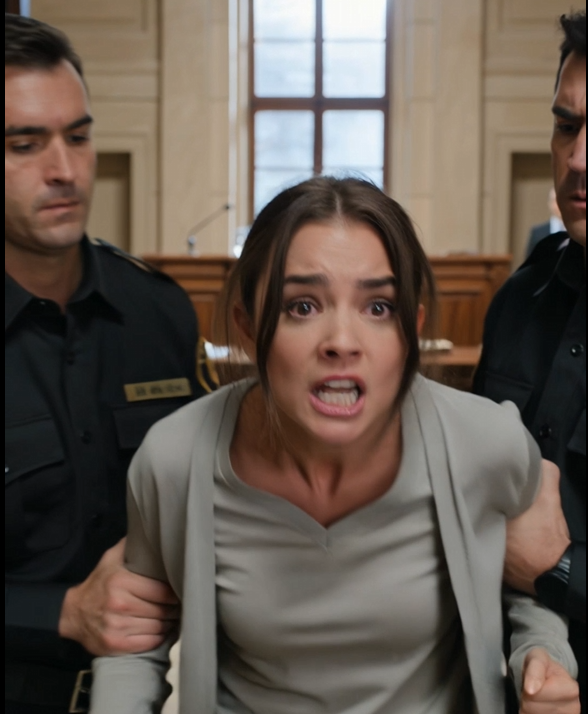
Every head in Courtroom Seven turned at exactly the same moment — the judge, the jury, the packed gallery of reporters and spectators who had been following the Harrington murder trial for eleven days like it was the most expensive television drama anyone had ever produced. In a way, it was. Marcus Harrington was thirty-four years old, heir to the Harrington pharmaceutical fortune, and the state of New York had spent the better part of six months building a case that said he had strangled his wife, Celeste, in the bedroom of their Upper East Side townhouse on the night of March 14th and then called his lawyer before he called the police.
The prosecution had witnesses. They had a timeline. They had a 911 call in which Marcus’s voice was eerily composed for a man who had supposedly just discovered his wife’s body.
What they did not have — what nobody in that courtroom had, until the doors flew open — was Adrienne Cole.
She came in fast, the way people move when they have been running and have not yet decided whether to stop. Her dark hair was loose, her blouse untucked, one heel of her left shoe slightly broken so that her stride had an uneven, desperate quality that made everyone in the room register her as someone in genuine distress rather than someone performing it. Her eyes swept the room and found Marcus at the defense table — hands folded, face carefully neutral, the practiced composure of a man who had been coached extensively on how to appear in front of a jury.
His composure lasted approximately one second after he saw her face.
“STOP!” Adrienne’s voice cracked off the marble walls and the tall windows and the gilded ceiling of Courtroom Seven. “He didn’t kill her!”
The room fractured into sound.
Gasps from the gallery. A reporter’s phone clattered to the floor. Two jurors in the back row grabbed each other’s arms. The court stenographer stopped typing and simply stared.
Marcus Harrington rose halfway out of his chair, his lawyer grabbing his arm and pulling him back down, whispering urgently. But Marcus wasn’t listening to his lawyer. He was staring at Adrienne with an expression that was not relief — not yet — but something rawer and more complicated than relief. The expression of a man watching something he had stopped believing in walk through a door.
The two court security officers moved fast. They were trained for disruptions, and a disruption was what they had. One came from the left, one from the right, and they reached Adrienne before she made it three steps past the threshold.
She fought them.
Not the symbolic struggling of someone making a dramatic point — real, physical resistance, elbows and shoulders and her full body weight thrown against two men who outweighed her by sixty pounds each. She got one arm halfway free and used it to point across the courtroom toward the prosecution’s table, toward the neat stacks of evidence folders and the prosecutor, Jonathan Marsh, who was already on his feet, his face doing something careful and controlled that Adrienne had spent the last seventy-two hours learning to read.
“You’re hiding the truth!” she screamed. “You know who did it!”
Marsh said nothing. His face stayed controlled. But his eyes — for just a fraction of a second, the length of a single heartbeat — went to his briefcase.
Adrienne saw it. She had been watching for exactly that.
The judge’s gavel came down like a gunshot. Once. Twice. Three times.
“Get her out NOW!” Judge Patricia Ellison’s voice carried the particular authority of a woman who had spent twenty-two years on the bench and had long since stopped being impressed by theatrics. She was on her feet, gavel raised, gray hair precise, reading glasses pushed up onto her forehead. “Officers, remove this woman from my courtroom immediately!”
They had both of Adrienne’s arms now, lifting her slightly, her feet dragging against the polished marble, and the gallery was a wall of noise behind her — people standing, phones raised, reporters already composing their first sentences. The defense attorney was shouting something about due process. A juror in the front row had pressed both hands over her mouth.
Adrienne stopped fighting.
Not because she had given up. Because she had reached into the inside pocket of her blazer with the three inches of movement she still had, and closed her fingers around the photograph.
She had carried it for seventy-two hours. She had slept with it under her pillow in a hotel room in Midtown, checking every few hours to make sure it was still there, that she hadn’t imagined it. She had shown it to no one. She had called the defense team twice and been told both times that new evidence couldn’t be introduced at this stage, that there were procedures, that she needed to contact the proper—
She threw it.
A hard, flat throw, the way you’d skip a stone across water, and it spun across the marble floor of Courtroom Seven in a long, sliding arc and came to rest face-up in the center of the room.
The room went quiet in a way that felt physical, like pressure dropping before a storm.
The photograph showed Celeste Harrington.
She was standing in the kitchen of the townhouse — recognizable from the trial’s evidence photographs, the distinctive pale blue cabinetry, the copper pendant lights — in the cream-colored robe she’d been found in. Her dark hair down. Her posture relaxed, unaware of the camera.
The medical examiner had established time of death at between 10 PM and midnight on March 14th. Marcus had placed a takeout order at 9:47 PM, which put him in the kitchen. His lawyer had argued this proved nothing. The prosecution had argued the order was placed to establish an alibi. Eleven days of testimony, and the jury was still watching both sides with the careful attention of people who genuinely couldn’t decide.
The photograph was timestamped 11:23 PM.
Celeste Harrington, alive, in the kitchen of her home, at 11:23 PM on March 14th.
But that was not what had stopped the room.
Behind her — partially visible in the reflection of the dark window above the sink, caught by whatever angle had captured this image — was a figure. Standing in the doorway that led to the back hall. Tall. Broad-shouldered. Wearing a jacket that was not the gray suit Marcus had been documented wearing that evening.
A figure that was not Marcus Harrington.
Jonathan Marsh had not moved. He stood at the prosecution’s table with both hands flat on its surface, and the careful control in his face had developed a hairline fracture, something showing through underneath that the nearest jurors were close enough to see.
Marcus Harrington rose from his chair. Fully this time. His lawyer did not try to stop him. He rose and looked at the photograph on the floor and then looked at Adrienne, who was still suspended between two security officers, feet barely touching the ground, breathing hard.
His mouth formed her name but no sound came out.
Adrienne looked at the jury. She looked at the gallery. She looked at Judge Ellison, whose gavel was still raised but had not come down.
She had one breath left before they carried her out the door.
She used it.
“That photo,” she said, and her voice cracked on the first word and she let it crack, she was past performing composure in front of people who had been selling a lie for six months, “was taken after she died.”
Silence.
The specific, enormous silence of a room full of people simultaneously processing the same impossible sentence.
After she died.
If the timestamp was accurate — and timestamps on security cameras didn’t lie, couldn’t be coached or rehearsed or introduced on cross-examination — then Celeste Harrington had been photographed alive at 11:23 PM. But the medical examiner’s report, the cornerstone of the prosecution’s entire case, placed the time of death before 11 PM. The prosecution had built their timeline on that window. Marcus’s composure on the 911 call, his lawyer’s presence before the paramedics arrived, his inability to account for forty minutes — all of it rested on the assumption that Celeste had died before 11 PM.
If she was alive at 11:23, the entire structure collapsed.
And the figure in the window reflection — tall, broad-shouldered, the wrong jacket — had been standing in that hallway after the prosecution’s timeline said Celeste was already dead.
Adrienne had found the photograph in the cloud backup of Celeste’s personal laptop, which she had been given access to eighteen months ago when Celeste was alive and they were still close, and which she had spent seventy-two sleepless hours combing through after something a mutual friend said at a dinner party made her realize the defense had never been given access to Celeste’s personal devices. Only her phone. The prosecution had controlled the phone. The laptop had gone to a storage unit with the rest of the estate, unexamined, because nobody had thought to look and because, Adrienne had come to understand, someone had specifically ensured nobody would think to look.
She looked at Jonathan Marsh.
He was still standing with his hands flat on the table. The hairline fracture in his composure had widened into something more visible now, something that the court reporter was noticing, that the front-row jurors were noticing, that the journalist from the Times in the third row of the gallery was absolutely noticing.
“Who is in that photograph, Mr. Marsh?” Adrienne said.
Her voice was quiet now. The security officers had stopped pulling. Maybe they had felt the shift in the room. Maybe they were just tired. Maybe they were human beings who had understood, in the way that everyone in Courtroom Seven was beginning to understand, that what was happening right now was not a disruption.
It was a reckoning.
“Who were you protecting?” she said. “When you buried the laptop. When you narrowed the time of death. When you made sure Marcus couldn’t account for those forty minutes because you already knew exactly how they were spent and you needed the jury to fill that silence with the worst thing they could imagine.”
Marcus Harrington sat back down. Not the coached, careful sitting of the past eleven days — a different kind of sitting. The sitting of a man whose legs have stopped working because something enormous has shifted in the architecture of the world.
His lawyer placed one hand on his shoulder.
In the gallery, someone was crying.
Judge Ellison had lowered her gavel. She was looking at the photograph on the floor. She was looking at Jonathan Marsh. She was looking at the security officers, who had released Adrienne’s arms and were now standing slightly away from her, as though distance might clarify their position in what was unfolding.
“Mr. Marsh,” Judge Ellison said. Her voice had changed. The authority was still there, but something had been added to it — something careful and grave and aware that the next words spoken in this room would matter for a very long time. “I think you’d better sit down.”
Marsh didn’t sit.
He looked at the photograph. He looked at Adrienne. He looked at the jury, eleven faces and one empty chair because Juror Four had called in sick that morning, and he read their faces the way a man reads a verdict.
He reached slowly for his briefcase.
“Don’t,” said the judge.
He stopped.
Adrienne Cole walked forward, past the frozen security officers, across the polished marble floor, and crouched down. She picked up the photograph carefully, holding it by the edges the way she had taught herself to over seventy-two hours of handling it, and she placed it on the defense table in front of Marcus Harrington’s attorney.
Marcus looked at it. Then he looked up at Adrienne.
“How long have you had this?” he said. His voice was completely stripped of everything — the composure, the coaching, eleven days of careful performance. Just the voice itself.
“Three days,” she said. “I’m sorry it took me so long.”
He nodded once. A small, private nod that was not for the gallery or the jury or the reporters whose fingers were already flying across their phones.
It was just for her.
Behind them, Judge Ellison was speaking, and bailiffs were moving, and somewhere in the controlled chaos of Courtroom Seven, Jonathan Marsh was doing the private arithmetic of a man calculating how fast everything is about to fall.
The photograph lay on the defense table.
Celeste, alive. The figure in the window. The timestamp that broke everything.
Seventy-two hours. Three days of a woman who couldn’t sleep, couldn’t eat, couldn’t stop asking herself whether she was seeing what she thought she was seeing — whether she was brave enough to walk through those doors.
She had been.
