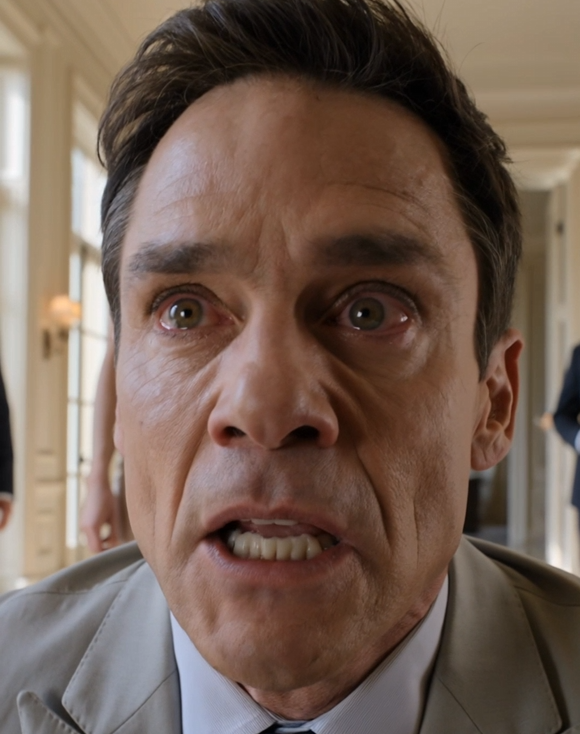
The Voss house had stood for forty years on the edge of the Connecticut hills, and it had always been the kind of house that made people feel small in a way they couldn’t quite name.
Not because it was cruel. Because it was perfect.
The ceilings in the main hall ran twenty-two feet to a plaster crown molding that had been hand-restored twice in the last decade. The marble floor — cream with grey veining, laid in a herringbone pattern that cost more per square foot than most people’s monthly rent — had been polished every Thursday morning for as long as anyone could remember, by a woman named Irena who had worked for the family since before the youngest children were born. The windows along the east wall were floor-to-ceiling Georgian glass, and on a clear morning, the light came through them in thick, angled columns that hit the marble and scattered into something that looked almost holy. Visitors remarked on it every time. What a beautiful house, they always said. What a beautiful family.
Heinrich Voss, sixty-one, had heard it so many times that it had stopped meaning anything to him. He accepted it the way he accepted most things — as confirmation of something he already knew.
He was standing in the center of that hall on a Sunday morning in October, wearing a pressed grey shirt and reading glasses pushed up on his forehead, a coffee cup in one hand and his phone in the other, when his daughter walked in from the east corridor.
He didn’t look up immediately. He had learned, over years of being Heinrich Voss, that not looking up immediately established something important about the distribution of attention in any given room. He finished reading the line he was on. He set down the coffee cup.
Then he looked up.
And something in the way Mara was standing made the reading glasses slide off his forehead entirely. He didn’t catch them. They hit the marble with a small, clean sound.
Mara Voss was thirty-one years old. She had her mother’s cheekbones and her father’s eyes — pale grey, precise, the kind of eyes that missed very little — and she had spent the last four days in the east wing of the house doing something she’d told no one about. Her clothes were wrong for a Sunday morning at the Voss estate. She was wearing work pants. Old ones, with dust ground into the knees. Her hair was pulled back roughly. There was a grey-white smear along her left forearm that looked like plaster.
Her right hand was closed in a fist at her side.
Behind her, in the hallway that led to the east wing — the oldest part of the house, the part that had been partially walled off during the renovation of 2009, the renovation Heinrich had personally overseen with an architect flown in from Zurich and a contractor who had since moved to Portugal and didn’t return calls — behind her, other family members were appearing. Her brother Lukas, twenty-eight, in a rumpled sweater, who had heard something from his room and come to find the source. Her aunt Petra, fifty-five, Heinrich’s younger sister, who had arrived the night before for what was supposed to be a quiet family weekend. The housekeeper Irena, standing at the edge of the corridor with her hands pressed together, saying nothing.
Mara walked forward.
She crossed the marble floor in seven steps.
And then she raised her hand and she hit her father across the face with everything she had.
The sound was extraordinary in that room. The marble took it and multiplied it — sent it up to the plaster ceiling and back down and into the walls, and for a half-second it was the only sound in the world, that sharp, flat crack, and then the echo, and then nothing.
Heinrich’s coffee cup, which he had been holding loosely, dropped. It didn’t shatter. It bounced once on the marble and came to rest near his feet, dark liquid spreading in a slow, quiet pool across the cream stone.
He stood completely still.
His hand came up — slowly, not defensively, but with the particular deliberateness of a man who has just experienced something his body hasn’t processed yet — and touched his own cheek. He turned his head back toward his daughter. His reading glasses were on the floor. Without them, without the phone, without the coffee cup, without any of the small props of authority and routine, he looked, for just a moment, like something other than Heinrich Voss.
He looked like a man who had been waiting for this.
Mara’s eyes were wet. Not crying yet — past crying, maybe, or before it, in that place where the emotion is so large it hasn’t found its form yet. Her jaw was set. She was shaking slightly, the fine tremor of someone running on adrenaline and something older and darker than adrenaline.
Behind her, Lukas had frozen in the corridor doorway. Aunt Petra had one hand over her mouth. Irena hadn’t moved.
“Tell them,” Mara said.
Her voice was lower than usual. Controlled in the way that things are controlled when the alternative is coming completely apart.
“Tell them what you did to her.”
Heinrich Voss lowered his hand from his cheek. Something moved behind his eyes — a calculation, fast and practiced, the movement of a man who has been managing information his entire adult life and is assessing, right now, what he is dealing with and how much damage can still be contained.
“Mara.” His voice was quiet. Warning. The particular tone that had, for thirty-one years, functioned as a boundary — this far and no further, this topic and no others, this version of events and nothing else. “You don’t know anything.”
She grabbed his collar with both hands.
It was not a gesture he had any frame of reference for. His daughter had never — in thirty-one years — put her hands on him in any way that wasn’t choreographed by occasion. Hugs at airports. Cheek kisses at Christmas. The formal, managed physical language of a family that expressed everything through architecture and silence and the quality of the marble and never, ever through touch that wasn’t controlled.
She grabbed his collar and she pulled down, and Heinrich Voss — sixty-one years old, master of the room, owner of the house, architect of the family’s story — went to his knees on his own marble floor.
The camera of the moment, if there had been one, would have shaken. Would have dipped with the motion, caught the light fracturing off the polished stone, stayed close — uncomfortably close — on the faces.
Lukas made a sound. Not words. Just a sound.
Mara opened her right hand.
She had been holding it for four days. Not literally — but from the moment she’d found it, she had carried it with her everywhere, wrapped in a cloth in her pocket, and taken it out at night to look at it, and each time she looked at it the thing inside her chest that had been building for twenty years got a little larger, a little less containable.
It was a necklace. Or it had been. Gold chain, most of it intact, but two links near the clasp were broken and bent in a way that suggested force rather than wear. The pendant was a small oval locket, tarnished almost to black, the engraving on the front worn down but still legible if you held it at the right angle to the light. The chain and the locket were both coated in a fine grey-white dust — the specific dust of old plaster, of walls opened and walls closed, of things put inside spaces that were then sealed.
She let it dangle from her fingers.
The light from the east windows caught it.
“I found this,” she said. Her voice was steady now, in the terrible way that voices go steady when everything else has stopped mattering. “Inside the wall.”
The silence that followed was a different kind of silence than the one after the slap. The slap’s silence had been shock — instantaneous, physical, the silence of systems rebooting. This silence was the silence of understanding arriving, slowly, into a room full of people who had chosen, for a very long time, not to understand.
Lukas stepped forward from the doorway. He was looking at the necklace with an expression that suggested he recognized it and was trying very hard, in real time, not to. His mouth opened. Closed.
Petra — Aunt Petra, who had been at every Christmas and every birthday and every family gathering for thirty-one years, who had always been warm and slightly nervous in Heinrich’s presence in a way that Mara had filed away at age twelve and never taken out to examine until four days ago — Petra made a sound that was not a word and pressed both hands to her face and began to cry with the sudden, helpless totality of someone who has been not-crying about something for a very long time.
Irena, at the edge of the corridor, closed her eyes.
Heinrich was still on his knees. He was looking at the necklace. Something was happening to his face that Mara had never seen before — the particular expression of a man whose control is not failing but has already failed, and what she was watching was not the failure itself but the moment he understood that it had happened.
A crack. Just a moment. There and then managed, suppressed, pushed back down by forty years of practice.
But she had seen it.
“The east wall,” Mara said. “The one you had rebuilt in 2009. The contractor you flew in from Zurich. The section you told us was structural damage from the winter.” She paused. “I’ve been in that wing for four days. I found the cavity. I found where the plaster was newer than the rest — painted to match, but newer. Someone with time and a lamp could see it.” Another pause. “I had time. I had a lamp.”
Lukas said: “Mara—” in a voice that meant stop, stop, don’t say what comes next, we can still not know this.
She didn’t stop.
“There was a cavity. About the size of a shoebox. Sealed in 2009, judging by the materials.” She looked down at her father. “The necklace was inside it. Along with other things I haven’t shown anyone yet.”
Heinrich said nothing. He was looking at the floor.
“This belonged to her,” Mara said. Not a question. “This was hers.”
The her in that sentence had a name that no one in the family had spoken aloud in twenty years. Not by agreement — no meeting had been called, no decision formally made. It had simply stopped being said, the way words stop being said when the cost of saying them becomes too high. Her name had been Elena. She had worked in this house. She had been twenty-four years old. She had, according to the official version of events — the version Heinrich had provided, the version everyone had accepted because the alternative was a door no one wanted to open — simply left. Gone back to her family. These things happened.
Mara leaned down. Her father was still on his knees, and she brought her face level with his, and she said — quietly, barely above a whisper, but in a room that silent it traveled to every corner:
“You buried her truth.”
She let the necklace swing once, gently, in the light.
“Not deep enough.”
The light from the Georgian windows fell across the marble floor. The coffee was still spreading in its slow pool near Heinrich’s knees. The necklace turned on its broken chain, its tarnished locket catching the light, the worn engraving facing outward.
E.
And on his face — replacing, finally and completely, the practiced calm of forty years — was the one thing Heinrich Voss had never, in any room, allowed anyone to see.
Fear.
The east wing renovation records were subpoenaed six weeks later.
The contractor in Portugal eventually returned a call.
The other things Mara had found in the cavity — she had said there were other things — were never publicly described.
She kept them.
For now.
