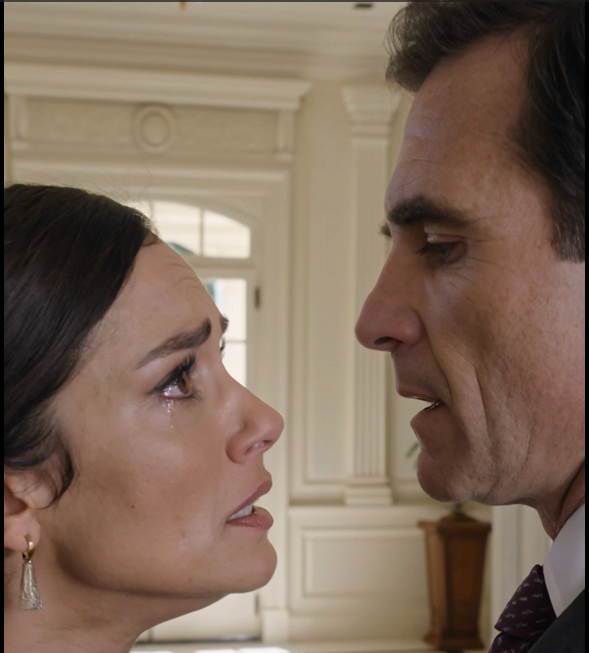
The slap happened at 11:14 in the morning.
Later, people would remember the time because the grandfather clock in the east hall had just finished its quarter-hour chime — four clean, aristocratic tones that rang through seventeen thousand square feet of polished silence — and then, almost as if the house itself had been waiting, the sound of skin meeting skin cracked across the marble like a gunshot.
Vivienne Alcott-Marsh had not slept.
You could see it in the way she moved — not with the usual composed glide that twenty years of marriage to a Marsh had trained into her body, but with something rawer, something that had been sitting in her chest for seventy-two hours and had finally outgrown the ribcage trying to contain it. She had driven through the night from the Connecticut house, the one with the yellow shutters that Edward had always hated but had never bothered to sell because selling things required acknowledging they existed, and he preferred simply to look away from what displeased him.
She had been erased from the Connecticut house too, she’d discovered.
The property records had been updated four days ago.
She had found out the way people always found out in the age of digital everything — a notification from a real estate alert she had set years ago, almost as a joke, on the Marsh family properties, because she had been bored at a charity luncheon and had wanted to feel like she had some small window into a world that was technically hers but had never quite felt that way. The notification had arrived at 2:47 a.m. while she was reading in bed, her glasses on, a glass of warm white wine going flatter by the minute, and the subject line had read: Property ownership change recorded — 14 Ashford Lane, Westport, CT.
The new owner was listed as a limited liability company she had never heard of.
She had Googled it in the dark, lying there with the phone three inches from her face, her husband sleeping four feet away with his characteristic stillness, the kind of sleep that always looked less like rest and more like the practiced performance of someone who had learned to be unreachable even unconscious. The LLC traced back through two holding companies and a Delaware registration to a single name: Edward James Marsh III, acting as sole principal.
He had moved the house out of their shared estate.
In the dark, she had been so still for so long that the phone screen had gone black.
Then she had gotten up, dressed without turning on a light, gotten in the car, and driven south toward New York and the Manhattan townhouse and the man who had quietly, methodically, while she slept beside him, begun dismantling the architecture of her life.
The entrance hall of the Marsh townhouse was the kind of room that made people feel small on purpose. Edward’s grandmother had designed it that way — tall ceilings, a staircase that curved up and away like something that had better things to do than meet you at the bottom, windows that ran floor to ceiling along the south wall and flooded the space with the kind of light that looked beautiful in photographs and felt, in person, a little like being examined. The marble floor was cream and ivory and faintly warm-toned, and it reflected everything: the light, the furniture, and now Vivienne, standing three feet from her husband with her hand still tingling from the blow she had just delivered, watching him touch his jaw with two fingers the way a man checks whether a building has moved.
He hadn’t expected her.
That, she realized, was perhaps the most useful thing she had learned this morning — that she had caught him off guard, which meant he was not as far along in this process as she’d feared, or that he had simply never believed she would drive through the night and arrive before breakfast in the house he was currently, apparently, in the process of stealing.
“You erased me from everything?” Her voice was shaking. She hadn’t meant for it to shake — she had rehearsed this in the car, had delivered it cleanly and coldly at eighty miles per hour on the empty highway, but now that she was here, now that she was standing on the marble that had been half hers for two decades, the shake was unavoidable. It wasn’t weakness. It was the sound a thing makes when it’s been pulled too tight for too long.
Edward straightened. He was wearing a grey cashmere sweater and dark trousers, dressed for a quiet Saturday morning at home, and the contrast between how ordinary he looked and what he had done was the kind of thing that would stay with Vivienne for years afterward — the sweater, the slight disarray of his silver hair, the coffee cup she could see on the side table that he had apparently been drinking before she arrived, as if erasing a person from your shared life was the sort of thing you did between the first and second cup.
His jaw was tight. His breathing was careful. He had, in whatever seconds the slap had given him, rebuilt himself.
“You were already gone,” he said.
The words landed differently than she expected. Not cruel, exactly — worse than that. Factual. The way a man states weather conditions or investment returns. She stepped closer, and the marble reflected two of her, the real one and the upside-down one beneath her feet, both of them furious.
“Say that again.”
He didn’t step back. He never stepped back — she had always found this quality in him both admirable and, she now understood, deeply sinister. He leaned in slightly, and his voice dropped to the register he used in boardrooms when he wanted people to understand that the meeting was over and they had lost.
“I changed the will,” he said. “None of this is yours anymore.”
The silence that followed was the kind that fills a room the way water fills a sealed space — completely, immediately, leaving no corner untouched. Vivienne heard the grandfather clock ticking. She heard, somewhere outside, a car moving slowly down the street. She heard her own heartbeat, which had apparently decided this was an appropriate moment to become extremely audible.
The marble floor reflected the window light and her stillness and his.
She had prepared for anger. She had prepared for denial, for negotiation, for the particular brand of sophisticated condescension Edward had spent twenty years perfecting. She had not prepared for this — for the flat, unadorned confirmation, delivered quietly, in a sweater, over a cooling cup of coffee.
She thought about what she owned.
She thought about the Connecticut house with the yellow shutters, now an LLC. She thought about the Aspen property, the one they had bought the year after their daughter was born, standing on the deck in the cold and feeling for the first and possibly only time like their marriage was a real thing they had both chosen rather than a structure they had moved into and then gradually stopped questioning. She thought about the accounts. She thought about the art — there was a painting in the study that she had picked out herself, had argued for, had loved for eleven years, and she thought about whether a painting could be moved into an LLC.
She thought about the will.
She had seen the will. She had seen the original will, twelve years ago, when they had sat across from each other in a lawyer’s office in Midtown and signed documents in the businesslike way that wealthy couples sign documents, which is to say quickly and without reading much because the whole point of having lawyers is to outsource the reading. She had been listed. She had been listed as primary beneficiary of the estate, the properties, the trust interests, the —
“When,” she said. The word came out as one syllable of pure ice.
“Thursday,” Edward said.
Four days ago. The same day as the Connecticut property transfer. He had done it all at once, then — a single efficient Thursday in which he had unmade the legal reality of their marriage with the same methodical patience he applied to everything. She thought of him sitting in that lawyer’s office, or perhaps doing it remotely now, electronically, the whole dissolution of twenty years managed via secure PDF.
She was about to speak again when she heard it: the faint sound of footsteps on marble.
Or rather — she felt it. The way a room changes temperature when another person enters it. The particular shift in atmosphere that happens when you realize you have been miscounting.
The light from the south windows was very bright.
Vivienne turned slowly.
She was standing near the far doorway — the entrance to the library corridor, the one that most guests never used because it required knowing the house well enough to know it existed. She was a woman perhaps a decade younger than Vivienne, with the kind of composed beauty that read as effortless because enormous effort had been spent making it look that way. She was wearing a white shirt tucked into tailored trousers, and she was holding a folder — not casually, but with the particular grip of someone holding something that matters.
Documents.
Legal-sized paper, from the look of it. The kind of paper that changes things.
Vivienne looked at her for a long moment. Then she looked at Edward. Then she looked at the woman again.
The woman did not look surprised. The woman had, Vivienne realized, the look of someone who had known this moment was coming and had dressed for it.
The documents in her hands were not random. They were organized. Tabbed.
Vivienne understood, in the particular way you understand something you have actually known for a long time but successfully refused to look at directly, several things simultaneously: who this woman was, what the documents likely contained, how long this had been in motion, and why Edward had seemed, in the weeks before this morning, not anxious but quietly patient, in the manner of a man waiting for a timer to expire.
She had driven through the night to confront a betrayal.
She had arrived to find it was already a transaction.
The grandfather clock ticked. The light came through the tall windows and lay flat and bright across the marble floor, which reflected everything faithfully: two women and one man, a folder of papers, a coffee cup going cold, and the particular stillness of a room in which something has just irrevocably changed.
Vivienne Alcott-Marsh stood very straight.
She had arrived here with anger, which had felt like power.
She understood now that she had arrived with nothing.
But she also understood — feeling it rise in her with a coldness that surprised even herself, a coldness that was nothing like Edward’s and therefore nothing he would recognize or know how to manage — that leaving with nothing and leaving as nothing were two very different things.
She looked at the woman in the doorway one more time.
Then she looked at her husband.
“I want her name,” Vivienne said quietly. “And I want the name of your attorney.”
She was already reaching for her phone.
Outside, on the quiet Manhattan street, the morning continued without interruption. The car that had been moving slowly past the townhouse turned a corner and disappeared. The light shifted slightly as a cloud moved. The house held its silence the way old houses do — thoroughly, and without apology.
