Here’s your 2,000-word cinematic story — written for an American audience who loves family secrets, old money, and the kind of betrayal that’s been hiding in plain sight for decades:
The Necklace
A Story About Two Brothers, One House, and a Secret That Was Never Theirs to Keep
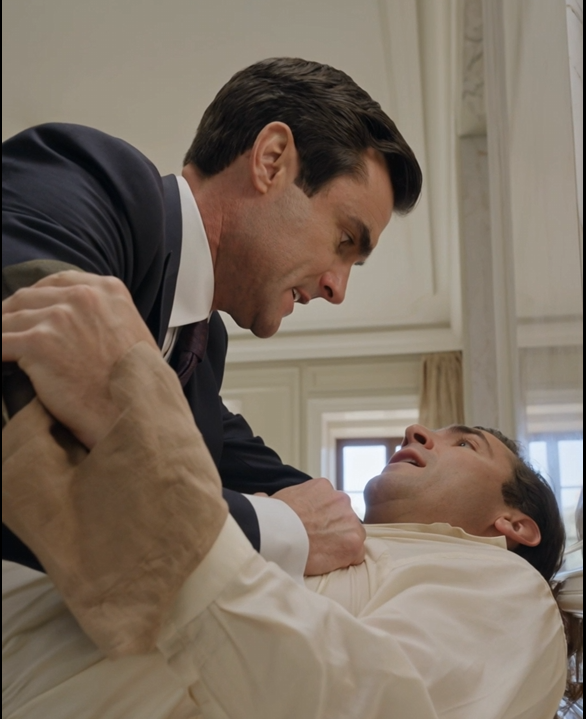
The shove happened before Marcus Vellard had fully closed the front door behind him.
One second he was stepping into the entrance hall of the estate he had grown up in — the marble floor, the tall windows, the particular quality of morning light that had been the backdrop of every significant moment of his childhood — and the next second his brother was standing in the center of that floor, hands in pockets, watching him with an expression that Marcus had learned over thirty-eight years to read the way sailors read weather. Quiet surface. Serious pressure underneath. The kind of stillness that preceded something.
He didn’t wait to find out what.
Six steps across the marble. Both hands. Julian’s collar in his fists, and then the wall, and then the impact — a sound that rang through seventeen rooms and probably reached the kitchen and definitely reached their mother, who was standing somewhere behind him and made a sound like a word that never quite formed.
Marcus leaned in close. His voice came out low and even, the way their father’s voice used to come out when he had finished being patient.
“Say it again.”
Julian looked at him. Pinned against the cream-colored wall, collar twisted, feet barely touching the floor, he looked at his older brother with eyes that were calm in a way that had always been slightly unnerving — not the calm of someone who wasn’t afraid, but the calm of someone who had already been afraid and had moved through it to the other side.
He said it again.
“The house isn’t ours anymore.”
Marcus Vellard had built three companies by the age of forty-one. He had sat across negotiating tables from men who had spent careers learning to be unreadable and had read them anyway. He had been in rooms where millions of dollars changed hands on the strength of a handshake and had never once felt his hands shake. He was not, by any useful definition of the word, a man who rattled easily.
Julian rattled him.
“What do you mean,” Marcus said. Each word separate. Deliberate. The grip on his brother’s collar had not loosened. “You sold it.”
“I sold it.”
“You sold it to cover what I did.”
“Yes.”
The hall was very quiet. Outside, somewhere on the grounds, a bird was doing something cheerful and completely inappropriate to the moment. The grandfather clock — the one their father had bought at an estate sale in Vienna thirty years ago and installed in the east corridor with the satisfaction of a man who believed that serious houses deserved serious timekeeping — was ticking with its usual indifference.
“Julian.” Marcus’s voice had dropped further. It was barely above a whisper now, which in the Vellard family had always been the register of genuine danger. “What did I do.”
It wasn’t a question, exactly. It was more like a man standing at the edge of something dark, asking for a measurement of the depth before deciding whether to look down.
Julian’s eyes moved.
Just for a second. Just enough.
They moved to something over Marcus’s shoulder, and Marcus felt, rather than heard, the shift in the room that meant their mother had taken a step. He didn’t turn around. He kept his eyes on his brother’s face and watched Julian look at their mother with an expression that contained more information than Marcus could immediately process — something complicated, something that had been sitting between the two of them for a long time, a look that Marcus suddenly understood was not a look between two people sharing a secret but between two people who had been carrying the same weight from different ends.
“Julian.” Quieter still. “What did I do.”
His brother looked back at him. Exhaled once, slowly, through his nose.
“Ask her,” Julian said. “About the necklace.”
The necklace.
Marcus let go of his brother’s collar.
He stepped back, and the marble floor took his weight with its usual indifference, and he stood there in the morning light with his hands at his sides and felt something cold move through him from the chest outward — not fear, exactly, but the specific physical sensation of a very large thing rearranging itself inside your understanding of your own history.
The necklace.
He hadn’t thought about it in — he tried to calculate and couldn’t. Fifteen years? Sixteen? He had been twenty-four or twenty-five, home for a long weekend, the estate in its summer configuration with the east windows open and the smell of cut grass coming through every room. He remembered the weekend clearly in the broad strokes — a dinner party his mother had organized, the particular tension that had lived in the house that summer like a fourth family member, his father’s extended silences that everyone had been pretending were simply tiredness.
And then the necklace had disappeared.
It was not a small thing — not sentimentally and not financially. It had been his grandmother’s, brought from Europe before the war, reset twice over the decades but always recognizable, always significant. A piece that had its own place in the family’s sense of itself. His mother had noticed it missing on the Sunday morning and the weekend had ended early and badly, and in the days that followed there had been questions — quiet, careful, the kind of questions that wealthy families ask when something has gone missing and everyone is technically a suspect but no one can be seen to actually suspect anyone.
The questions had landed on Marcus.
Not directly. Not as an accusation. But in the way that things land on the oldest child in certain kinds of families — through implication, through the particular quality of silence that follows certain names, through the way his father had looked at him for the remainder of that summer with something behind the eyes that Marcus had spent sixteen years telling himself was exhaustion.
He had not taken the necklace.
He had said so, clearly and repeatedly, and eventually the subject had closed the way uncomfortable subjects close in families that value composure over resolution — not resolved, just covered over, like a crack in a wall that gets painted and painted until you can almost forget it’s there.
Almost.
He turned around.
His mother was standing near the foot of the staircase, and she looked the way she had been looking, Marcus now realized, for approximately sixteen years — like a woman holding something very heavy with both hands and smiling over the top of it. She was seventy-one years old and had always seemed younger than that, always had the particular vitality of a woman who kept herself busy enough to outrun her own interior, but this morning she looked her age and then some. Her hand was trembling slightly at her side. Her eyes, which had been avoiding his, found the floor.
“Mom,” Marcus said.
She didn’t look up.
“Mom.” His voice had changed completely now — no whisper, no controlled danger, just a forty-one-year-old man saying the word the way he’d said it at eight years old, when things had happened that he didn’t understand and had needed someone to explain the world to him. “Look at me.”
She looked up. Her eyes were wet. Not crying — not yet — but the kind of wet that means the decision is being made in real time.
“I need you to tell me about the necklace.”
The grandfather clock ticked in the east corridor.
Outside, the bird had stopped its cheerful noise.
Julian had not moved from the wall.
Their mother opened her mouth, closed it, opened it again, and Marcus watched her make the specific face of a person releasing something they have been holding for so long that letting go of it feels physically dangerous, like opening a valve that has been sealed under pressure for sixteen years and not being entirely sure what comes out.
“I took it,” she said.
The words were very small for the size of what they contained.
Marcus heard them. Processed them. Took them apart and put them back together and arrived at the same result each time.
“You took it,” he repeated.
“I had to.” Her voice was steadier than he expected, now that the words had started. The way voices get steady once the hardest part is already out. “There were debts your father didn’t know about. That I had — that I had made, over the course of a few years, decisions that I couldn’t —” She stopped. Pressed her lips together. Continued. “I needed money I couldn’t ask for. The necklace was mine originally, it came to me through my mother, and I thought — I told myself that made it acceptable. That it was mine to use.”
“You let everyone think it was me,” Marcus said.
“I never said it was you.”
“You never said it wasn’t.”
She looked at the floor again. That was its own answer.
Marcus stood very still. He was doing the arithmetic of sixteen years — the weight of his father’s look that summer, the particular texture of family gatherings that had always had something slightly unresolved in them, the way he had never quite been able to fully inhabit his own innocence because innocence without vindication is just another kind of carrying something. He thought about the conversations he hadn’t had. The defenses he had constructed internally against an accusation that had never been made out loud but had never been fully withdrawn either.
He looked at Julian.
“How long have you known?”
His brother was quiet for a moment. “Three years.”
“Three years.”
“She told me when the debts came back. Different debts, different decade, same problem.” Julian’s voice was careful. “I handled it. I’ve been handling it. The house was the last —” He stopped. “It was the last thing left that was big enough.”
Marcus turned back to his mother. She was watching him now — not hiding, not looking away, just watching him with the exhausted honesty of a woman who has finally put something down and is waiting to find out what happens next.
He thought about the estate — the marble floor, the tall windows, the Vienna clock, the smell of cut grass in summer. Sold. Gone. Paid as a debt on a debt on a secret that was sixteen years old and counting.
He thought about his brother, quietly managing their mother’s disasters for three years without a word, and selling the only home they had ever known to cover a hole that Marcus hadn’t known existed.
He thought about a necklace that had come from Europe before the war and had eventually paid for something shameful and ordinary.
He looked at his mother for a long time.
Then he said, very quietly: “I need to sit down.”
And the three of them moved, without discussing it, toward the sitting room off the main hall — the one with the yellow chairs and the west-facing window — and sat down together in the house that no longer belonged to any of them, in the particular silence of a family that has finally run out of places to put the thing it has been carrying.
Outside, the bird started up again.
The clock kept time.
Some secrets don’t explode. They compound. Quietly, over years, gathering interest — until one Tuesday morning, a door opens, and a brother is waiting in a marble hall, and everything that was hidden is suddenly just the furniture of the room you’re all standing in.
THE END
