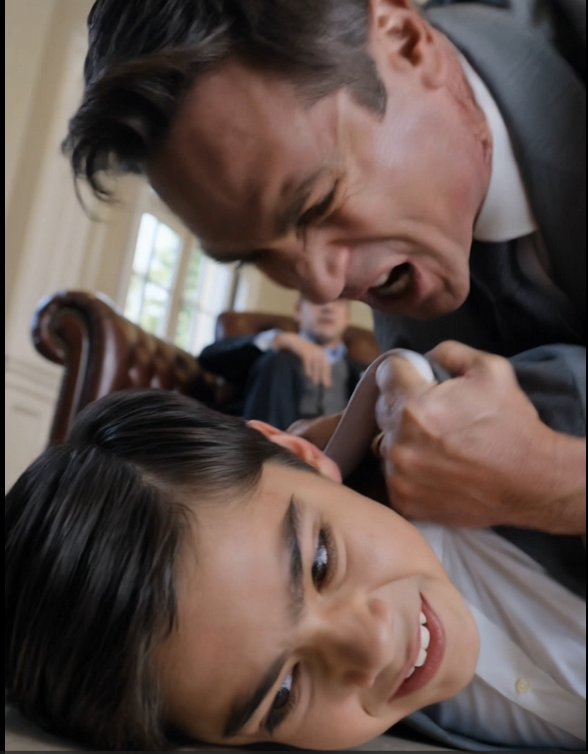
The boy hit the marble hard — no warning, no mercy, just a man’s fist twisted in his collar and the sound of a body meeting the floor.
“You think this is a charity?”
The room didn’t flinch. These were people who had learned long ago that what happens in a mansion stays in a mansion.
Then a chair scraped back. One man stood — slowly, deliberately — and the air shifted the moment he opened his mouth.
“Let him go.”
Everyone turned. The first man laughed, the way people laugh when they’re not sure if they should be afraid.
“Why? You know him?”
The standing man didn’t answer right away. He stared at the boy on the floor — at the shape of his jaw, the line of his nose, something that didn’t belong to a stranger — and when he finally spoke, his voice had lost every ounce of certainty he’d walked in with.
“…I think I do.”
The room went still. Because they all heard what he didn’t say: that if he was right, nothing in this house would ever be the same again.
His name was Richard Calloway. Fifty-one years old, self-made, the kind of man who had built his fortune quietly and spent it even more quietly. He had been invited to the Hargrove estate the way people like him were always invited — not out of friendship, but out of usefulness. Gerald Hargrove needed investors. Richard had money. That was the entire relationship, wrapped in crystal glasses and a three-course dinner.
He had not expected the boy.
The child couldn’t have been older than nine, maybe ten — small for his age, dressed in clothes that had no business being within five miles of this address. He’d appeared at the dining room entrance the way strays sometimes appear at back doors: quietly, apologetically, already braced for rejection. Gerald had wasted no time. He crossed the room in four steps, grabbed the boy by the collar, and introduced him to the floor with the casual cruelty of a man who had never once been told no.
Richard was on his feet before he’d made the conscious decision to stand.
The boy looked up at him from the marble — and that was the moment. That precise, unrepeatable moment when Richard felt the ground shift beneath him. Because the boy’s eyes were dark and wide-set and slightly too serious for his age, and the line of his jaw was narrow in a specific way, and there was a small indent above his left eyebrow that Richard had only ever seen once before in his life.
In the mirror.
“Get up,” Richard said quietly, and he wasn’t talking to Gerald anymore.
The boy hesitated, then pushed himself off the floor. He didn’t cry. He didn’t look at Gerald. He looked only at Richard, with an expression that was somehow both wary and desperate at the same time — the look of someone who has been disappointed so many times that hope has become the most dangerous thing they allow themselves to feel.
“What’s your name?” Richard asked.
The boy swallowed. “Daniel.”
“Daniel what?”
A pause. Then: “Daniel Mercer.”
The name meant nothing. Richard had expected that. He kept his voice level, kept his hands still, the way he’d learned to do in boardrooms when everything inside him was moving fast.
“Who brought you here, Daniel?”
“No one.” The boy’s chin lifted slightly. “I walked.”
Gerald laughed from somewhere behind Richard’s shoulder. “He walked. You hear that? Kid walks into my house like he owns it and helps himself to my dinner table.” He looked around at his guests, collecting their amusement. “Should I call the police, or is this entertaining enough?”
Richard turned. Just far enough to make his position clear.
“You’ll do neither,” he said. “Sit down, Gerald.”
The silence that followed was the kind that redraws the lines in a room. Gerald Hargrove was not a man who sat down when told to. But something in Richard’s voice — or perhaps something in the way the other guests had stopped laughing — made him take a half step back and reach for his wine instead.
Richard turned back to the boy.
He took Daniel to the far end of the hall, away from the dinner table and the noise and the eyes. A housekeeper brought a plate without being asked — she’d seen enough of Gerald’s performances to know when someone needed feeding and dignity more than ceremony. Daniel ate quickly, the way children eat when they’re not sure how long the food will last, and Richard sat across from him and waited.
“Where do you live?” Richard asked, when the plate was half empty.
“Different places.” Daniel didn’t look up. “Right now a shelter on Clement Street.”
“With your mother?”
The boy’s hands slowed. “She died. Eight months ago.”
Richard said nothing for a moment. Outside, through the tall windows, the city glittered with the particular indifference of money.
“I’m sorry,” he said finally. And he meant it in a way that went beyond the words.
“What was her name?”
Daniel looked up then. Really looked — the way children do when an adult asks a question they weren’t expecting, when the question feels like it might actually matter.
“Anna,” he said. “Anna Mercer.”
And there it was. The thing Richard had been both moving toward and running from since the moment he’d seen the boy’s face on the marble floor.
Anna Mercer.
He hadn’t heard that name in eleven years. He hadn’t let himself say it in almost as long. She had been twenty-six when they met — a junior architect at a firm he’d contracted for a renovation project, sharp and quiet and effortlessly certain of herself in a way that Richard, at forty, had found completely disarming. They had spent four months in something that didn’t have a clean name. Not quite a relationship. Not quite nothing. And then her firm relocated her to Portland, and Richard had told himself it was cleaner this way, easier, that they’d both known it wasn’t built to last.
He had never called. She had never written.
He had never asked if there was a reason she’d left so quickly.
“How old are you?” Richard asked. His voice was steady. He had spent thirty years making his voice steady.
“Ten,” Daniel said. “Eleven in February.”
Richard did the math without wanting to. He did it anyway. February. Eleven years. Anna had left in March, eleven years ago. The numbers didn’t ask for his permission. They simply sat there, patient and immovable, rearranging everything.
“Did your mother ever mention —” He stopped. Started again. “Did she ever talk about people she knew? Before Portland?”
Daniel tilted his head slightly. “She talked about a man, sometimes. When she thought I was asleep.” A pause. “She never said his name. She just said he was someone who didn’t know what he had until it was already gone.”
Richard looked at the table. At his own hands, resting flat against the wood. He was aware, distantly, of the dinner party continuing in the next room — glasses clinking, Gerald’s voice rising above the others, the whole machinery of wealth grinding forward as it always did, indifferent to everything happening in this hallway.
“She left a letter,” Daniel said suddenly.
Richard looked up.
“When she got sick. She knew it was coming, so she wrote letters. One for me. One that she said I should give to someone, if I could ever find him.” Daniel reached into the inside pocket of his jacket — a too-large jacket, Richard noticed now, adult-sized, something donated — and produced an envelope. White. Sealed. Slightly worn at the corners from being carried.
On the front, in handwriting Richard didn’t recognize but somehow knew: For R.
He stared at it for a long moment.
“She told me to look for a man named Richard,” Daniel said quietly. “She said I’d know him because he’d be the only one in any room who looked at me like he was trying to remember something.”
Richard reached out and took the envelope. His hands, for the first time in thirty years of boardrooms and negotiations and deals that had made and broken other men — his hands were not entirely steady.
He didn’t open it in the hallway. He folded it once and placed it inside his jacket, against his chest, and he sat with Daniel for another hour. They talked about small things — the shelter on Clement Street, a teacher Daniel liked, a book he’d been reading. Normal things. The kind of things that fill the space when the enormous thing is too large to approach directly.
When the housekeeper came to say the other guests were leaving, Richard stood.
“I’m going to need you to come with me,” he said. “Not tonight. But soon.” He looked at the boy carefully. “Would that be alright with you?”
Daniel studied him with those too-serious eyes. “Are you him?” he asked. “The man she wrote to?”
Richard thought about all the ways a person can be a coward. All the quiet, comfortable ways you can fail someone without ever raising your hand or your voice. All the things you convince yourself are kindness when really they are only convenience.
“I think so,” he said. “Yes.”
Daniel nodded slowly, as if he’d already made his peace with whatever answer came. As if hope, for him, had learned to arrive quietly, without fanfare, because the other kind had let him down too many times.
Richard walked back through the Hargrove dining room without stopping. Gerald said something as he passed — something about the boy, something designed to get a laugh. Richard didn’t hear it. Or perhaps he heard it and simply decided, for the first time in his life, that there were rooms he was done performing in.
He sat in the back of his car on the ride home with the envelope in his hands.
He opened it at a red light on Fifth, in the yellow glow of the city.
Anna’s handwriting was small and unhurried and completely, painfully familiar.
Richard, it began. I’m going to tell you something I should have told you eleven years ago. I’m going to tell you, and then I’m going to ask you to do something I have no right to ask. But I always believed, underneath everything, that you were better than you thought you were. I suppose this letter is my last bet on that.
His name is Daniel. He has your jaw and your eyes and your stubborn, infuriating habit of going quiet when things get hard.
He also has my temper. I’m sorry about that.
Take care of him, Richard. Not out of obligation. Not out of guilt. But because he is extraordinary, and because he has been through enough, and because somewhere in you — under all that careful distance you keep from everything — I think you already know that he’s yours.
— Anna
The light turned green.
Richard folded the letter. Pressed it flat against his knee. Looked out at the city moving past the window — all those lit windows, all those lives, all those rooms full of people who had no idea that somewhere across town, a boy named Daniel was sleeping in a shelter on Clement Street, waiting to find out what happened next.
Richard took out his phone and called his attorney.
“I need to start a process,” he said. “Tonight, if possible.”
He didn’t explain. He didn’t need to.
Some things, once you finally see them clearly, don’t require explanation at all.
