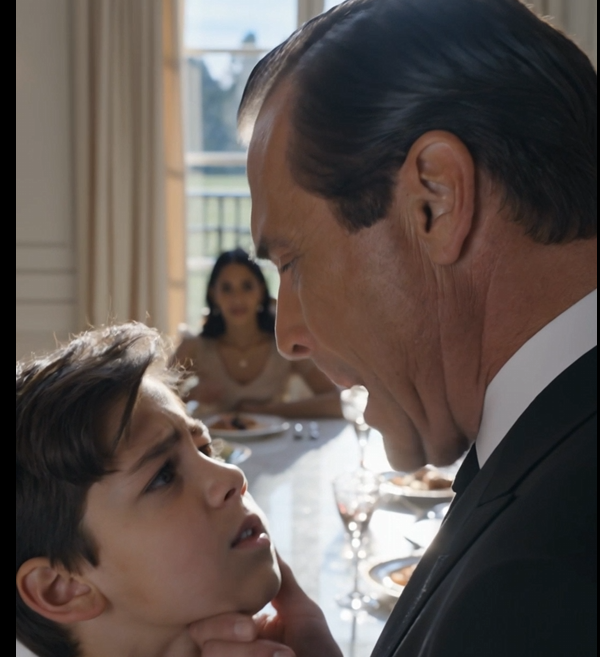
The first thing people would remember later wasn’t the slap of the fork against marble.
It was the hand.
The way he grabbed the boy’s chin like it didn’t belong to a person. Like it was just something small and inconvenient that needed to be adjusted. Fingers pressing in, not hard enough to leave marks right away, but hard enough to make a point. Hard enough that anyone watching understood exactly what was happening.
Control.
“Look at me when you beg,” he said.
Not loud. He didn’t need to be loud. The kind of authority he carried didn’t rely on volume. It relied on assumption—the quiet, practiced certainty that no one in the room would challenge him.
And no one did.
The restaurant was the kind of place where everything was designed to feel effortless. Soft lighting. Polished marble floors that reflected movement like water. Crisp tablecloths. Glassware so thin it seemed like it might dissolve if you held it too long. Conversations were low, contained, carefully curated.
Important people came here to not be disturbed.
So when the boy had walked in, thin and small and visibly out of place, it had created a kind of ripple. Not disruption. Not yet. Just a shift in attention. A collective awareness of something that didn’t belong.
He looked seven. Maybe eight.
It was hard to tell, because hunger did strange things to a face. It sharpened it. Hollowed it out. Made the eyes too big and the body too slight, like someone had erased parts of him but left the outline behind.
He had stood at the edge of the room for a few seconds, not moving, like he was trying to decide if he was allowed to exist there.
Then he stepped forward.
“Excuse me,” he said quietly.
A few people glanced at him. Not many. Just enough to register.
“I just need something to eat.”
There were a dozen ways that moment could have gone.
Someone could have called the manager. Someone could have offered him food. Someone could have gently redirected him somewhere else.
Instead, what happened was nothing.
And nothing, in a room like that, is a decision.
He moved from table to table, his voice getting softer each time he repeated the same sentence. Each time he was ignored, dismissed, waved away. A man lifted his hand without even looking at him, like brushing off a fly.
“Not here.”
A woman smiled, but it wasn’t kind.
“Oh honey, this isn’t the place.”
The boy nodded every time, like he understood rules he had never been taught. Like he was apologizing for something he didn’t know how to fix.
Until he reached that table.
The man sitting there didn’t look at him at first. He was mid-conversation, leaning back slightly, one hand resting on the table, the other holding a glass. Expensive watch. Perfectly tailored suit. The kind of presence that rearranged space without trying.
The boy stepped closer.
“Sir,” he said, quieter now. “Please.”
That’s when the man looked at him.
Just a glance. Quick. Dismissive.
“Go somewhere else,” he said.
The boy didn’t move.
“I’m hungry,” he said.
And something about the way he said it—flat, simple, not dramatic, not manipulative—lingered just a fraction longer than it should have.
It irritated him.
That’s what it was. Not guilt. Not compassion. Irritation.
The refusal to disappear.
That’s when he reached out.
Fast. Efficient.
His fingers closed around the boy’s chin, lifting his face upward like it weighed nothing.
“Look at me when you beg.”
And then—
Silence.
Not shocked silence. Not the kind that follows something unexpected.
This was a different kind.
Agreement.
The quiet, unspoken consensus that this moment didn’t require intervention. That this was unpleasant, yes, but not their responsibility. That the world was full of things like this, and you couldn’t possibly stop all of them.
So why start now?
The boy’s eyes were wide.
Not crying. Not yet. Just wide, like he was trying to understand what he had done wrong.
“I said—”
The man’s grip tightened slightly.
“—look at me.”
And then—
A sound.
Sharp. Out of place.
Metal against stone.
A fork hitting marble.
It didn’t shatter anything. It wasn’t loud enough to stop the world.
But it was enough.
Heads turned.
Chairs shifted.
Attention broke.
She was already standing.
No hesitation. No gradual movement. One second seated, the next on her feet, the chair legs scraping sharply against the floor behind her.
Her hand was still half-raised from where the fork had slipped.
Her eyes were locked on the boy.
Not on the man holding him.
On the boy.
There was something wrong with her expression.
Not just anger. Not just shock.
Recognition.
But not the kind that brings comfort.
The kind that brings fear.
“Stop.”
Her voice cut through the room, clean and direct.
The man frowned slightly, more annoyed at the interruption than concerned by it.
“Sit down,” he said without looking at her.
She didn’t move.
“Let him go.”
Now he turned.
Slowly.
Measured.
“You’re making a scene.”
“So are you.”
For a moment, they just looked at each other.
Then, with visible reluctance, he released his grip.
The boy stumbled back half a step, rubbing his jaw, eyes darting between them.
She moved immediately.
Two steps forward. Close enough that she could see everything. Every detail. The dirt under his fingernails. The faint bruise along his arm. The way his shirt hung too loose at the shoulders.
But it wasn’t any of that.
It was his face.
She stopped inches from him.
Too close for comfort. Too close for politeness.
The room watched.
“Say something,” she whispered.
The boy blinked.
Confused.
“I—”
His voice was small. Uncertain.
“I just need food.”
That was it.
One sentence.
Maybe less.
And she broke.
Not gradually. Not the slow, controlled unraveling people practiced in public.
This was different.
Immediate.
Total.
Her hand went to her mouth, but it was too late to contain it. The sound that came out wasn’t a sob. It was something sharper. More violent. Like something inside her had snapped under pressure.
“No,” she said, shaking her head. “No, no…”
The room shifted.
People leaned forward. Conversations stopped completely now.
“What is it?” someone asked quietly.
She didn’t answer.
Her eyes never left the boy.
She reached out, then stopped herself just before touching him, like she wasn’t sure she was allowed.
“Say it again,” she said.
The boy hesitated.
“I just need—”
“That’s his voice.”
She said it louder this time.
Clear.
Unmistakable.
“That’s his voice.”
Silence hit again—but this time it was different.
This time, it wasn’t agreement.
It was fear.
The man who had grabbed the boy straightened slightly, his expression tightening.
“What are you talking about?” he asked.
She didn’t look at him.
She couldn’t.
Her entire world had narrowed to the space between her and the boy.
“How old are you?” she asked.
“Eight,” he said.
Her breath caught.
“Eight…”
She closed her eyes for half a second, like she was doing math she didn’t want to finish.
“When’s your birthday?”
The boy shifted his weight.
“I don’t know,” he said.
That did something to her.
Something worse than anything else.
“Who takes care of you?” she asked.
He shrugged.
“No one.”
The room felt colder.
Someone stood up in the background. Someone else whispered something too quiet to hear.
But none of it mattered.
She was already shaking.
“Where did you come from?” she asked.
He looked down.
“I don’t remember,” he said.
And that was the moment everything broke open.
Because memory, or the lack of it, doesn’t exist in isolation. It connects. It echoes. It lines up with things you’ve spent years trying not to think about.
She turned, finally, toward the man.
Slowly.
Deliberately.
“Look at him,” she said.
He didn’t want to.
You could see it.
But he did.
A quick glance at first.
Then a second.
Longer.
Something flickered.
Dismissed.
Then flickered again.
Stronger.
“That’s not—” he started.
She cut him off.
“You remember the night he disappeared?”
The words landed heavy.
Too heavy.
The kind of words that don’t belong in places like this.
“That was years ago,” he said quickly.
“Yes.”
Her voice was steady now. Too steady.
“And you told me we would never find him.”
A pause.
“And now he walks in here—”
She gestured toward the boy, her hand trembling.
“—and you don’t even see him.”
The man stood up.
Slowly.
Carefully.
Like any sudden movement might confirm something he wasn’t ready to accept.
“That’s not possible,” he said.
But his voice had changed.
Less certain.
Less controlled.
She stepped aside.
Just enough to give him a clear view.
“Look again.”
The boy stood there, small and silent, watching them like he wasn’t sure if he was in trouble or not.
The man took one step forward.
Then another.
Close enough now.
Close enough to see details.
The shape of the eyes.
The line of the jaw.
Small things.
Things that shouldn’t matter.
But did.
His breath hitched.
Just slightly.
“What’s your name?” he asked.
The boy hesitated.
Then—
“Eli.”
The man froze.
Completely.
Because that wasn’t just a name.
That was the name.
The one they had stopped saying out loud.
The one that had been replaced with silence, with avoidance, with carefully constructed sentences that never quite touched the truth.
“That’s not possible,” he repeated.
But this time, it sounded like a plea.
Not a statement.
The woman shook her head slowly.
“I heard him,” she said. “I know that voice.”
And the worst part—the part no one wanted to say—was that voices don’t come back wrong.
Not like that.
Not by accident.
The room held its breath.
The man looked at the boy.
Really looked at him.
And for the first time, something cracked.
Not anger.
Not control.
Something else.
Recognition.
Or the beginning of it.
And once it starts—
You can’t stop it.
The boy shifted slightly, uncomfortable under the attention.
“I didn’t do anything,” he said quietly.
And that sentence—
That simple, defensive sentence—
hit harder than anything else that had happened.
Because it didn’t belong to a stranger.
It belonged to someone who had learned, a long time ago, that existing was enough to be blamed.
The man’s hand twitched at his side.
Like he wanted to reach out.
But didn’t know how.
Didn’t know if he was allowed.
Didn’t know if he deserved to.
The woman took a step closer to the boy.
This time, she didn’t stop herself.
Her hand hovered near his face, then gently, carefully, touched his cheek.
He flinched.
Just a little.
But enough.
And that—
more than anything—
destroyed her.
“Who did this to you?” she whispered.
The boy didn’t answer.
Because some questions don’t have simple answers.
And some answers don’t fit in rooms like this.
The man exhaled slowly.
Like the air had been knocked out of him.
“Eli…” he said.
Testing it.
Trying it.
Hearing it again after years of silence.
The boy looked up.
And in that moment—
there was no restaurant.
No audience.
No polished marble or expensive glassware.
Just three people.
And a truth that had finally found its way back into the room.
Uninvited.
Unavoidable.
And impossible to ignore.
The silence that followed was no longer agreement.
It was something else entirely.
The beginning of consequences.
