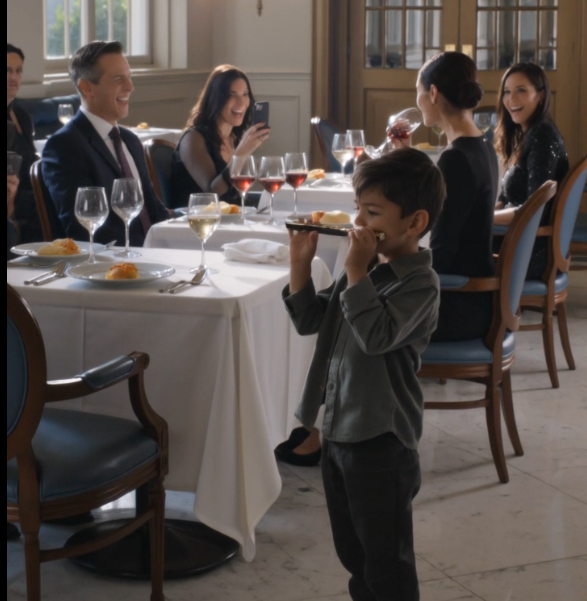
The lunch crowd at Maren’s had reached that particular pitch of prosperity — the clinking of crystal, the murmur of deals dressed up as conversation, the soft percussion of a room full of people who had never once wondered where their next meal was coming from.
The maître d’ had already spotted the boy.
He was moving toward him — unhurried, practiced, the kind of removal that happens in expensive rooms without anyone having to raise a voice — when the harmonica started.
The sound stopped him.
It stopped several people, actually, though most of them recovered quickly, returning to their salmon and their Sancerre with the trained indifference of those who have learned that acknowledgment is a form of obligation. The boy was maybe six years old. His jacket was a man’s jacket, cut off at the sleeves and cinched at the waist with a bungee cord. His sneakers had no laces. He had positioned himself near the window — instinctively, perhaps, or perhaps because the light was good there, the warm afternoon pouring through Maren’s floor-to-ceiling glass and landing on the marble in long gold panels — and he played with his eyes half-closed, swaying slightly, the way very small children sway when the music is coming from somewhere deep and private.
What he played was not a children’s song.
It was something older than that. Something with a blues structure underneath it — a walking, aching thing that sounded like it had been learned not from a lesson but from a room, from a particular quality of evening light, from the specific silence of someone leaving.
A man at table nine — navy blazer, open collar, the comfortable sprawl of someone whose 2 p.m. had nowhere to be — reached into his pocket without looking up from his phone. His fingers found a quarter. He flicked it. Not toward the boy, exactly. Near the boy. It hit the marble and spun, ringing, and came to rest near the boy’s right foot.
The boy stopped playing.
He looked at the coin. Then at the man, who still hadn’t looked up.
The boy crouched — slowly, with the particular deliberateness of a child who has learned to make himself small in rooms that don’t want him — and reached toward it.
The chair scraped.
The sound cut through the room the way the harmonica had, but differently — harder, more sudden, a sound with intention behind it. Several people looked up. The woman at table four was already standing, her napkin falling from her lap to the floor, her eyes fixed on the crouching boy with an expression that had moved through several things very quickly and landed on something final.
She was not young, but she was not old. She was the kind of woman who had arrived at a certain age the way very few people do — without softening, without performance, with only the distillation of everything she had learned and refused to forget. Her dress was dark. Her jewelry was minimal. She wore her hair the way women wear it when they have stopped caring what anyone thinks and started caring only what is true.
“Stop.”
One word. No volume to it. And yet.
The room went quiet. Not the polite quiet of people pausing their conversations out of curiosity — the involuntary quiet of people who have felt something shift in the air pressure and don’t yet know what it means.
The boy looked up at her. He had not taken the coin.
She crossed the room. Her heels on the marble were precise, unhurried — the walk of a person who has learned that the fastest way between two points is not speed but certainty. She reached him. She kneeled. Right there on the polished floor of Maren’s, in her dark dress and her minimal jewelry, she put one knee down and brought herself level with a six-year-old boy in a bungee-cord jacket.
Her hand came up and lifted his chin. Gently. The way you touch something you want to see clearly.
She looked at his face for a long moment. He let her. He was the kind of child who had been looked at in many ways — with pity, with annoyance, with the flat professional appraisal of people deciding what to do about him — but this was different, and he seemed to know it. He held still.
“Who taught you to play like that?” she asked. Her voice had lost its command. It was soft now. A different kind of serious.
The boy considered the question. He looked at the harmonica in his hand — dented, older than he was, the chrome worn smooth on one side where a thumb had rested against it for years.
“My dad,” he said. “Before he left.”
She stayed kneeled for another moment. Something moved through her face — recognition first, then something that went deeper than recognition, something that had to do with her own history and the particular way music carries the people who first gave it to you, carries them even after they have made themselves impossible to carry any other way.
She stood. She turned and looked at the room.
The room looked back at her.
The man with the navy blazer had put his phone down. The couple at table two had stopped mid-sentence. The maître d’ stood near the host stand with his hands clasped and his expression carefully neutral, waiting to see what kind of situation this was going to be.
“No one here,” she said, “understands what they were hearing.”
She didn’t raise her voice. She said it the way you state a fact about the weather — without accusation, without theater, with only the flat authority of someone who knows things that other people don’t and has stopped apologizing for it.
The silence that followed was a different kind of silence than the one that had preceded it.
She turned back to the boy. She extended her hand — open, palm up, the way you offer a hand to someone you are asking, not commanding.
“Come with me,” she said.
The boy looked at her hand. He looked at the coin on the floor. He looked at the harmonica.
He put the harmonica in his pocket.
He took her hand.
The walk across the restaurant was not long — thirty feet, maybe thirty-five — but it had the quality of a much larger distance. The camera, if there had been a camera, would have followed them at a slight remove, the handheld drift of something witnessing rather than recording, the frame catching in its edges the faces of the people who watched them go: the man at table nine with his phone face-down now on the tablecloth, the woman at the window who had looked away and then looked back, the elderly couple near the door whose expressions had moved from surprise to something that resembled, uncomfortably, shame.
The boy walked beside her with his hand in hers and his chin up and his laceless sneakers quiet on the marble. He was six years old. He had learned a blues structure from his father in a room that no longer existed, on a harmonica that was older than he was, in the specific evening light of a time before leaving. He had carried that song into every room since. Not all rooms had deserved it.
The door opened. The city came in — briefly, warmly, the sound of traffic and August heat and a world outside that was louder and harder and realer than anything inside Maren’s polished walls.
They walked through it together.
Behind them, the restaurant settled back into itself — or tried to. The Sancerre was still cold. The salmon was still perfectly seared. The light still came through the floor-to-ceiling windows in long gold panels and landed on the marble in the same places it always had.
But the coin was still on the floor.
Nobody picked it up.
The maître d’ looked at it for a moment. Then he looked at the empty space near the window where the boy had stood, and then at the door, which had closed again and showed nothing now but the street outside.
He cleared his throat.
He returned to his position at the host stand.
The lunch crowd found its rhythm again — the crystal, the deals, the soft percussion of prosperity. But something had changed in the frequency of the room, something below the level of conversation, below the level of anyone’s willingness to name it. The man at table nine picked up his phone and looked at it and put it down again. The couple at table two spoke to each other in quieter voices. The elderly man near the door said something to his wife that nobody else heard, and she nodded once, and pressed her hand over his.
Outside, somewhere on the street — faint, then fainter, then gone — the sound of a harmonica.
Something old. Something walking, aching, blues-structured, learned in a specific light from a specific person in a time that could not be returned to but could, apparently, still be carried.
They heard it and said nothing.
They heard it and looked at their plates.
The light moved on the marble. The coin sat where it had landed. The silence in Maren’s that afternoon was the heaviest thing in the room — heavier than the marble, heavier than the crystal, heavier than the accumulated wealth of everyone seated inside it — and not one person there could have told you, honestly, exactly what it weighed.
Some rooms deserve the music they get. Some don’t.
The boy knew the difference. He had always known.
