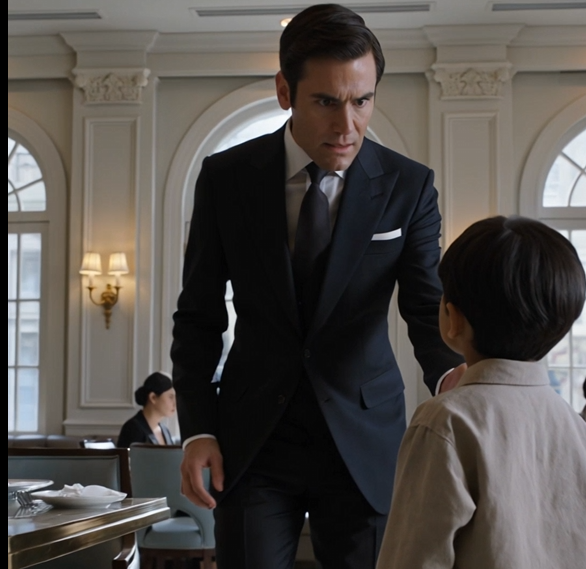
The coin spun across the marble for what felt like forever — that sharp, ringing sound cutting through every conversation in the room until there was nothing left but silence and a small boy too frightened to go after it.
“That’s all you get.”
The man turned back to his table. And the boy stood there, staring at the floor, learning a lesson no child should ever have to learn before the age of ten.
Then something shattered. Not a plate — a glass, slipping clean from a woman’s hand as her eyes landed on the boy, or more precisely, on the outline of something small pressed against the fabric of his pocket. She was on her feet without thinking, crossing the room with the kind of urgency that has nothing to do with anger and everything to do with fear.
“Where did you get that…?”
Her voice barely made it out whole. The boy’s hand moved instinctively, fingers curling around the object the way children protect the only things they have left — and that single gesture stopped her cold. Because she recognized it. Not the shape, not the color, but the way he held it. Exactly the way someone else used to. Someone who was supposed to be gone.
Her name was Elena Vasquez. Forty-two years old, a woman who had survived the particular kind of grief that doesn’t announce itself cleanly — no funeral, no closure, no body to stand over and say goodbye to. Just an absence that arrived one morning and never left. She had learned to carry it the way you carry something very heavy for very long distances: by adjusting your posture around it until you forget what it felt like to stand up straight.
She had been invited to the Aldridge dinner party because her firm had recently merged with one of Robert Aldridge’s subsidiaries, and Robert believed in cementing professional relationships with social ones. She had come because refusing would have required an explanation, and Elena had long ago run out of energy for explaining herself to people who wouldn’t understand anyway.
She had not expected the boy. She had not expected any of this.
The object in his pocket was a compass. Small, brass, with a cracked face and a needle that no longer pointed perfectly north — it drifted slightly west, which had always been its particular flaw and, according to the man who’d owned it, its particular charm. Everything worth finding is a little west of where you expect it, he used to say, which was the kind of thing that had seemed profound at twenty-nine and now, thirteen years later, seemed like exactly the sort of sentence a person constructs when they are trying to make peace with being lost.
His name had been Marco. Her brother. Younger by four years, which had always felt like a reversal of the natural order because Marco had been, in every way that mattered, the one who knew where he was going. He had been twenty-six when he disappeared — not dramatically, not all at once, but in the gradual way of someone being pulled under by a current that looks, from the surface, like ordinary water. Depression that went untreated too long. A silence that Elena had mistaken for recovery. A morning when she called and the phone rang and rang and rang.
They had searched. They had filed reports. They had spent eight months following threads that went nowhere, and then the threads ran out and the official conclusion was that Marco had chosen to disappear, which was the conclusion authorities reached when they ran out of better ones. Elena had never believed it. She had also never been able to prove otherwise, which was a different kind of grief entirely — the grief of an open question that no one else was still asking.
She had kept his compass on her nightstand for thirteen years. She had reached for it on bad nights the way other people reached for sleeping pills. She had held it in the specific way that the boy in front of her was holding it now — thumb pressed against the cracked face, fingers curled under — because that was how Marco had always held it, and holding it that way made the distance feel smaller.
She had never shown anyone that gesture. She had never described it. It was the kind of private thing that lives between a person and an object and goes nowhere else.
And yet.
“What’s your name?” Elena asked. She was crouching in front of him now, on the marble floor of Robert Aldridge’s dining room, with twelve dinner guests pretending not to watch and the shattered glass still glittering around her feet.
“Benji,” the boy said. He was perhaps nine, dark-eyed, with the careful watchfulness of a child who has navigated too many adult situations alone.
“Benji,” she repeated. “Can I see what you’re holding?”
His fingers tightened. Automatic, protective.
“It’s okay,” Elena said. “I’m not going to take it. I just want to look.”
He studied her for a moment — that particular child-assessment, weighing her against some internal scale of trustworthiness she couldn’t see. Then, slowly, he opened his hand.
The compass lay in his palm. Cracked face. Brass casing, worn smooth at the edges from years of handling. Needle drifting slightly west.
Elena’s breath left her body.
“Where did you get this?” she asked. Her voice, remarkably, stayed level.
“My dad gave it to me,” Benji said. “Before he went away.”
“When did he go away?”
“Long time ago.” The boy’s expression did something complicated. “I was really little. I don’t remember his face. But I remember the compass because he let me hold it and I asked him why it was broken and he said —”
He stopped.
“What did he say?” Elena asked.
Benji looked at her with those careful dark eyes. “He said everything worth finding is a little west of where you expect it.” He tilted his head slightly. “Do you know what that means?”
Elena sat down on the marble floor. She didn’t plan to. Her legs simply made the decision without consulting her.
“Yes,” she said. “I do.”
His mother’s name was Claire. She was waiting outside — Elena learned this in pieces, the way you learn things from children, in the order they consider important rather than the order that would be most useful. Claire had brought Benji to the party because she worked in the Aldridge kitchen, and the regular sitter had canceled, and there was nowhere else for him to go on short notice. He had wandered in from the service entrance, drawn by the noise and the light, and had been standing at the edge of the dining room for approximately four minutes before Raymond Aldridge — Robert’s brother, a man with the specific cruelty of someone who has never once been told he was wrong — had noticed him and produced the coin.
Elena found Claire in the kitchen. She was thirty-four, quiet, with the self-contained efficiency of someone who had been managing alone for a long time. When Elena came through the door, Claire looked at her with the wariness of a woman accustomed to conversations that began in dining rooms and ended badly.
“Your son showed me something,” Elena said. “A compass.”
Claire’s expression shifted — not dramatically, but enough. “He carries it everywhere. I’ve told him to leave it at home but he —” She stopped. “He says it makes him feel like his dad is with him.”
“I knew his father,” Elena said. “I think I knew his father.”
The kitchen went very quiet. Somewhere in the dining room, someone laughed at something, and the sound floated through the door and dissolved.
“Marco?” Claire asked. Barely a whisper.
“Marco Vasquez,” Elena said. “He was my brother.”
Claire set down the dish she was holding. She set it down with the deliberate care of someone who needs their hands to be empty before they can deal with what is coming next.
“He talked about you,” she said. “He talked about you constantly.” Her voice had gone rough at the edges. “He said you were the only one who ever really understood him. He said he was going to call you. He said —” She stopped. Pressed her lips together. “He said he was going to call when he was better. He didn’t want you to see him the way he was.”
Elena had spent thirteen years constructing various versions of this conversation in her head. She had imagined anger, and relief, and the particular cold clarity of finally having answers. She had not imagined this — standing in a stranger’s kitchen while her brother’s son sat in the next room holding a broken compass, listening to a woman tell her that Marco had loved her enough to protect her from the worst of himself.
“Is he —” Elena stopped. Started again. “Where is he?”
Claire looked at her for a long moment. Long enough that Elena understood, before the words came, what shape the answer would take.
“He passed,” Claire said quietly. “Four years ago. He was — he had gotten better, actually. He was doing well. It was his heart. Nobody knew.” She exhaled slowly. “He never stopped talking about calling you. He just kept waiting until he felt ready. And then —”
“He ran out of time,” Elena said.
“Yes.”
They sat at the kitchen table for a long time. Benji came in at some point and climbed into his mother’s lap and fell asleep there with the compass still in his hand, the way children fall asleep when the adults around them have finally stopped performing and started simply being present with each other.
Elena looked at her nephew — this boy she hadn’t known existed an hour ago, this child who had carried a broken compass into a stranger’s dining room and held it in a way that had crossed thirteen years of silence and grief in a single moment — and she felt something shift in her chest. Not the sharp pain of fresh loss. Something older and more complicated. The specific feeling of a door opening onto a room you had convinced yourself was empty.
“He looks like Marco,” she said.
“I know,” Claire said. “Every single day.”
“He has his hands.”
Claire looked down at her son’s sleeping face. “He has his laugh too. I didn’t realize until Benji was about three, and then one afternoon he laughed at something on TV and I had to leave the room.” She paused. “Not because it hurt. Because it was so completely Marco that it felt like a gift I hadn’t been told I was getting.”
Elena reached across the table and placed her hand over Claire’s.
“I want to know him,” she said. “If that’s — if you’d be willing. I want to know my nephew.”
Claire looked at her for a long moment. “Marco would have wanted that,” she said finally. “He wanted Benji to know where he came from. He just never figured out how to make it happen.”
“Then I will,” Elena said. “That can be my job.”
She left the Aldridge house at midnight, long after the dinner party had dissolved and Robert had said his carefully worded goodbyes and the marble floors had been cleaned of broken glass and scattered coins. She left with Claire’s phone number in her pocket and a promise to call in the morning and the specific lightness of someone who has been carrying a question for thirteen years and has finally, imperfectly, incompletely, begun to find its answer.
She drove home slowly. On her nightstand, she knew, a space had been sitting empty for thirteen years — the place she’d kept Marco’s compass on the nights it had found its way back to her. It was a small space. Unremarkable. The kind of space that looks like nothing until you understand what it was holding.
Tomorrow she would call. Tomorrow she would begin the long, necessary work of becoming someone’s family again.
Tonight she drove west — slightly west, the way the compass always pointed — and let the city blur past the windows, and did not try to stop the tears when they finally came.
They were not only sad tears. That was the thing she hadn’t expected.
They were also, underneath everything, the tears of someone who has just found what they had given up looking for — not where they expected, not in the shape they expected, but real. Undeniably, irrevocably real.
Everything worth finding, Marco had always said.
A little west of where you expect it.
