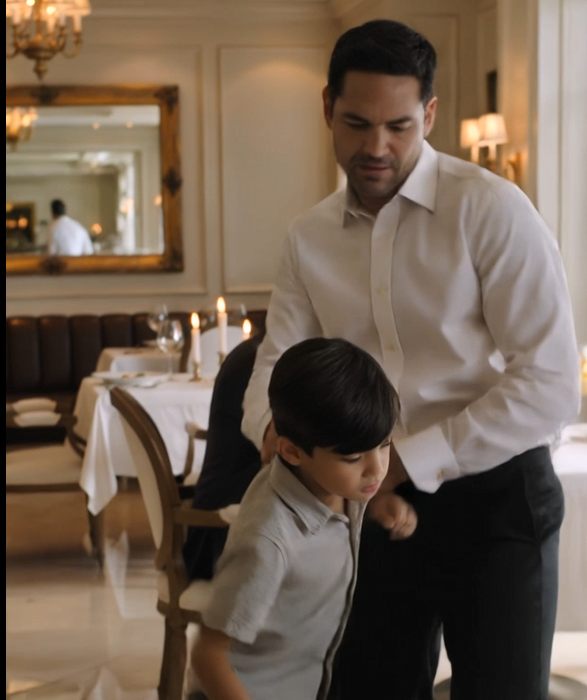
The waiter’s grip was not accidental.
It was practiced.
A controlled, efficient motion meant to communicate something without needing words. A hard yank backward, just enough force to make the boy lose his balance, just enough shame to make the entire room understand what kind of place this was.
The boy stumbled.
His shoulder hit the edge of a table—lightly enough not to injure him, hard enough to make him feel it. Glassware trembled. A fork shifted. A couple at the table leaned back slightly, not out of concern, but out of instinctive distancing. As if proximity alone might make them responsible.
“You can’t be here,” the waiter said.
No anger. No emotion. Just procedure.
The boy didn’t fight back. He didn’t even look at the waiter.
He had learned already that fighting back cost more than silence.
He was small—seven, maybe eight years old. It was hard to tell. Hunger did something strange to time. It stretched it. Bent it. Made childhood look older and adulthood feel far away and unreachable.
His clothes were too big in places, too thin in others. His face was smudged with something that might have been dust or might have been days of trying not to cry.
He steadied himself with one hand on the table edge.
The people sitting there didn’t move.
Didn’t intervene.
Didn’t acknowledge him beyond the brief discomfort of having their evening interrupted.
The restaurant itself was the kind of place where silence had a price tag.
Soft lighting. Marble floors polished so perfectly they reflected movement like water. Crystal glasses catching the glow of chandeliers above. Conversations kept low, careful, curated—money didn’t like being disturbed.
And then there was the boy.
Out of place.
Visible in the way that made people uncomfortable, because visibility demanded response.
He looked up at no one in particular.
And said it.
Three words.
Quiet.
Almost swallowed by the air.
“Please… I’m hungry.”
Most people didn’t hear him.
And that was the point.
Not because they were deaf.
Because they chose not to listen.
The waiter tightened his grip again, preparing to drag him fully out now, to remove the inconvenience and restore order.
But something changed.
Not in the boy.
In the room.
One man had heard.
He had been mid-sentence—something about work, something about numbers, something that no longer mattered. His voice simply stopped.
It didn’t fade.
It cut off.
Like a wire snapped.
The glass in his hand stayed halfway to his lips.
He wasn’t moving.
Wasn’t blinking.
Just staring.
At the boy.
At those three words.
Something in his expression shifted—not immediately, not dramatically. It wasn’t shock. It wasn’t sympathy.
It was recognition.
But not clean recognition.
The kind that comes with weight.
History.
Damage.
He slowly lowered the glass back to the table.
Carefully.
Like any sudden movement might break the moment before he understood what it meant.
“Let him go,” someone at the table said quietly.
The man didn’t respond.
His eyes stayed locked on the boy.
Not moving.
Not softening.
Just… calculating.
Then, finally, he spoke.
But not to the waiter.
Not to anyone else in the room.
To the boy.
His voice was low.
Controlled.
Urgent in a way that didn’t belong in a place like this.
“…Say that again.”
The boy blinked.
Confused.
“I’m hungry,” he said again.
Same words.
Same tone.
No performance. No strategy. Just truth.
And that was when the man’s face changed.
Not gradually.
Not carefully.
It broke.
Something inside him cracked open so quietly that no one noticed at first.
Except her.
A woman seated across from him.
His wife.
She knew that face.
She had lived beside it for years.
She had seen him angry. Calm. Tired. Focused. Detached.
But she had never seen this.
This wasn’t emotion.
This was collapse held together by habit.
“Daniel?” she said carefully.
He didn’t answer her.
Didn’t even acknowledge her presence.
He had shifted slightly in his chair, leaning forward now, elbows resting on the table—but not in relaxation.
In tension.
Like every muscle in his body had suddenly remembered something it had spent years trying to forget.
“What’s your name?” he asked the boy.
The boy hesitated.
Names were dangerous sometimes.
People used them to own you.
To keep track of you.
To make you easier to find.
“Daniel,” the boy said finally.
The air changed.
Not loudly.
Not physically.
But enough that the temperature of the room seemed to drop a degree.
The man’s hand tightened slightly on the edge of the table.
His wife noticed.
Everyone noticed something now, even if they didn’t know what.
“That’s not possible,” someone muttered behind them.
But the man didn’t hear it.
Or didn’t process it.
He was already somewhere else.
Somewhere far away.
Years back.
A different version of this moment playing out in reverse.
The boy shifted uncomfortably under the attention.
“I didn’t do anything wrong,” he said quickly.
That sentence hit harder than anything else.
Because it wasn’t defensive.
It was rehearsed.
Learned.
Survival language.
The man stood up.
Slowly.
Chair legs scraping against marble in a sound that felt too loud for what it carried.
Now people were watching.
Fully.
Finally.
The waiter let go of the boy, uncertain now. The rules had changed, but no one had told him what they were yet.
The man stepped closer.
One step.
Then another.
Stopping just a few feet away.
Close enough now.
Too close for comfort.
He looked at the boy’s face.
Really looked.
The shape of it.
The eyes.
The small details most people never notice because they don’t want to.
And then he saw it.
Just below the boy’s ear.
A thin, pale line.
A scar.
Faint.
Almost invisible.
But not to him.
Not to her.
The glass on the table behind him shattered.
Not from force.
From release.
His wife had dropped it without realizing.
It rolled slightly before settling among fragments of crystal.
She didn’t move to clean it.
Didn’t breathe.
Didn’t speak.
Because she was staring at the same scar.
And she knew.
Before anyone else.
Before logic caught up.
Before denial could form.
“I know that,” she whispered.
Her voice didn’t sound like her own.
The man didn’t look away from the boy.
“When?” he asked quietly.
The boy flinched slightly at the tone.
“Before,” the boy said.
A child’s answer.
Not helpful.
Not precise.
Just… honest in the way children are when they don’t know they’re supposed to lie better.
The man’s breathing changed.
Shallow now.
Controlled, but breaking rhythm.
“That scar,” his wife said slowly, stepping closer now, her voice shaking, “he got that when he was—”
She stopped.
Couldn’t finish.
Because finishing meant admitting something she had never allowed herself to think fully.
The man finally turned his head slightly toward her.
“Say it,” he said.
But it wasn’t a command.
It was a plea disguised as one.
She swallowed hard.
“That night,” she whispered, “he fell.”
Silence.
The boy looked between them.
Uncertain.
Uncomfortable.
The waiter took a step back without realizing it.
The entire restaurant felt it now.
Something had shifted from disturbance to event.
The man closed his eyes briefly.
Just a second.
But in that second, something inside him rearranged.
“What happened after?” he asked.
His wife shook her head.
“I thought— I thought he was fine. I thought—”
Her voice broke.
“I didn’t tell you everything.”
That landed.
He opened his eyes.
Slowly.
Now there was something else there.
Not recognition.
Not confusion.
Understanding.
Heavy.
Final.
“You said he was gone,” he said.
She nodded.
“I thought—”
“You thought what?” His voice sharpened slightly now. “That he disappeared?”
She couldn’t answer.
Because the answer would destroy what was left of her.
The boy stepped back slightly.
Unaware of the gravity of what was happening.
Just a child sensing tension without context.
“I want to leave,” he said quietly.
But no one moved.
Not yet.
Because now it wasn’t about him leaving.
It was about what leaving would mean.
The man looked at him again.
At the scar.
At the name.
At everything that didn’t fit but somehow did.
“What happened to you?” he asked.
The boy shrugged.
“I don’t know,” he said. “People take me places. Then I leave.”
Simple.
Devastating.
The man’s hands curled into fists at his sides.
Not anger.
Not aggression.
Something worse.
Helplessness.
His wife stepped forward again, trembling now.
“I think—” she said slowly, “I think he’s ours.”
The word “ours” hit the air like something fragile breaking.
The man didn’t respond immediately.
Because he couldn’t.
Because if he did, it would become real.
The boy looked up at him.
Confused.
Waiting.
And for the first time in the entire room—
the silence wasn’t judgment.
It was truth arriving too late to be avoided.
The man finally spoke.
Barely above a whisper.
“What’s your real name?”
The boy hesitated.
Then:
“Daniel.”
Again.
The same answer.
And this time—
there was no escape from it.
Because sometimes truth doesn’t arrive loudly.
It just sits down at the table.
And refuses to leave.
