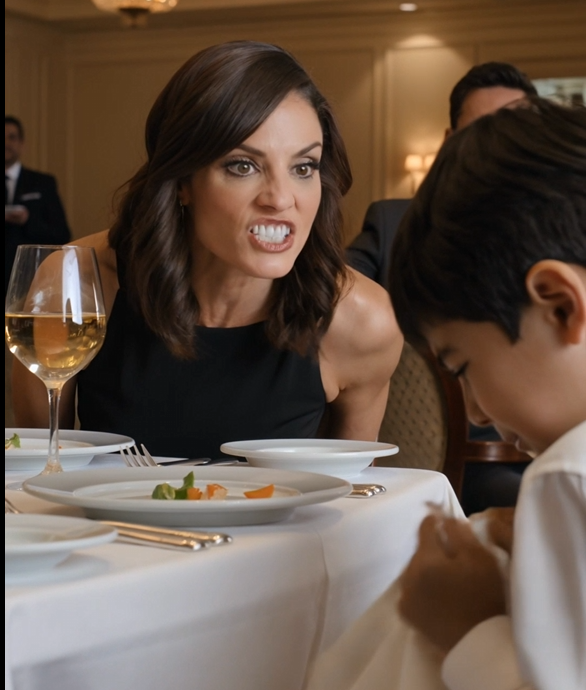
The napkin hit him in the face. Not dropped, not handed — thrown, with enough contempt to make the table laugh and enough precision to make it clear she’d enjoyed it.
“Clean yourself before you beg.”
The boy flinched, pulled his shirt tighter, and did what children learn to do in rooms full of people who have decided they don’t matter: he made himself smaller.
But one man stopped laughing. He rose slowly, the way people rise when something clicks into place that they can’t yet explain — not rushing, not performing, just moving toward the boy with his eyes fixed and his jaw tight, like a man walking toward an answer he’s been circling for years. The room went quiet. He stopped in front of the boy and studied his face with an intensity that made everyone uncomfortable. Then, voice stripped of everything except the question itself:
“What’s your name?”
The boy hesitated. One breath. Two. Then he answered — and whatever name left his lips, it didn’t just shake the man. It unmade him. Right there, in front of everyone, something behind his eyes collapsed completely.
His name was Gabriel Reyes. Forty-seven years old, the kind of man who had built his life with enough deliberate care that it looked, from the outside, like the life of someone who had always known exactly what he was doing. He ran a construction company out of Nashville — real work, physical work, the kind that leaves marks on your hands and requires you to know the difference between what holds and what only looks like it holds. He had been invited to the Mercer estate because Warren Mercer wanted to expand his property and Gabriel’s company had the best reputation in three counties.
He had not wanted to come. He had come anyway, because he was professional, and because forty-seven-year-old men with thriving businesses do not cancel dinners with potential clients over a feeling they cannot name.
Now he wished he had trusted the feeling.
The boy’s name was Lucas. Lucas Reyes.
Not a common name. Not a coincidence. Gabriel stood in the center of Warren Mercer’s dining room and heard those two words come out of the boy’s mouth and felt the floor do something floors are not supposed to do.
Lucas Reyes had been his son’s name.
His son, who had been taken from him ten years ago — not by death, but by the particular legal violence of a custody arrangement engineered by a woman with better lawyers and fewer scruples. His son, who had been two years old when Diana packed everything that mattered and drove north to her mother’s house in Vermont and filed papers that Gabriel hadn’t understood until it was already too late. His son, whose last known address had stopped being current seven years ago when Diana moved again without notifying anyone she was legally required to notify, which was a violation that Gabriel’s attorney had pursued through three jurisdictions before running out of road.
His son, who would be twelve years old now.
The boy in front of him was twelve. Maybe thirteen. Dark-haired, slight, with a jaw that Gabriel recognized not because he had memorized it from photographs — though he had, he had studied every photograph he owned until he could reconstruct them from memory in the dark — but because it was the same jaw he shaved around every morning. The same jaw his own father had, and his father’s father before that. The Reyes jaw, his grandmother had called it. Stubborn bone, she’d said, which meant something specific in their family and had always been meant as a compliment.
“Say that again,” Gabriel said. His voice was very quiet. “Your name. Say it again.”
The boy looked at him with eyes that were wary and exhausted and — underneath both of those things — something that might have been, if Gabriel wasn’t projecting, the faintest edge of hope.
“Lucas Reyes,” he said.
The room had gone the specific silent of people witnessing something they don’t yet have the context to understand but can feel the weight of. Warren Mercer sat at the head of his table with his wine glass halfway to his lips. His wife Patricia — the one who had thrown the napkin, who was now very still in her chair — watched Gabriel with the expression of someone calculating rapidly.
Gabriel didn’t look at any of them. He looked only at the boy.
“Who is your mother?” he asked.
Lucas’s chin lifted slightly — a defensive gesture, automatic, the kind that gets installed in children when they’ve had to defend something important enough times.
“Why?” he asked.
“Because I think,” Gabriel said carefully, the way you speak when the words are load-bearing, when the wrong ones could bring everything down, “that I might be your father.”
The dining room collectively stopped breathing.
Lucas stared at him. His expression moved through several things in quick succession — disbelief, calculation, something that wanted very badly to be something else and was afraid to be.
“My mom said my dad left,” Lucas said. “She said he didn’t want us.”
The sentence landed like a physical thing. Gabriel absorbed it. He had spent ten years imagining the versions of himself that Diana had constructed for their son, and he had tried to prepare for hearing one of them out loud, and he had been wrong about what it would feel like. It felt like being told a story about a stranger who happened to share your name and your face and your entire life.
“That isn’t true,” Gabriel said. “I looked for you for seven years.”
He took Lucas out of the dining room. They sat in a small room off the main hallway — some kind of reading room, bookshelves and two chairs and a lamp that cast everything in amber — and Gabriel did the thing he had rehearsed in his head for years without ever expecting to actually do: he told his son the truth.
Not all of it. Not the legal details, the jurisdictional dead ends, the years of attorney fees and unanswered motions. That was adult machinery, and Lucas was twelve, and twelve-year-olds deserve the human version before they receive the procedural one.
He told him that he had loved his mother, and that it had ended badly, and that he had fought to stay in Lucas’s life with every tool available to him. He told him about the photographs he’d kept — a whole box of them, two-year-old Lucas at Christmas, at the beach, asleep in a car seat with his mouth open and both fists curled against his chest the way Gabriel himself still slept, according to every woman who had ever told him so. He told him about the private investigator he’d hired in 2021 who had found an address in Vermont that turned out to be six months out of date. He told him about the birthday cards he had written every year and kept in a drawer because he had no address to send them to.
Lucas listened. He sat very still, in the way he’d been sitting still all evening, but it was a different kind of stillness now. Less defensive. More — processing.
“She told me you were gone,” Lucas said finally. “She said you chose to go.”
“I know.”
“She said that a lot. He chose.” Lucas looked at his hands. “I used to think about what I would say to you if I ever found you. I had this whole speech.” He paused. “It was pretty angry.”
“That’s fair,” Gabriel said.
“I’m not — I don’t know how I feel right now.” Lucas looked up. “Is that okay?”
“That’s more than okay,” Gabriel said. “You don’t have to feel any particular way. You don’t owe me anything, Lucas. I want to be clear about that. I’m not here to — I’m not going to show up and tell you how this goes. I just need you to know the truth. What you do with it is yours.”
Lucas was quiet for a moment. Outside, through the walls, the dinner party had resumed its murmur — people returning to the comfortable territory of wine and small talk, the way people always return to familiar ground after something large has moved through the room.
“How did you know?” Lucas asked. “When you saw me. How did you know?”
“Your jaw,” Gabriel said. “It’s my father’s jaw. My grandmother called it stubborn bone.” He paused. “And the way you made yourself smaller when that woman threw the napkin. I’ve seen that. My sister used to do that, when she was young and someone frightened her. There’s a specific way our family goes quiet when we’re protecting ourselves.” He shook his head slightly. “I can’t explain it better than that. I just knew.”
Lucas touched his own jaw, unconsciously, with two fingers. As if testing whether it was what Gabriel had said it was.
“Where do you live?” he asked.
“Nashville,” Gabriel said. “I have a house there. A yard. I have a dog named Brick, which is a terrible name but he came with it and he’s eight years old and it seemed cruel to change it at this point.” He watched the corner of Lucas’s mouth move — barely, almost nothing. “I have a room,” Gabriel said quietly. “I’ve had a room for ten years. I kept it empty.” He stopped. “I don’t know why I kept it empty. I think I knew I’d need it someday.”
Lucas looked at him for a long time. Twelve years old and sitting in a stranger’s reading room and doing the most adult thing a person can do: deciding whether to let someone in who has the full capacity to devastate them.
“My mom’s in Phoenix,” he said finally. “She’s been — things have been hard. She left me with her cousin three weeks ago. Said she needed time.” His voice was careful and factual, the voice of a child reporting damage without editorializing, because editorializing would make it too heavy to carry. “Her cousin’s nice but she has four kids already. I kind of just — I needed somewhere to go.”
“So you walked into Warren Mercer’s dinner party,” Gabriel said.
“I walked into a lot of places today,” Lucas said. “This one had the most food.” He paused. “Also I heard someone say your name when I was outside. Gabriel Reyes. I didn’t — I didn’t think it meant anything. My mom said your name once, years ago, and I remembered it because kids remember the things they’re not supposed to.” He looked at his hands again. “Maybe that’s why I came in.”
Gabriel thought about the architecture of moments like this — how many small decisions, how many random turns and overheard words and unlocked doors, had to align perfectly to produce a single instant of collision. How easily it could have gone otherwise. How it almost certainly should have.
“I’m glad you came in,” Gabriel said.
“Even though that woman threw a napkin at me?”
“Especially because of that,” Gabriel said. “Because it made me stand up.”
He called his attorney from the parking lot at ten o’clock, with Lucas sitting on a low stone wall nearby, looking at his phone with the studied casualness of a child pretending not to be paying close attention to the adult conversation happening twelve feet away.
The attorney picked up on the third ring, which meant she recognized the number, which meant she understood that Gabriel Reyes did not call at ten on a Tuesday for trivial reasons.
“I found him,” Gabriel said. “Lucas. He’s here. He’s twelve and he’s fine and I need to know what the next steps look like.”
A pause. Then: “Gabriel. Are you sure?”
“I’m sure,” he said. “I’ve been sure since the moment I saw his face.”
Another pause, longer. He could hear her shifting into the professional gear that had always made her worth every dollar he’d paid her.
“I’ll start making calls in the morning,” she said. “In the meantime — don’t let him out of your sight.”
Gabriel looked at Lucas on the stone wall. Lucas looked up at that exact moment and caught him looking and held his gaze for two full seconds before looking back at his phone with the elaborately indifferent expression of a twelve-year-old who absolutely had not just been watching his father watch him.
“Not planning to,” Gabriel said.
They drove to a diner because Lucas said he was hungry and Gabriel said he knew a place and it turned out the place was thirty minutes away, which was too far for what it was, but neither of them mentioned that. They sat in a corner booth under fluorescent light and ordered pancakes at ten-thirty at night and Lucas ate with the focused efficiency of someone who had not had enough to eat recently, and Gabriel drank coffee and watched his son and tried to memorize everything.
The jaw. The way he held his fork. The small crease between his eyebrows when he was thinking about something. The laugh — not deployed yet, not fully, but visible at the edges of a couple of moments when Gabriel said something that landed right.
Stubborn bone, his grandmother would have said.
Every bit of it.
“What’s Nashville like?” Lucas asked, somewhere in the middle of the second plate of pancakes.
“Loud,” Gabriel said. “Good loud, mostly. Good food. Brick will like you — he likes everyone, which makes him useless as a guard dog but excellent at everything else.”
Lucas considered this. “I’ve never had a dog.”
“You have one now,” Gabriel said. “If you want.”
The words came out before he’d assembled them carefully, and he braced for the too-much of it, the way the boy might pull back from something offered too quickly. But Lucas didn’t pull back. He looked at his pancakes for a moment, and then he looked at Gabriel, and what was in his face was something that had been making itself smaller all evening and was, cautiously, testing whether it was safe to take up a little more space.
“Okay,” he said. Just that. Okay.
Outside, Nashville was weeks away and the future was entirely uncharted and there were lawyers to call and hard conversations ahead and a twelve-year-old boy who had been told a story about his father that would take a long time to fully un-believe. All of that was real and none of it was going away.
But in the diner, under the fluorescent light, a man and his son ate pancakes at ten-thirty at night, and the distance between them was exactly the width of a table, and for the first time in ten years, Gabriel Reyes could reach across it.
