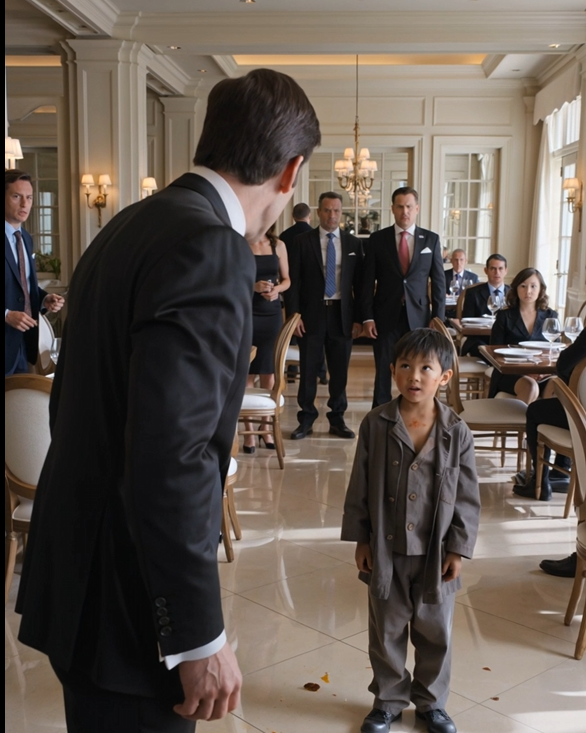
The plate didn’t just fall — it exploded against the marble, the sound sharp enough to cut through every conversation in the room.
“You didn’t pay!” the waiter snapped, already stepping back like the boy didn’t belong in the same space as the broken pieces at his feet.
Guests turned, watched, then quickly looked away — the kind of silence that protects itself. But the boy didn’t move. He didn’t reach for the food. He just stared at it for a second, like it wasn’t the worst thing that had happened to him today, and said, quietly, “You did.”
The waiter let out a short, uneasy laugh. “Not for you.”
That’s when the boy looked up. Really looked at him — steady, calm, almost too calm for someone his age.
“Yes,” he said, his voice firm enough to stop the room without raising it. “For me.”
And something in the waiter’s face shifted. Not confusion. Not anger. Something deeper — like recognition trying to break through a memory he didn’t want to touch.
Because the boy wasn’t guessing. He was remembering. And whatever he remembered… the waiter already knew it was true.
The restaurant was built to make people feel important.
White marble floors reflected warm chandelier light. Glass walls framed a perfect city skyline. Every table was expensive enough that nobody asked for prices out loud. Laughter here was controlled, soft, polite — the kind of laughter that came from people who had never had to count coins before ordering food.
Which made the boy feel like a mistake in the architecture.
He stood near the shattered plate, barefoot shoes too thin for the polished floor. His jacket hung off him like it belonged to someone else first. No one knew exactly how he had gotten in. No one really cared until the plate broke.
Now they cared.
The waiter was still frozen, half a step back from the mess, his jaw tight like he was trying to decide whether this was anger or something else he didn’t want to name.
“You need to leave,” the waiter said again, louder this time, performing for the room now. “This is not a shelter.”
A couple at a nearby table chuckled under their breath. A man shook his head, amused. Someone whispered something about security.
The boy bent slightly, finally, but not to pick up the food.
He touched the edge of the broken plate.
Then stopped.
Like he was checking if it was real.
“I remember this one,” he said softly.
The waiter frowned. “What?”
The boy didn’t answer right away. He looked at the food scattered across marble like it meant something more than wasted dinner.
“They used to serve it with extra bread,” he said. “You always said not to waste it.”
The waiter’s expression tightened. “I don’t know what you’re talking about.”
But his voice had changed. Less confident now. Less certain.
The boy stood again.
“You said that every time,” he continued. “Even when I ate too fast. Even when I dropped things.”
A pause.
The restaurant noise felt farther away now, like the room was slowly stepping out of itself.
“I used to sit closer to the kitchen,” the boy said. “So you could see me.”
The waiter’s throat moved slightly.
A swallow.
Subtle. But visible.
“That’s enough,” he said, but it didn’t sound like authority anymore. It sounded like warning. Or fear.
The boy tilted his head.
“You changed your voice,” he said.
A flicker crossed the waiter’s face.
“I said stop,” the waiter repeated, but softer again.
Now the guests were watching fully. Phones were no longer discreetly down. People leaned in. Something about the shift in tone made the scene feel less like a disturbance and more like a reveal.
The boy took a step forward.
The waiter didn’t move back this time.
“You don’t recognize me,” the boy said, not as a question.
The waiter’s lips parted slightly.
Nothing came out at first.
Then: “No.”
But it wasn’t convincing. Not even to him.
The boy nodded slowly, like he had expected that answer.
“I didn’t think you would,” he said.
Silence stretched.
Not the polite kind. The heavy kind.
The waiter looked around, as if expecting someone to step in and reset the moment. A manager. Security. Reality.
No one did.
Because something about the boy’s presence had already changed the room.
The boy looked down at the broken plate again.
“You used to call me stubborn,” he said. “Because I wouldn’t stop eating when I was hungry.”
The waiter’s hands tightened at his sides.
“That’s not—” he started.
But stopped.
Because the boy wasn’t arguing.
He was reconstructing something.
Piece by piece.
“You told me stories while you worked,” the boy continued. “About places you wanted to go. About people you left behind.”
The waiter’s face had gone pale in a way that didn’t match the lighting anymore.
“Stop,” he said again, but weaker.
The boy looked up.
“I did stop,” he said.
Another pause.
“When you stopped coming back.”
That landed differently.
Not like an accusation.
Like a memory finally naming itself.
A woman at a nearby table lowered her glass without realizing it. A man stopped chewing. Even the distant music from the speakers felt too loud now.
The waiter’s voice dropped.
“Who are you?”
The boy studied him for a long moment.
Not dramatic. Not emotional.
Just steady.
Then he said it.
“My name used to matter to you.”
The waiter shook his head slightly, almost involuntary. “No.”
But the word had no force behind it.
The boy stepped closer again.
“I waited outside,” he said. “Every night. Even when they told me not to.”
The waiter’s breath changed.
Faster now.
Uneven.
“I don’t know—” he started again.
But the sentence collapsed before it finished.
Because something had started to surface behind his eyes.
Not fully formed.
But undeniable.
The boy watched it happen.
Quietly.
Patiently.
Like he had been waiting longer than this moment.
“You used to bring me food after closing,” the boy said. “When the restaurant was empty.”
The waiter closed his eyes for half a second.
Too long for coincidence.
Too short for denial.
When he opened them again, they weren’t looking at a stranger anymore.
They were looking at something he had buried.
“No,” he whispered.
But this time it wasn’t rejection.
It was recognition trying to survive.
The boy nodded once.
“Yes,” he said.
A long silence followed.
The kind that doesn’t ask permission.
The kind that rewrites everything.
And somewhere in that silence, the waiter finally understood the worst part wasn’t the broken plate.
It was the fact that the child in front of him wasn’t lost.
He had been left.
And now he had come back.
