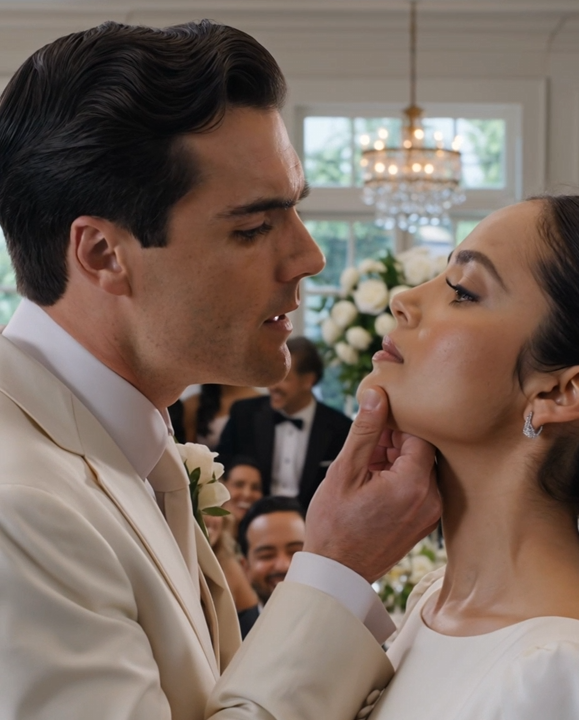
The rehearsal dinner had been Garrett’s idea — every detail of it.
The venue, a restored Federal-era estate in the Virginia hunt country, forty minutes outside Washington where the old money still preferred to conduct its business away from cameras. The guest list: seventy-three people, every one of them chosen for what they represented rather than who they were. The seating arrangement, which placed Elena between Garrett’s college roommate and a sitting federal judge, and which Garrett had revised three times in the final week, for reasons he hadn’t explained.
Elena Vasquez had noticed all of it. She noticed most things. It was, depending on who was describing her, either her greatest quality or her most inconvenient one.
She was thirty-one years old, the daughter of a civil engineer from Albuquerque and a woman who had taught middle school English for twenty-six years and believed, sincerely, that precision of language was a form of moral courage. Elena had inherited the precision. She worked in financial compliance — not glamorous, not the kind of work that got described at dinner parties — and she was exceptionally good at it. She found things that weren’t meant to be found. She followed money through the particular labyrinths that people built when they thought they were being clever.
She had been engaged to Garrett Ashworth for four months. The engagement had moved quickly. Garrett had cited love. Elena, at the time, had not questioned it.
She was questioning it now.
The dining room glittered in the way that only candlelight and old silver can produce — a warmth that looks like generosity but is really just expensive. Elena sat straight in her chair and watched the room with the quiet attention she’d learned not to advertise. Garrett sat at the head of the table, as he always positioned himself, holding court with the easy fluency of a man who’d been raised to believe that a room was something you commanded rather than inhabited.
He was handsome. He’d always been handsome, in that clean-lined, well-maintained way that photographs well and reads as trustworthy from a distance. He was also forty, a partner at a firm that managed private equity for clients who preferred not to appear in the news, and possessed of a specific social intelligence — knowing when to laugh, when to defer, when to place a hand on a shoulder — that Elena had initially mistaken for warmth.
Warmth, she had since learned, left a different residue.
He was telling a story she’d heard before, something from a ski trip, the kind of story that required everyone else to be slightly less capable than Garrett. Laughter moved around the table like a wave — some of it genuine, some of it performed, none of it hers.
She lifted her wine glass.
Across the table, Garrett’s mother, Patricia Ashworth — silver-haired, sphinx-still, wearing a string of pearls that had almost certainly been photographed at important events since the Eisenhower administration — caught Elena’s eye. The older woman’s expression did not change. But she held the look for exactly one second longer than necessary.
Elena had thought, once, that Patricia disapproved of her. She’d revised that reading. Patricia didn’t disapprove. Patricia knew something. And she had been deciding, for four months, whether to say it.
It happened between the salad and the fish course.
Elena had leaned over to say something to the judge on her left — something bland, something social, the kind of sentence that exists to fill space rather than carry meaning — when Garrett’s voice cut across the table.
“Elena.”
The sharpness of it turned heads. Not dramatically — just the micro-adjustments of people recalibrating attention.
She looked at him.
“Come sit over here,” he said. The chair beside him had been empty all evening; the original seating card replaced at the last minute for a guest who hadn’t come.
She didn’t understand the request. That was honest. She also understood, with the part of her that had been running its own quiet audit for the past several weeks, that the request had nothing to do with wanting her near him. It had to do with where she was sitting. With the federal judge. With whatever conversation Garrett had decided, at the last minute, should not happen.
“I’m fine here,” she said. Pleasantly. Evenly.
The room didn’t hold its breath. It didn’t have to. What happened next happened quickly.
He stood. He crossed to her chair. And he shoved it — not violently, but publicly, chair legs scraping marble loud enough to cut through the laughter that followed because several people laughed, reflexively, nervously, the social response to aggression when aggression is performed by someone with enough status to make it uncomfortable to name.
“Sit,” he said. “Don’t embarrass me.”
The laughter died.
Elena sat for exactly the time it took her to process what had just happened. Then she stood. Slowly and deliberately, the way her mother had once shown her — you don’t rush a moment like this, you don’t let it rush you. She smoothed her dress, which was navy, which she had chosen because she liked it, not because it photographed well, though it did.
She looked at him.
Not angry. Not shaken. The way she looked at a spreadsheet when she’d found the number that didn’t belong.
“I already know,” she said.
The silence that followed was the specific silence of a room that has stopped pretending.
Garrett’s smile — the default expression he wore the way other men wore cologne — faltered. Just slightly. A tremor in the architecture.
“Know what?” he asked.
But she could hear it already, the register shift. The question that wasn’t really a question because the man asking it already knew the answer and was hoping, in the three seconds he had, that he was wrong about what she meant.
He wasn’t.
She let the silence stretch. She had learned — in boardrooms, in depositions that weren’t technically depositions but functioned as them, in every room where someone wanted her to fill the quiet before she was ready — that silence was not empty. Silence was load-bearing. It held things.
Then she leaned forward. Just enough.
“Why you rushed this wedding,” she said.
What she knew:
She knew about the firm. Not everything — she was precise about what she claimed and what she suspected — but enough. Enough to understand that the SEC inquiry that had begun fourteen months ago and which Garrett believed was moving slowly enough not to matter was, in fact, not moving slowly at all. She knew this because she was good at her job and because she still had colleagues in regulatory circles and because financial concealment, at a certain level of sophistication, becomes almost aesthetic — and she had learned to recognize the aesthetic.
She knew that a spouse, in certain circumstances, could not be compelled to testify against a partner. She knew that Garrett’s own attorney — she had identified him, a man who billed at rates that reflected clients with problems rather than clients with transactions — had met with Garrett four times in the past three months. She knew the dates because she had access to Garrett’s shared calendar, which he had given her upon the engagement and which he had since clearly forgotten about.
She knew that the wedding date had been moved up twice, each time by Garrett, each time attributed to logistics.
She knew that the federal judge sitting to her left had, for the past eighteen months, been quietly providing legal analysis to the same regulatory body conducting the inquiry. This was public record. Garrett had apparently not checked.
She knew that Patricia Ashworth, who had said very little in four months and who was currently sitting at the far end of the table with her wine glass untouched, had tried to call her two weeks ago at a number Elena had not given Garrett. She had left no message. Elena had called back. They had spoken for eleven minutes. Patricia had not said everything. But she had said enough.
She knew that she did not love Garrett Ashworth, and that she had been confusing the feeling of being chosen by someone like him with the feeling of choosing. She knew this was a mistake she would not repeat.
His expression broke.
Not all at once — more like load-bearing walls going in sequence, the structural collapse that follows when the thing the whole architecture depended on has been removed. She watched it happen. She didn’t look away.
The table watched too. That was the thing about rooms like this — the performance of not-watching required so much obvious effort that it amounted to the same thing.
“Elena,” he said, and his voice had lost its social competence entirely, reduced now to something rawer and more honest than anything she’d heard from him before.
“Don’t,” she said. Not unkindly. The way you’d stop someone from saying something they couldn’t take back.
She picked up her bag from where it hung on the back of her chair. She took her phone from the table. She looked once more at Garrett, who was standing in the middle of the dining room of a Federal-era estate in the Virginia hunt country, surrounded by seventy-three people who had been selected for what they represented, and she recognized that this was the truest thing she had ever seen on his face — not charm, not authority, not the careful management of impressions — just a man who had gambled on someone not looking too closely.
He had bet wrong.
Patricia Ashworth set down her untouched wine glass and rose from her chair.
She walked the length of the table with the measured pace of a woman who had attended a great many important events and understood that dignity was not something you performed but something you maintained through the patience of small decisions.
She stopped beside Elena.
“My car is outside,” she said. “The driver will take you wherever you’d like.”
Elena looked at her. “You don’t have to do that.”
“I know I don’t have to,” Patricia said. “That’s why it counts.”
Elena nodded once. Then she walked out of the dining room, through the entry hall with its black-and-white marble and its portrait of someone’s distinguished ancestor, and out the front door into the October night, where the air was cold and clean and smelled like turned earth and something recent becoming something past.
She sat in the back of the car and told the driver a hotel name and then sat with her hands folded in her lap while the estate’s lit windows shrank in the rear window.
She didn’t cry. Not because she was suppressing anything, but because she’d already done that part — in private, over several weeks, with the honest grief of someone mourning not a person but an idea she’d carried longer than she should have.
What she felt now, driving through the Virginia dark, was something cleaner and more complicated.
She felt like a woman who had done her homework.
She took out her phone. She had three numbers to call in the morning — one former colleague, one attorney she trusted, one contact at a regulatory agency who had told her once, offhandedly, that tips from people who knew what they were looking at were worth more than people understood.
She would make those calls. But not tonight.
Tonight she watched the dark fields pass outside the window and thought about her mother, who had taught middle school English for twenty-six years, and who had told her once — matter-of-factly, between other sentences, the way the important things often arrive — that the most powerful position you could ever stand in was the one where you already knew, and you were simply deciding what to do with it.
Elena Vasquez was deciding.
