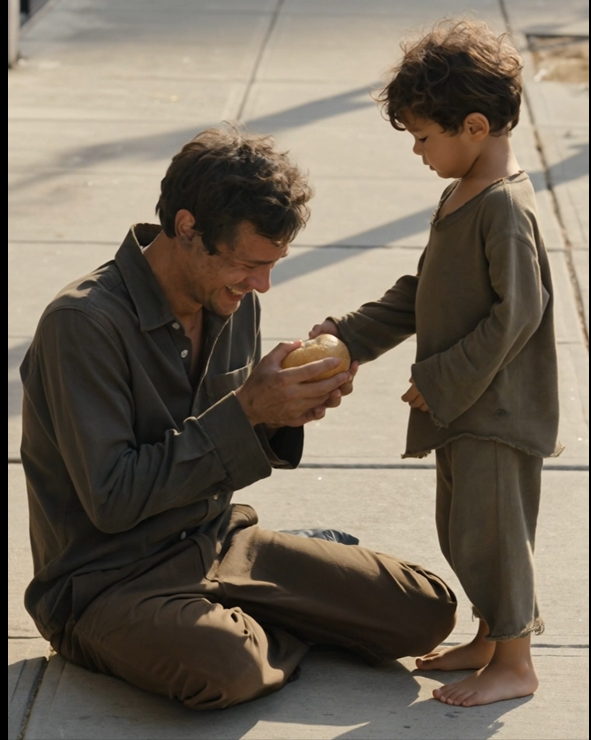
It was the kind of August afternoon that made everything shimmer at the edges—the parked cars along Denton Avenue, the yellow fire hydrant bolted to the curb, the pigeons roosting in the shadow of the overpass. The city moved around him the way water moves around a stone: indifferent, continuous, unbothered.
Daniel Marsh sat on the pavement with his back against a brick wall and his knees pulled loosely to his chest. He wasn’t homeless—not technically. He had a room at the Fairfield Inn on Route 9 paid through Thursday. He had a cell phone with a cracked screen in his left front pocket and forty-two dollars in his wallet and a brother in Phoenix who hadn’t picked up in six days. He had all of that.
What he didn’t have was anywhere to go.
The crying had started somewhere on the walk from the parking garage. It wasn’t dramatic. It wasn’t the kind of crying you see in movies—no heaving, no wailing. It was the quiet kind. The kind that happens when the body finally stops pretending. Tears just moved down his face in the heat, and he let them, because he was forty-one years old and he was sitting on a sidewalk in New Jersey and there was no one watching.
Or so he thought.
He heard the footsteps first. Small. Uneven. The soft slap of bare skin on hot pavement.
Daniel didn’t look up immediately. He was watching a crack in the concrete between his shoes—a dark line that split and forked like a river delta—when the shadow fell across him. Small shadow. Short and thin.
He looked up.
The boy was maybe seven years old. Maybe eight. He had dark hair that needed cutting, brown skin that had seen a lot of sun, and eyes that were large and calm in the way that children’s eyes sometimes are when they’ve seen more than they should. He was wearing a faded green T-shirt with a cartoon dinosaur on the front, and his feet were bare. No shoes. Just the hot sidewalk under them.
In his hands, he held a piece of bread. Not a slice—a torn chunk, the soft white interior facing out, the crust dark and slightly burned on one edge. He was holding it out. Toward Daniel.
Daniel stared at it.
“You look worse than me,” the boy said.
It was delivered without cruelty. It was simply a fact, stated plainly, the way children state facts. Daniel looked at him—this small barefoot child offering bread on a city sidewalk—and something cracked open in the middle of his chest. Not painfully. More like a window opening in a room that had been sealed too long.
He let out a sound. Weak. Surprised. Somewhere between a laugh and a sob.
He took the bread.
It was soft. Still slightly warm. He held it in both hands and didn’t eat it, just held it, and looked down at the ground again while his eyes continued their quiet betrayal.
The boy didn’t leave.
Daniel expected him to. Expected him to hand over the bread like some small ambassador of charity and then run back to wherever he’d come from—a mother on a stoop somewhere, a grandmother watching from a window. But he stayed. He stood close, closer than a stranger’s child should stand, studying Daniel’s face with an expression that wasn’t pity and wasn’t fear.
Then the boy lifted his arm.
He pulled his sleeve—the green cotton of his dinosaur shirt—across Daniel’s face. Slow. Careful. Wiping the tears from his cheek the way you’d wipe something precious. The way someone does when they’ve done it before.
Daniel went very still.
“You always cried like this,” the boy said.
His voice had changed slightly. Quieter. Softer. The way voices get when they’re reaching toward something old.
Daniel looked at him.
“What?”
The boy tilted his head. Just slightly. The way a dog tilts its head when it recognizes a sound.
“When mom locked you out.”
The sentence didn’t make sense.
That was Daniel’s first thought—it’s nonsense, it’s something he misheard, it’s a fragment of a sentence meant for someone else. His second thought came right behind the first, and it came with something physical: a drop in temperature that had nothing to do with the weather. A coldness at the base of his spine.
When mom locked you out.
He was ten years old. It was a winter night—January, maybe February, the specific month lost to time but the cold perfectly preserved in his body’s memory. His mother had been drinking since four in the afternoon. He’d come home from school to the smell of it, that particular sweetness-gone-wrong that meant the evening would require careful navigation. He’d been quiet. He’d done his homework at the kitchen table without being asked. He’d eaten cereal for dinner because there was nothing else and said nothing about it.
He didn’t remember what he’d done to set her off. He never remembered that part. What he remembered was the door. The sound of it—not a slam but something worse, a deliberate closing, the click of the lock that followed. He’d stood on the front steps of their house in his jacket that wasn’t warm enough, and he’d cried. Not loudly. Quietly. The same way he was crying now.
He had never told anyone that story.
Not his brother. Not his ex-wife. Not the therapist he’d seen briefly in his thirties who had a poster of a lighthouse in her office and kept offering him vocabulary for things he didn’t want to name. He had not told a single living person about that night on the steps.
He looked at the boy.
“How do you know that?”
The question came out low. Shaken. The words barely held their shape.
The boy didn’t answer.
He just looked at Daniel. And Daniel looked at him.
The street noise continued—a truck somewhere, the distant complaint of a car horn, a woman’s laughter two blocks away—but it felt far off now, pressed behind glass. The space between them had changed. It had weight to it. Texture.
Daniel studied the boy’s face.
The eyes. Large and dark and calm.
He thought of photographs. The kind packed in cardboard boxes, the kind no one looks at anymore because the people in them are either dead or complicated. He had one somewhere—his mother had kept it in a green metal box under her bed, and after she died he’d taken the box without opening it and put it in storage with everything else. A photograph of himself at seven or eight years old, standing in the backyard of the house on Clement Street. Dark hair that needed cutting. Brown from the summer sun.
The boy had not moved. He was still watching. His head still tilted at that slight angle. His expression unreadable in the way that grief is sometimes unreadable—present everywhere, named nowhere.
“Who are you?” Daniel asked.
His voice had gone somewhere it had never gone before. Somewhere below fear, below confusion. Somewhere older.
The boy didn’t answer that either.
But something moved across his face—not a smile, not quite. Something more complicated. The expression of someone who has waited a long time for a question they don’t know how to answer.
The sun was still bright. The heat still pressed down on the pavement, on the parked cars, on the pigeons under the overpass. The city was still moving—still continuous, still indifferent.
But Daniel was not a stone anymore.
He was looking at a boy with bare feet on a hot sidewalk, holding a torn piece of bread, and the boy was looking back at him, and the silence between them was the loudest thing Daniel had ever heard in his life.
Later—hours later, in the room at the Fairfield Inn with the curtains drawn against the evening—Daniel would try to reconstruct what happened next.
He would not be able to.
He remembered standing. He remembered that much. Getting to his feet slowly, the way his knees protested, the way the bread was still in his hand. He remembered looking up from his shoes to find the sidewalk in front of him empty.
No boy. No shadow.
He walked to the corner. He looked both ways down the block, down the cross street, across toward the parking structure and the dry cleaner and the nail salon with the pink neon sign. He didn’t see him. He didn’t see anyone small, anyone barefoot, anyone in a faded green shirt.
He stood there for a long time.
Then he went back to the hotel.
He sat on the edge of the bed and he called his brother in Phoenix. It rang four times. Five. He was already composing the voicemail in his head when the line clicked open.
“Danny.” His brother’s voice. Rough from sleep or something else. “Hey. What time is it?”
“I need to ask you something.”
A pause. “Okay.”
“Do you still have mom’s box? The green one. With the photos.”
Another pause. Longer. “Yeah. Yeah, I think Karen put it in the garage. Why?”
Daniel looked at the piece of bread on the nightstand. He’d set it there when he came in. He didn’t know why he’d kept it.
“I want to see a picture,” he said. “Of me. When I was little.”
His brother was quiet for a moment. Daniel could hear him breathing, could hear the distant sound of a television somewhere in the Phoenix house.
“Danny,” his brother said finally, and his voice had changed. Gone softer. Gone to some older frequency. “Are you okay?”
Daniel looked at the bread.
He thought about a winter night and a locked door and a small boy crying on front steps. He thought about bare feet on hot concrete. He thought about a sleeve—green cotton—pressed gently against his face.
You always cried like this.
“I don’t know,” Daniel said.
It was the most honest thing he’d said in years.
Outside the window, the city kept moving. Somewhere in it, maybe, a small boy with dark hair walked home across warm pavement, feet bare, hands empty.
Or maybe not.
Maybe the sidewalk had been empty all along, and something else entirely had found Daniel Marsh on a Wednesday afternoon in August—something old and patient that had been waiting for him to finally sit down.
Either way, he had stopped crying.
Either way, he held the bread.
